
“U Curdunn ci pais!! iè nu stuzz d paradis” – a piece of paradise
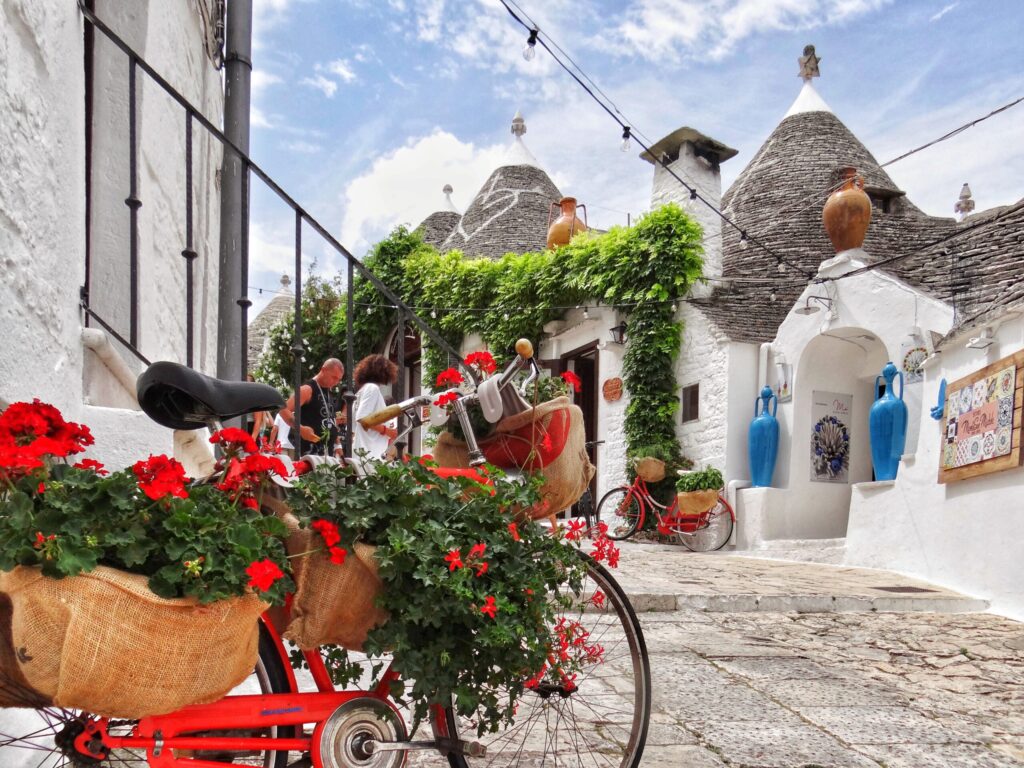
A town of white houses with sloping roofs, paved lanes, flowering balconies and courtyards, precious monuments, a town that wakes early to the sound of women washing the chianche, spreading the scents of cooking and welcoming you with warmth and kindness.
Famously described as a “piece of paradise” by one of its most beloved sons, parish priest Don Peppino Rosato (1921 – 1963), Locorotondo is a small, compact hill town of around 14,000 residents. Just over 800 reside in the old town, giving you an idea of its relatively small size.
Set on a natural terrace 410 metres above sea level in Puglia’s Valle d’Itria, sitting opposite Martina Franca on the far side, it enjoys wide, uninterrupted views across the Itria Valley towards Cisternino and, in the distance, Ceglie Messapica. The old-town features whitewashed buildings and lanes, brightened by balconies and inner courtyards filled with flowers.
The town’s elevated position helped shape and preserve Locorotondo’s defining feature: a perfectly circular medieval plan. The name itself comes from the Latin locus rotundus, meaning “round place,” a reference to the original ring of houses that once enclosed the settlement. Medieval documents describe it simply as locus qui dicitur rotondus – “the place called round.”
That circular form is still evident; a ring of whitewashed buildings with cummerse roofs (from Latin cum vertice), steeply pitched-roofed houses built with chiancarelle, thin limestone slabs typical of the area. These structures are found almost exclusively in Locorotondo, and a few nearby hamlets, creating one of the most distinctive skylines in Puglia.
The most striking view is the approach from Martina Franca, where you first see Via Nardelli, lined with Locorotondo’s characteristic houses, the cummerse, alongside the dome and bell tower of the mother church.
Locorotondo is recognised as one of Italy’s most beautiful towns – i borghi più belli d’Italia. It is also the holder of the Bandiera Arancione (Orange Flag) of the Touring Club of Italy, awarded to inland towns of recognised historic, cultural and environmental quality – a distinction that reflects both the quality of the centro storico and its exceptional accessibility on foot.


A brief historical overview
Little is known about Locorotondo’s earliest origins, it is una città senza storia (a city without history).
The first known written record of an ancient settlement here is a 1087 document relating to the foundation of the Abbey of Santo Stefano in Monopoli, and a church dedicated to St George. An imperial diploma issued by Henry VI from 1195 confirms the presence of a “Locus qui dicitur rotondus” (the place that is called round, an early documentary reference to Locorotondo’s circular layout).
Across the centuries, the town appears in various forms in written sources. In 1276 it is recorded as Locirotundi; in 1431, as part of the Principality of Taranto under the Orsini del Balzo, it appears as terra Loc Rotundi. Through the seventeenth and eighteenth centuries the town’s name continued to vary – Loco Rotondo, Luoco Rotondo, Luogo Rotondo – though always retaining the reference to the “round place”.
Locorotondo’s recorded history is one of shifting feudal control rather than independent development. Although disputes over land and pasture appear in the archives, the town never played a prominent political or military role of its own.
Over the centuries, the town was disputed by various powers and families: the Knights Hospitaller (1314), the Del Balzo Orsini and Pirro dei Loffredo in the fifteenth century, and later another Neapolitan family. After a brief period under the Carafa (late 1400s), control returned to the Loffredo (1530), who subsequently shared dominion over the town: half with the Figueroa and half with the Borrassa.
One of its most important monuments, the Church of the Madonna della Greca, is traditionally attributed to Pirro del Balzo (1481), son of Giovanni Antonio. From the sixteenth century onwards, new churches were built, as well as the Università (now home to the municipality) alongside Palazzo Morelli.
In 1645 Locorotondo was finally acquired by Francesco Caracciolo, Duke of Martina.
Locorotondo | The Puglia Podcast
The Puglia Podcast is available on Apple Podcasts, Spotify and wherever you get your podcasts from.
Locorotondo highlights
Locorotondo’s historic centre is small but exceptionally pretty and well preserved. The whole district, its streets, lanes, small squares and whitewashed houses, is effectively the town’s key monument. There are cute, boutique shops, hospitable restaurants in traditional vaulted cellars and easy bars on the main piazza (Piazza Vittorio Emanuele II).
There are two main gateways into the historic centre: Porta Napoli, sometimes call the Porta Vecchia, leading into Piazza Vittorio Emanuele (the “drawing room” of the old town), and Porta Nuova, also referred to as Porta Lecce, on the opposite side and whose street of the same name leads directly to the mother church, Chiesa Madre di San Giorgio Martire, dedicated to the patron saint, St George, in the heart of the old town.
Other monuments of note include the churches of San Nicola, Madonna della Greca, San Rocco, Madonna del Soccorso, Spirito Santo, and on the other side of the railway station, Madonna della Catena.
From Largo Bellavista, Via Nardelli and the Villa Comunale Garibaldi, you can enjoy sweeping, uninterrupted views across the Itria Valley, taking in trulli, dry-stone walls, vineyards, and olive groves.
In the surrounding countryside, the Trullo di Marziolla is the oldest dated trullo in the Itria Valley – the stone inscription above the entrance gives the date 1614, making it one of the few trulli whose age can be verified from the structure itself. It sits on private land, but the owner welcomes visitors who wish to see the interior: contact in advance to arrange a visit. Well worth the small detour.
Also worth visiting are the rural churches such as those in Contrada San Marco and Contrada Trito; and the Acquedotto Pugliese Cycle Route, whose restored stretch crosses part of the territory.
A visit is best approached in two parts: an external circuit along Via Nardelli, the main terrace that runs around the centro storico and affectionately known locally as the lungomare (seafront), with views over the valley, and an internal wander through the tangle of old town streets.


Locorotondo walking route
The centro storico is so small, compact and easy to navigate that there’s no need to worry about finding the “perfect” route. You’ll probably double back once or twice in the little maze of lanes. That’s part of the pleasure. Within minutes you’ll understand the circular layout and get your bearings. What matters is that you include both the panoramic circuit around the outer edge and a wander through the inner streets.
If you want to surprise yourself with Locorotondo’s two most impressive views, enter the old town from the Via Cisternino side, and exit either at Largo Bellavista, or at the Porta Napoli and continue to the panoramic viewing point in the Villa Comunale. You won’t be disappointed!
We tend to use the on-street blue pay-to-park spaces on Via Cisternino (arriving from Ostuni or Cisternino), or the roads surrounding Piazza Antonio Mitrano (arriving from Martina Franca). Note that the parking inside Piazza Antonio Mitrano is for residents only.
From Via Cisternino, take the steps up to the old town and you’ll emerge at Largo San Rocco.
- For the panoramic walk, continue along Via della Madonna della Grecia towards Piazza Antonio Mitrano, which leads directly onto Via Nardelli with its famous views.
- To explore the old town first, continue from Largo San Rocco up Via Vittorio Veneto and towards the Chiesa Madre at the heart of the centro storico. For the most impactful views, once you have walked around the old town, exit via the elevated Largo Bellavista, bringing you down onto Via Nardelli and continue along to the Villa Comunale.

Locorotondo Part 1: Via Nardelli to Villa Comunale
Follow Via Nardelli, the terrace road that borders the outer edge of the old town. It takes you all the way along to the Villa Garibaldi park, which offers one of the best panoramic viewpoints over the Itria Valley.
- On your left: uninterrupted views across the valley.
- On your right: the curved outer wall of the historic centre – low, whitewashed houses with double-pitched cummerse roofs, an architectural line almost unchanged for centuries.
Come here at sunset for a spectacular sunset (look towards Alberobello). The seating area outside Pavì wine restaurant is a perfect place to pause.
Locorotondo Part 2: the historic centre
Following along the Via Nardella panoramic terrace route, enter Locorotondo’s historic centre at Porta Napoli. Once inside the centro storico you’ll experience the town’s tightly woven lanes, quiet corners and tiny squares, lime-washed façades, carved stone doorframes and wrought-iron balconies overflowing with flowers.
This is classic Locorotondo: intimate, orderly and beautifully maintained.
What to see in Locorotondo
Here’s what to look out for as you wander through Locorotondo’s old town, though not in any particular order. Part of the charm is simply strolling and allowing the circular layout to reveal itself. You’ll approach the same streets from different angles, recognise corners you’ve already passed, and gradually piece together the town’s shape. It’s all part of the pleasure of discovering Locorotondo.
Don’t forget Locorotondo’s two most impressive views sweeping across the Valle d’Itria, at Largo Bellavista, and from the panoramic viewing point in the Villa Comunale.

Chiesa Madre di San Giorgio Martire (Mother Church of St George the Martyr)
Located in Piazza Fra’ G. A. Rodio, this is a neoclassical church was built between 1790 and 1825, on the foundations of two earlier churches: the sixteenth-century structure and the primitive Casale San Giorgio.
The church has a neoclassical façade with a triangular pediment carved with St George slaying the dragon, the work of local stonemasons. Statues of Saints Peter and Paul stand at the corners. Dedicated to the town’s patron, St George, the building is marked by a 35-metre-high dome and an accompanying bell tower.
A 2010 repaving includes glass panels revealing sections of earlier constructions beneath, including part of the sixteenth-century façade.
The interior, three naves divided by massive Corinthian columns, is bright and spacious, with Baroque altars of polychrome marble. On the left is the Chapel of the Sacrament, featuring the nineteenth-century painting The Wedding at Cana and a Baroque altar with alternating marble and pietre dure, and finely worked silver on the tabernacle.
Also on display are the works of several Neapolitan artists, including Gennaro Maldarelli, whose four large paintings date from 1839–1841.
Particularly extraordinary – and unique – are the carved stone blocks forming the double lateral pillars of the chapel: 42 sculpted panels depicting scenes from the Old Testament. These fourteenth-century reliefs, probably reused from an earlier church, remain mysterious. Nothing is known about the sculptor, the patron or the circumstances of their creation.


St George is celebrated on 23 April, preceded on 22 April by the solemn and significant ritual of the dono (the offering).
Next to the mother church stands the Church of the Annunziata, built in the early nineteenth century on the foundations of the former oratory of the same name.


Chiesa della Madonna della Greca
Reached via Via Vittorio Veneto and Piazza Mitrano, this is the town’s oldest surviving church. Its origins are uncertain; the earliest documentary reference dates only to 1520, though architectural evidence makes it clear that the building is considerably older.
The exterior comprises a simple, austere façade with a modern (1981) rose window modelled on that of Acquaviva delle Fonti Cathedral.
Its basilican plan is composed of three naves: the central nave with four bays and ribbed Gothic cross vaults, and lateral naves with sloping half-barrel vaults.
The half-barrel vault is typical of Puglian single-axis domed churches of the twelfth and thirteenth centuries. The combination of the two systems—ribbed Gothic vaulting and half-barrel vaults—appears rarely, with notable parallels in the Church of San Benedetto in Brindisi and Santa Maria de Colonna in Trani.
Look out for the finely carved stone capitals on the semi-columns. Other notable features include a large stone altar frontal with the Virgin and Child at its centre, flanked by statues of St Peter and St Lucy (left), and St Paul and St Orontius (right). Bas-reliefs of the Four Evangelists sit above. Faint traces of frescoes from the former altar of the Madonna della Greca on the left wall still remain.
Additionally there are paintings along the walls, which are striking for their unusual style, and which we found moving in their simplicity. Painted by Italian artist Onofrio Bramante, better known for his work on Italian and French comic books.


Chiesetta San Rocco di Montpellier
After several alterations, including a major refurbishment in 1872, San Rocco comprises a simple neoclassical façade with a relief of the saint in the pediment. St Rocco is credited with saving the town from a plague between 1690 and 1691, though evidence of an earlier chapel exists from the sixteenth century.
Inside are:
- an 1834 painting of St Rocco among the plague victims, by Locorotondo artist Antonio Semeraro
- two anonymous works depicting St Francis of Paola and St Irene with a city view
- eighteenth-century statues of St Eligius and St Orontius
St Rocco is celebrated on 16 August with a major festival involving the entire community, combining religious and civic events.


Chiesetta della Madonna Addolorata
Built in 1858 on the ruins of the now-lost castle, the church was constructed by the Confraternity of the Seven Sorrows, which is still active today. The neoclassical façade bears the symbols of the confraternity, and the statues outside likely represent the Sibyls of Delphi and Erythrae. The current church replaced an earlier oratory in what is still called Via Addolorata Vecchia, near the mother church.
The former castle, known as the Gran Cavaliere, was a large structure with a square tower and drawbridge; its underground spaces housed the fossa di Locorotondo, associated with abuses and injustices.
Today, on the external walls to the left of the church, you can still see stone blocks that may belong to the castle.

Piazza Vittorio Emanuele II
Locorotondo’s main square stands just at the edge of the historic centre and forms the natural gateway into the old town.
- The square is framed by elegant nineteenth-century civic buildings and is one of the town’s key gathering points.
- Cafés, bars and the tourist office sit around its edges, making it a convenient orientation point.
- From here, the old town curls gently upward into the circular layout, making the square an ideal starting or end point for a walking route.
Villa Comunale & Panoramic Terrace
The villa (public gardens) sits on the outer rim of the centro storico and offers one of the most expansive viewpoints in the Itria Valley.
- The terrace looks directly towards Martina Franca on one side of the valley, and towards Cisternino on the other, with views extending as far as Ceglie Messapica on clear days.
- This is an excellent stop at golden hour, when the light falls across the trulli-dotted landscape.
- Benches and shaded areas make it a restful pause point, especially in warmer months.

Cappella Madonna del Soccorso
This small, chapel lies within the old town just steps from Piazza Vittorio Emanuele. It was built at the command of the baron Giovanni Giacomo Borrassa, of Spanish origin, who used funds originally donated by a local citizen, Vincenzo di Borgerio, to enlarge an existing chapel, which the baron instead demolished in order to erect the present church, likely built before 1632, the year of his death.
The façade features a simple lunettes portal, a small bell gable, and the family coat of arms. Inside is a striking seventeenth-century painting of the Madonna del Soccorso, raising a staff to drive away the devil and protect a child. The church is still cared for by the women living in the neighbouring lanes.

Palazzo Morelli
Built in 1819, Palazzo Morelli, just a few metres from the municipal library and tourist information point, stands as a fine example of Baroque architecture. Beyond the entrance portal lies a small courtyard, open to visitors, where the arrangement of spaces around the external staircase reflects the hierarchical organisation typical of manor houses.
Chiesa di San Nicola di Myra
This seventeenth-century chapel unites the two characteristic structures of the area: the cummersa with its single nave and barrel vault, and the trullo cone forming the dome.
Commissioned by Paolo De Aprile, it features rich wall decoration dating to the early seventeenth century. Since 1977 it has been officially recognised as a building of significant historic and artistic interest.
The church is dedicated to San Nicola (Saint Nicholas), one of the most venerated saints in the Christian world and the patron saint of Bari. His relics were brought to Bari in 1087 and are housed in the city’s Basilica di San Nicola.
Two of his most famous miracles shaped his enduring identity. In one story, he brought back to life three children who had been killed and hidden in a barrel, establishing him as the protector of children. In another, he secretly provided dowries to the father of three impoverished daughters, saving them from being forced into prostitution; the tale explains his role as a discreet gift-giver.
These traditions eventually travelled across Europe and, through later adaptations, became the foundation of the modern figure of Santa Claus.
You can see these stories represented in the church’s frescoes, which illustrate the key episodes that made San Nicola such a central figure to Christian and Orthodox religions.


Chiesa dello Spirito Santo
Located just outside the historic centre, the Chiesa dello Spirito Santo is a seventeenth-century church of modest external appearance but considerable interior interest. The single-nave interior retains original frescoes and carved stone detailing, and a carved stone altar that bears comparison with similar work found elsewhere in the Valle d’Itria. The church is also one of the more atmospheric in the town when its bells are heard from inside the centro storico, a detail easy to miss, and hard to forget once noticed.
Note: check access hours before visiting, it may only open for services.
Locorotondo DOC: the wine of the valley
Most people think of Puglia as red wine country – Primitivo, Negroamaro, Susumaniello. What they often don’t know is that Locorotondo sits at the heart of one of the oldest and most distinctive white wine appellations in the whole of Italy.
Bianco Locorotondo DOC was established in 1969, making it one of the first DOC designations in Puglia and still one of the most characterful. The wine is made primarily from Verdeca (50–65%) blended with Bianco d’Alessano, two ancient indigenous varieties almost exclusively grown in this valley. The result is a dry, pale straw-green white with a subtle fruit character, a clean mineral edge and a distinctive almond-like finish – crisp and refreshing in a way that surprises people who have only ever tasted Puglia’s reds. A Spumante (sparkling) version also exists and is worth seeking out.
The DOC covers around 1,650 hectares, taking in parts of Locorotondo, Cisternino and Fasano. Quality, it has to be said, varies. The wine can be exceptional; it can also be almost characterless. Producers worth knowing:
I Pastini – a small, family-run estate near Locorotondo and the producer we would point anyone towards first. Their Antico Locorotondo DOC is made by the old alberello (gobelet) method, harvesting all three varieties together as they have been for centuries, and the result is something genuinely fine. The winery also makes a single-variety Verdeca and a Minutolo. Highly recommended and available directly from the winery.
Cooperativa Cantine di Locorotondo – the town’s large producer cooperative, a reliable and accessible entry point for the DOC. Their standard Locorotondo Bianco is well-made and widely available at local restaurants and shops. Not as exciting as I Pastini, but honest and very reasonably priced.
If you are visiting Pavì Wine Bar (see below), Ignazio’s tasting flights typically include at least one example of the local DOC – it’s an excellent way to understand what the appellation can do in the right hands.
Eat / Drink / Stay in Locorotondo
Within the centro storico, Locorotondo’s dining scene is compact. During the summer season there isn’t a separate “tourist” vs locals circuit to navigate. The same places that serve visitors are the ones locals return to once the season ends. That means there will be tourists – but the restaurants we visit are reliably authentic: straightforward trattorie, simple wine bars and a handful of contemporary kitchens rooted in local flavours.
Locorotondo has a good choice. We list our top choices – many other interesting restaurants are available, we just haven’t had the chance to eat at them yet!
Where to eat
U’Curdunn
A long-standing reference point for traditional local and regional cooking. Some dishes are ultra-hyper local (see the tripe Locorotondo style, pictured). If you are feeling adventurous, or up for real local cuisine, we say go for it. Fresh pasta, grilled meats, seasonal vegetables and well-prepared classics without fuss or theatrics. Honest, reliable, and very local. The service was super friendly (we were very off season on our visit, so had plenty time for conversation with the staff). Our laganari con funghi cardoncelli, salsiccia (laganari pasta with cardoncelli mushrooms, sausage and crumbled tarallo) was utterly flavourful.


Ristorante Osteria Il Rosone
A small, reliable spot for traditional Puglian cooking, with attentive service and a semi-open kitchen where you can watch the chef at work. Our orecchiette con cime di rape – in season during our visit – was extremely generous, especially with the cime. The room filled quickly with locals and Italian visitors, a good sign that the cooking remains honest and rooted in place. The restaurant is compact and very much in demand: the proprietor’s phone rang constantly with reservation requests. Be sure to book ahead for a table.


Pizzeria Casa Pinto
Excellent pizza, with a selection of local specials using regional ingredients. The antipasti are superb, typical dishes, with some unusual choices (like the mortadella arrosto). The pizza oven cooked focaccia is highly recommended. Well priced, and often frequented by locals. Traditional vaulted-cellar setting and efficient, friendly service. Once again, booking is recommended to ensure a table.


Where to eat and drink
Pavì Wine Bar and Restaurant
About midway along Via Nardelli, Pavì Wine Bar is a favourite spot for:
- wine tasting, with a strong focus on local DOC wines and Valle d’Itria producers
- valley views, thanks to its position directly overlooking the trulli-dotted landscape
- sunset, when the ridge catches the late light and the terraces fill with a warm, quiet glow
Owner Ignazio curates one of Locorotondo’s most enjoyable wine tastings, pairing a carefully chosen flight of wines with aperitivo dishes or more substantial small plates. But it is far more than a standard wine-pairing menu. Ignazio talks you through each wine, explaining why he has selected it and offering personalised recommendations (he is equally happy to choose for you).

The Puglia Podcast – Wine tasting at Pavì Wine Restaurant

For more information on Puglia’s wines and our wine tasting with Ignazio at Pavì Wine Restaurant visit our Puglia Wine and Wine Tasting Guide.
We have visited twice – once with a group of tourists and once on our own – and on both occasions the selections were excellent and the commentary genuinely informative. What we particularly appreciate is his focus on a variety of local producers from across the Valle d’Itria, often small-volume wineries.
The tasting is popular and places are limited, so advance booking is strongly recommended. You can reserve easily via the Pavì Wine Restaurant Instagram account (messages in English and via WhatsApp are both welcome).
Otherwise it’s an ideal pause during a late-afternoon walk or before dinner in the old town. Be sure to tell Ignazio that the Puglia Guys sent you!


Mandragora Pozioni & Porzioni
Friendly bistrot, with outdoor tables in one of the most atmospheric corners of the centro storico.


Caffè della Villa
Set at the edge of Villa Garibaldi, this is ideal for a morning coffee or an aperitivo, perfectly located for people watching.

Where to stay
Locorotondo’s accommodation leans towards small B&Bs, boutique conversions, and countryside masserie rather than large hotels. For those without a car, staying inside or close to the historic centre is most practical.
For a trulli stay we prefer those in the countryside of the Valle d’Itria, rather than in Alberobello, especially around Locorotondo, which is why we include them here.
Sotto le Cummerse
Part home, part hotel, the Albergo Diffuso concept, not uncommon in Puglia, offers rooms and small apartments spread across different historic buildings across the old town. Atmospheric, quiet, and ideal for travellers wanting to immerse themselves in the centro storico.
Relais Il Palmento (6km outside Locorotondo)
A five-star resort-style stay in restored trulli and cottages. Peaceful, comfortable and suited to longer, slow stays.
Masseria Aprile (countryside)
A traditional masseria with trulli in a beautiful rural setting, just 1km outside Locorotondo. With a spectacular view of Locorotondo offering stylish, comfortable rooms.
Leonardo Trulli Resort (2.5km from Locorotondo)
A well-kept countryside option with trulli suites, a pool, and excellent landscaping. Stylish but still rooted in the local rural aesthetic.
Getting there
Locorotondo is well connected to neighbouring towns in the Itria Valley but less so to the national high-speed rail network. The most convenient access is via Bari or Brindisi. Locorotondo’s train station is a 800 metre (10 minute walk) from the old town.
Locorotondo by train
Locorotondo is served by the Ferrovie Sud Est (FSE) regional line running between Bari, Putignano, Martina Franca, Locorotondo and Alberobello.
- Direct trains do not operate from the national rail network; you must change to FSE at Bari Centrale or Putignano.
- Trains are reliable but slow, and services are less frequent on Sundays and public holidays.
Approximate journey times:
- Bari → Locorotondo: 1 hr 40 min – 2 hrs
- Martina Franca → Locorotondo: 10 min
- Alberobello → Locorotondo: 8–10 min
For day trips, the train works well within the Valle d’Itria, but not for reaching Matera, Lecce or the Gargano.
Locorotondo by car
Driving is the easiest and most efficient way to reach and explore Locorotondo, especially if you plan to visit the wider valley.
- Bari Airport → Locorotondo: approx. 1 hr 10 min
- Brindisi Airport → Locorotondo: approx. 1 hr
- Parking is available around the perimeter of the historic centre; the old town itself is pedestrianised or ZTL.
Locorotondo by bus
Limited services connect Locorotondo to nearby towns, but timetables are irregular and not ideal for day-to-day travel. Trains are usually the more reliable public transport option.
Best connected bases
If travelling without a car, Locorotondo can work, but Bari, Monopoli, Polignano or Lecce offer far better train connections. Locorotondo is best suited as a base for visitors travelling by car or staying primarily within the Valle d’Itria.
Events & Festivals
Locorotondo has a fuller calendar of events than its size might suggest. Some are rooted in centuries of local tradition; others, like the Locus Festival, have brought the town to a national and international audience.
Festa di San Giorgio (22–23 April) – St George is the town’s patron saint and his feast day is the most significant event in Locorotondo’s religious calendar. The celebration begins on the evening of 22 April with the dono, a solemn offering ritual that precedes the main feast. The following day, 23 April, sees a market fair and processions through the old town. It is an occasion that belongs entirely to the community, and watching it unfold is a reminder of how alive Locorotondo’s civic and religious traditions remain.
Locus Festival (7–14 August) – details below.
Festa di San Rocco (16 August) – San Rocco is credited with saving Locorotondo from plague in the 1690s, and the town repays the debt every year with a festival combining religious and civic events — masses, processions, music and the Trofeo San Rocco. It is one of the most participatory events of the summer season, with the whole community involved.
Libri nei Vicoli del Borgo (August) – a literary festival staged across the centro storico, with book presentations in Piazza Rodio, Piazza Mazzini and various lanes and courtyards of the old town. Quietly lovely and very local in feel.
Christmas in Locorotondo (late November – early January) – read on.
Christmas in Puglia: A very Locorotondo Christmas
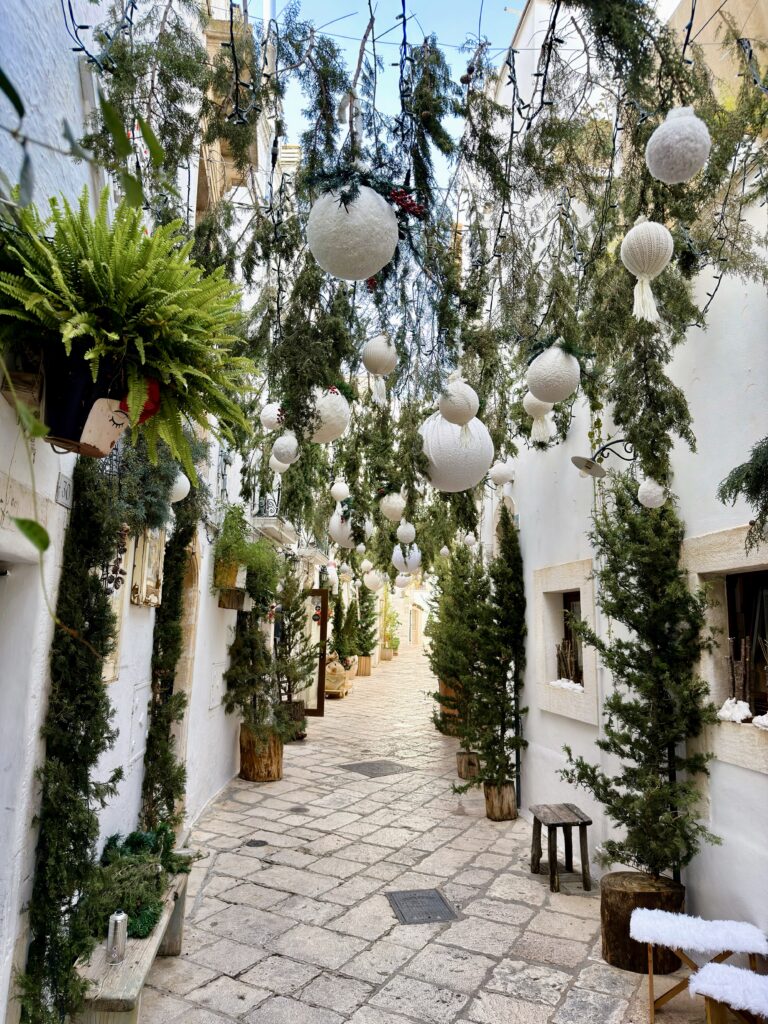
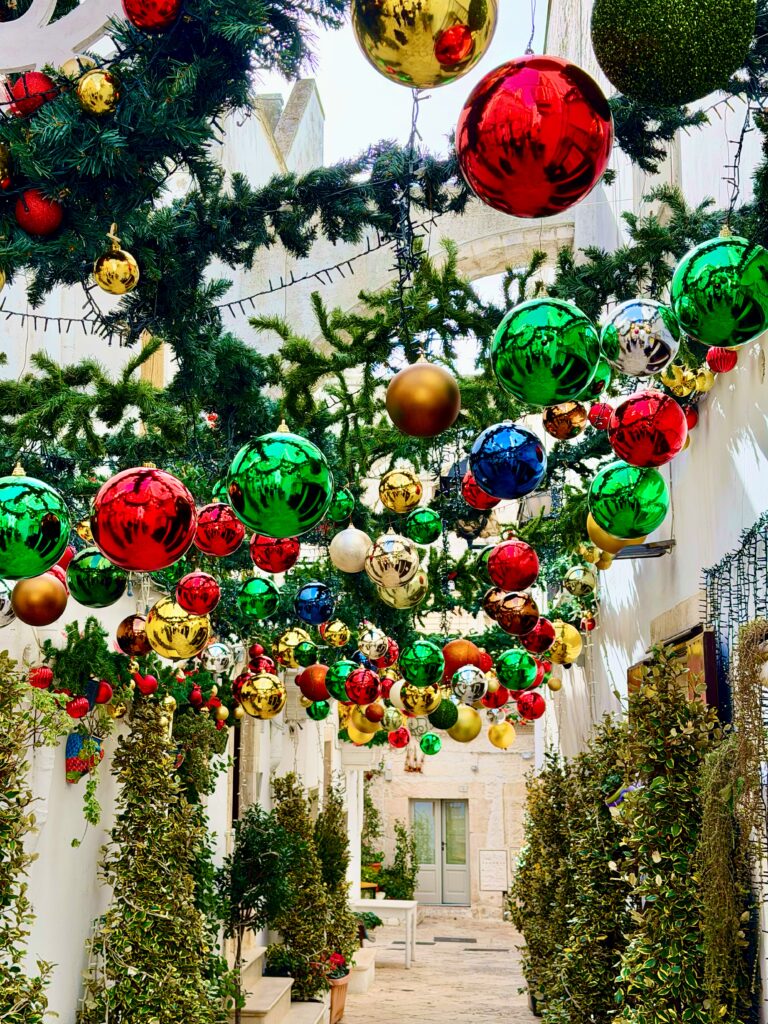
Locorotondo is one of the most atmospheric places in the Valle d’Itria during the Christmas period. Its circular old town, narrow whitewashed streets and stepped cummerse roofs lend themselves naturally to winter lights. In recent years the town has invested heavily in creating a curated, winter village experience.
From late November through early January, Locorotondo decorates its historic centre with understated but beautifully arranged illuminations. The bigger displays are spread across the main thoroughfares – Via Garibaldi, Via Morelli, Via Dura, Via Vittorio Veneto – but even the smallest corners and individual houses join in.


Nativity scenes
Like many towns in the Itria Valley, Locorotondo has a strong presepe (nativity scene) tradition. You’ll typically find indoor nativity displays created by local associations. The presepe often feature rotating exhibitions of handcrafted figures and miniature landscapes.
At home, the presepe nativity scene grows year on year as new pieces are bought to create new memories.
A traditional feature of Puglia’s presepe are that the figures are not always to the same scale. Some presepe are grand and ambitious, others more thrown together. All part of the tradition. We even spotted some Playmobil figures!


When to visit
Our strong advice is to visit during the week if you can. In recent years Locorotondo’s Christmas illuminations have become a victim of their own success, drawing ever larger crowds from across the region. Just this past weekend, the local press led with the headline:
“…monta la rabbia a Locorotondo invasa in un giorno da 80 pullman di turisti” (anger mounts in Locorotondo, invaded in a single day by 80 tourist coaches).
(Gabriella de Matteis, La Repubblica Bari)
The village was described as a “hostage to overtourism”, with eighty coach parties arriving in a single day, leading to chaotic parking and overcrowded alleys. Much of this surge has been driven by low-cost excursion packages amplified by influencers and social media, another reminder of how fragile small historic centres can be under sudden visitor pressure.

For more information on Christmas in Puglia, see our Puglia Guys Christmas in Puglia themed guides, recipes and posts.
Locus Festival (August, Masseria Ferragnano)
Every August, one of Italy’s most respected independent music festivals takes up residence in a masseria just outside Locorotondo, and the Valle d’Itria briefly becomes one of the most culturally alive corners of southern Europe.
Locus has been running since 2005, born in Locorotondo’s centro storico, now occupying the beautiful outdoor setting of Masseria Ferragnano, a short drive from town. The programming is genuinely eclectic and consistently high quality: jazz, soul, electronica, Italian cantautorato, global sounds and the occasional major international name, all presented in an intimate, considered way that larger festivals rarely manage. Past headliners have included Kamasi Washington, Kings of Convenience, Snarky Puppy, Thundercat and Nils Frahm. Their ethos is welcome: quality over spectacle, territory over tourism.
The 2026 edition runs 7–14 August at Masseria Ferragnano, with eight consecutive nights of concerts. Confirmed acts include Mannarino (9 Aug), Soulwax with Sébastien Tellier (11 Aug), Thundercat (13 Aug), and Subsonica with The Orb (14 Aug). A Locorotondo Pass (multi-night subscription) is available via the festival website and Ticketone.
Locus has expanded over the years to include events in Bari, Ostuni, Fasano and beyond, but Locorotondo remains its spiritual home. If your visit coincides with the festival, it is not to be missed.
See locusfestival.it