
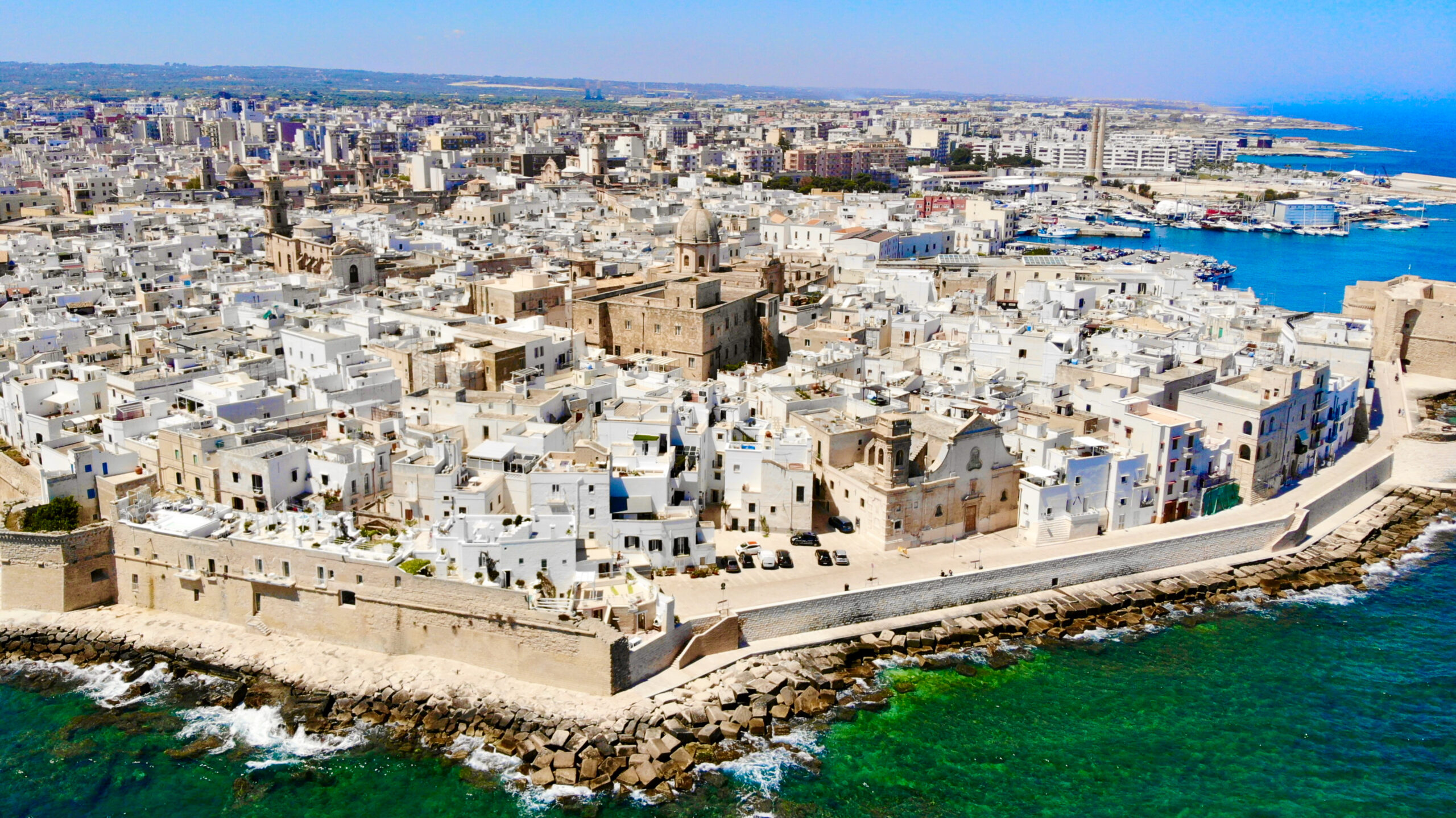
Benvenuti a Monopoli
Until just a few years ago, Monopoli was the insider’s answer to nearby Polignano a Mare – a compact old town, lively piazzas, a working harbour, and honest seafood at honest prices, without the crowds or the queues. Word has since got out. As Puglia’s international profile has surged, Monopoli has grown from local favourite to one of the region’s most sought-after seaside bases. In peak summer it buzzes day and night; you’ll still eat for less than in Polignano, but the days of simply turning up and grabbing a table are over.
What sets Monopoli apart from its more photographed neighbours is precisely what Italian visitors keep coming back for: it’s a town that still feels like a town. Fishermen mend their nets in the Porto Antico. The morning catch is landed and sold, not staged. The piazze are genuinely lively with local families at aperitivo hour. It retains, in other words, the everyday life that Alberobello, Polignano, and high-season Ostuni have largely surrendered to tourism – and Italian travellers, who read those crowded scenes with particular exasperation, are keenly aware of this distinction.
For the self-driving visitor, Monopoli is one of the great smart bases of central Puglia. It sits precisely on the hinge between the Adriatic coast and the Valle d’Itria, with Alberobello, Locorotondo, Cisternino, Ostuni, Castellana Grotte, and the ruins at Egnazia all within easy day-trip range. If you’re basing yourself here for three nights (a popular and sensible strategy) you can combine slow morning walks in the centro storico with afternoon drives into the trullo country, returning to eat well by the sea each evening.
For travellers without a car, Monopoli is a convenient base. It lies directly on the Trenitalia Adriatic railway line, with fast, frequent trains north to Bari and Polignano a Mare, and south to Brindisi and Lecce. These connections make day trips easy, reliable and inexpensive, while the town itself offers enough atmosphere, food and seaside life to enjoy at a slower pace between excursions.
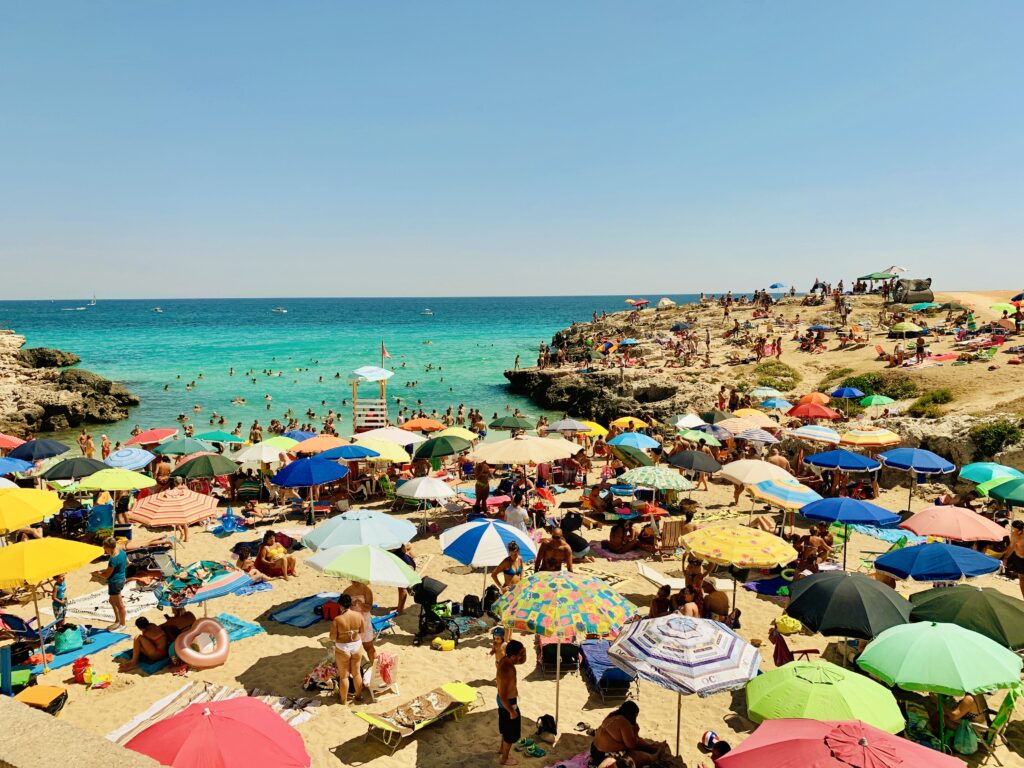
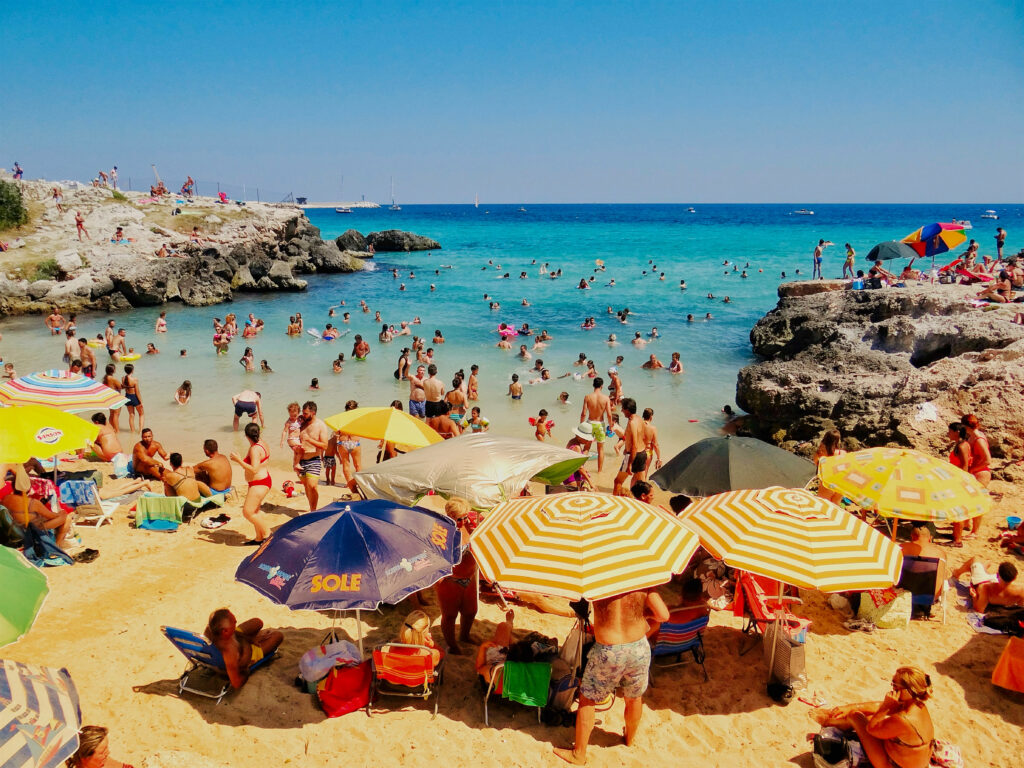
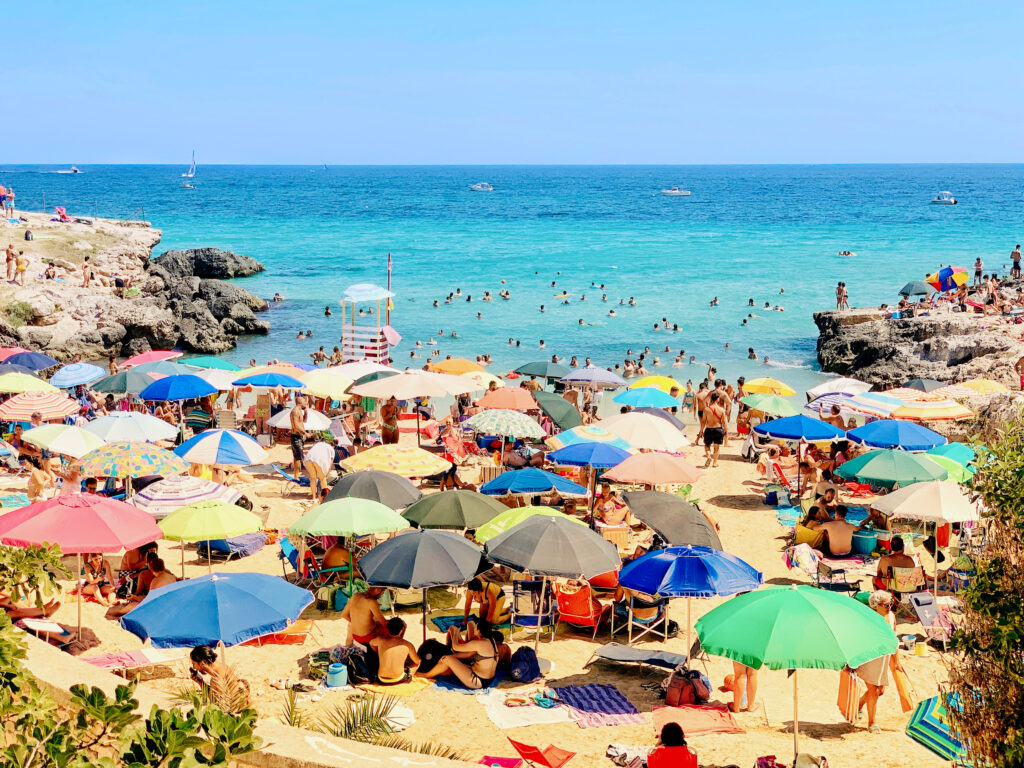
| Monopoli is a town that Italian visitors trust and return to, but with realistic expectations. It is best understood as an excellent base for central Puglia, a place with genuine character and good food, but not a beach resort (Monopoli’s central shoreline is rocky rather than sandy, the city beaches are small and cramped), and not undiscovered. While Monopoli remains better value than Polignano, it has shed its former paese nascosto (hidden gem) status. Go in May, June, or September. Accommodation in particular is expensive in July and August, and the town at its busiest can feel pressured rather than relaxed. |
Advance to Go: Monopoli vs Monopoly
The name comes from the Greek meaning ‘unique city’: monos (single) + polis (city). A seafaring hub since Messapian and Roman times, Monopoli has been shaped by Greeks, Byzantines, Venetians, Saracens, and Spanish viceroys – each leaving marks in the walls, churches, and culinary traditions that survive today. The Castello di Carlo V, the baroque Cathedral, the Porto Antico, and the labyrinth of the centro storico are all legible chapters in this layered story.
As for the board game: Monopoly takes its name from the English word monopoly, meaning exclusive control of a trade or commodity — itself derived from the Greek monopōlion (monos + pōlein, ‘to sell’). The game and the city share ancient Greek roots, but nothing else.
The Puglia Podcast – Monopoli guide
The Puglia Podcast is also available from Apple Podcasts, Spotify and wherever else you get your podcasts from.
Getting to Monopoli
By Train
Monopoli sits directly on the main Trenitalia Adriatic line, making it unusually well-connected for a Puglian town of its size. The station is about a 15-minute walk from the seafront and old town. For car-free visitors, it’s one of the best-positioned bases in the region.
- Bari Centrale – approximately 30 minutes
- Polignano a Mare – 5 minutes (the closest coastal neighbour)
- Brindisi – approximately 45 minutes
- Lecce – approximately 1 hour 10 minutes
By Bus
Regional buses operated by Ferrovie del Sud Est (FSE) and COTRAP serve Alberobello, Castellana Grotte, Fasano, and Polignano a Mare. Buses depart from Piazza Falcone e Borsellino and Piazza Vittorio Emanuele II. Timetables can be patchy at weekends and on public holidays — always check ahead and allow extra time.
By Car
Driving gives you the flexibility to make the most of Monopoli’s excellent day-trip position. Parking in the historic centre is restricted; the most convenient options are Piazza Vittorio Emanuele II or the harbour car park, both just outside the old town.
- Bari – 45 km, approximately 45 minutes
- Ostuni – 40 km, approximately 40 minutes
- Alberobello – 20 km, approximately 30 minutes
| Parking tip: Blue lines = pay-and-display; white lines = free; yellow lines = reserved. Many meters in Puglia require you to enter your car registration number. Keep coins handy. |
What to do in Monopoli
When we visit Lecce, we feel the pull of baroque architecture. In Bari Vecchia, we want to watch the nonne rolling orecchiette, and snack on street food. In Alberobello we weave through the crowds. But Monopoli, with its compact centro storico (and equally compact city beaches), is where we come to take slow down. The attractions here are not things to tick off; they’re things to settle into.
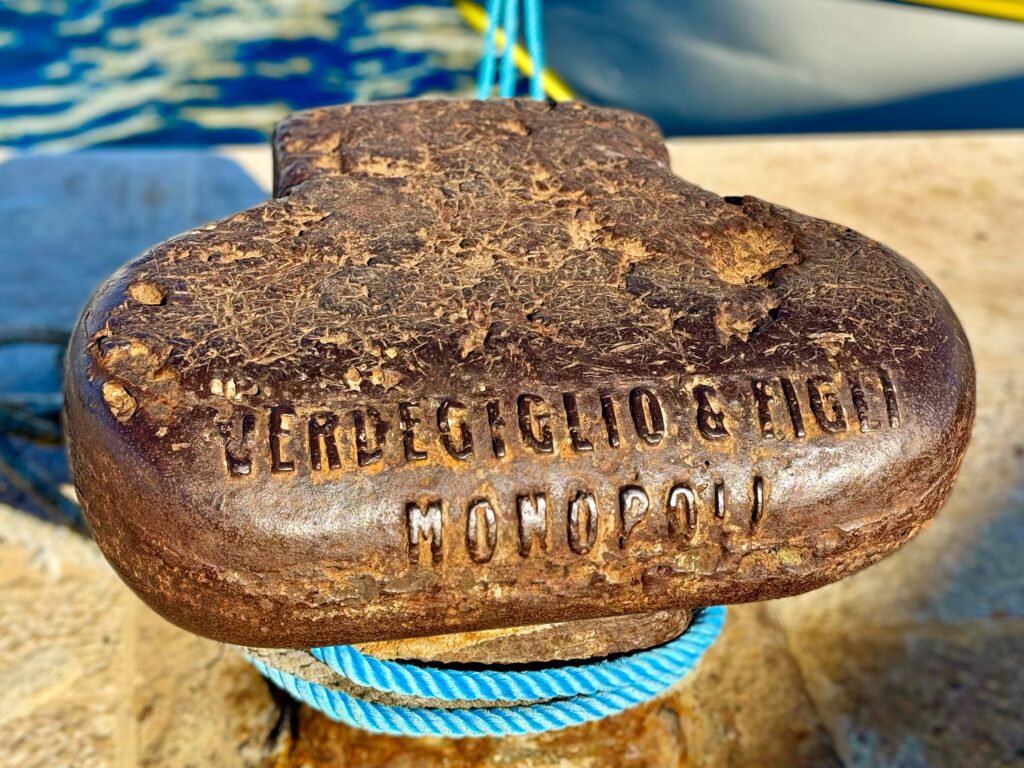
Piazza Giuseppe Garibaldi
This is Monopoli’s beating heart, a small, animated square that serves as the social hub of the centro storico at almost every hour of the day. Come for a morning espresso, return for aperitivo, and linger for dinner. Restaurants usually close after lunch service, so arrive before 2pm (2.30pm at the absolute latest). The golden hour, as the light goes horizontal and the locals emerge, is the moment the piazza is at its most alive.
Porto Antico
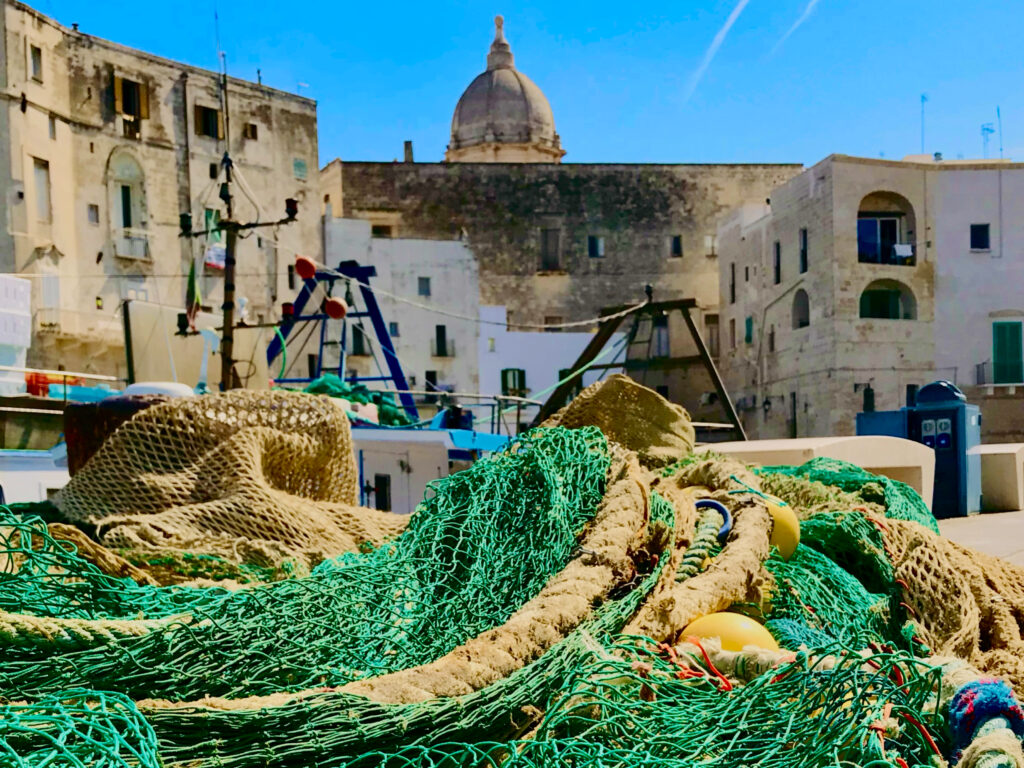
Monopoli is a city born of the sea and still living from it. The homes of the centro storico were built for fishermen and their families, and the old port retains the atmosphere of a working maritime community. The traditional u vozz (the light blue and red wooden fishing boats that are as much a symbol of Monopoli as anything in its architecture) shelter here just as they have for generations. Each morning, the catch is landed and sold at the dockside; in the afternoons, fishermen can often be found mending their nets by hand, using techniques unchanged for centuries.
Italian visitors consistently identify this as Monopoli’s most distinctive quality: the sense that a real working culture persists beneath the tourism. Watching the boats bob in the small bay, surrounded by the shifting blues and greens of the Adriatic, is quietly hypnotic – and it’s entirely free.
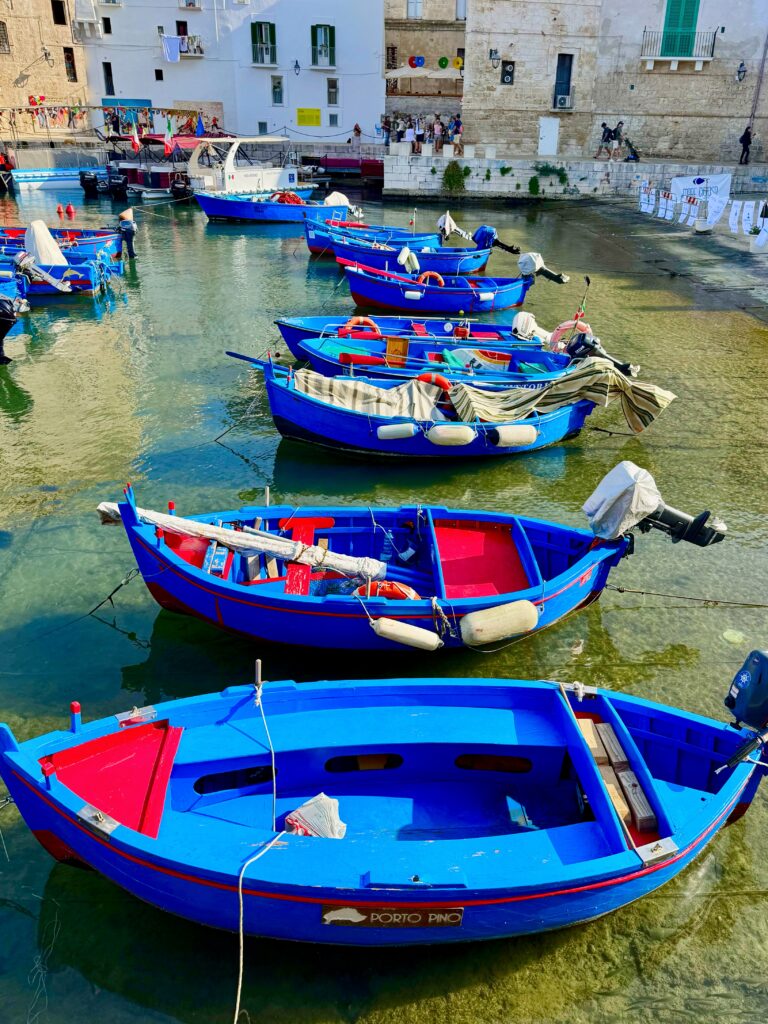
Lungomare and Castello di Carlo V
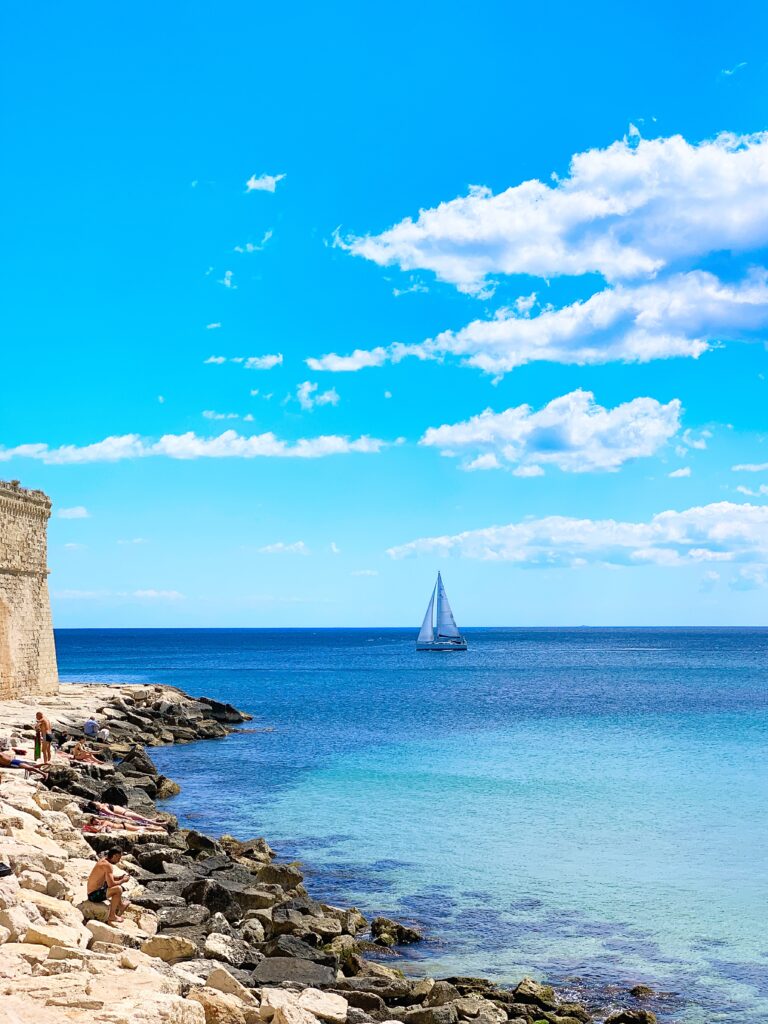
Monopoli has a beautiful lungomare (seafront promenade) that follows the old defensive sea wall in a sweeping arc around the old town. Walk it from Cala Porta Vecchia towards the Castello di Carlo V – a 16th-century sea fort that now serves as an exhibition space – and pause at the Bastione Santa Maria, a defensive tower still equipped with two cannons pointing defiantly out to sea. The combination of ancient fortifications and working harbour below is a particularly satisfying piece of urban theatre, especially at sunset.
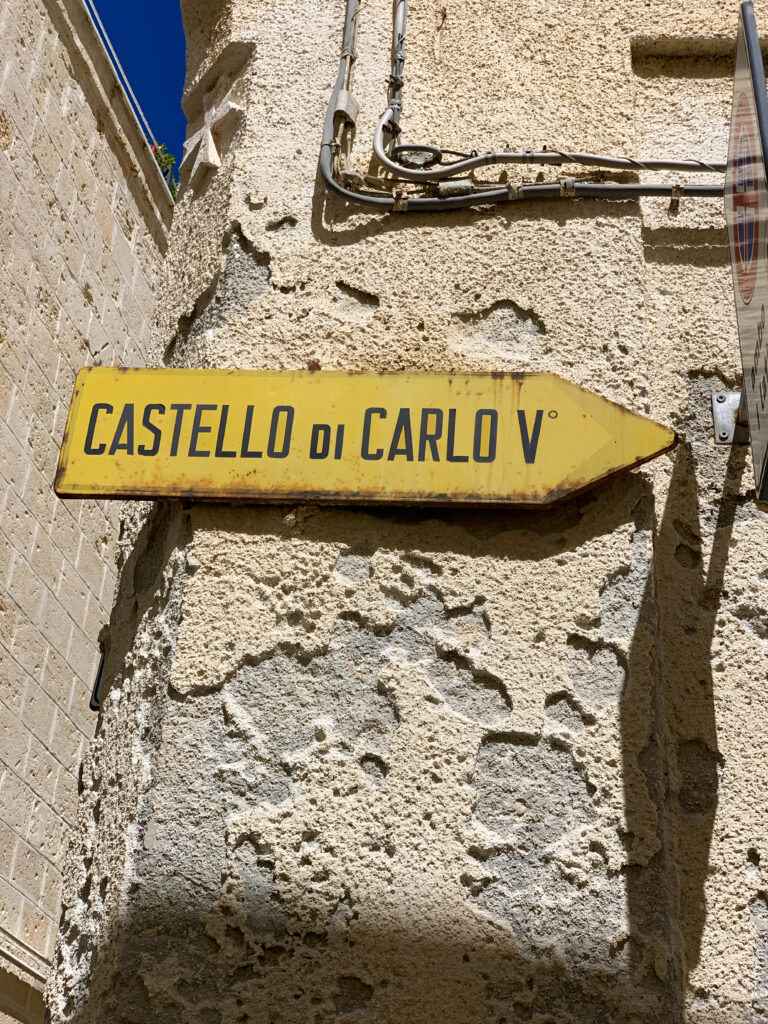
Walking tour: the city of churches
Monopoli’s informal nickname as the ‘city of churches’ is entirely earned: there are more than 20 in the historic centre alone. Start at the Cathedral of Maria Santissima della Madia, home to the city’s most revered icon, the miraculous Madonna della Madia, and work outwards from there. The streets between churches are the reward: quiet whitewashed lanes, hidden courtyards, and the occasional glimpse of sea between the buildings.
Recharge
Monopoli is the place we come to slow down. Whether you’re sitting in the piazza, wandering the narrow streets, or gazing at the boats in the harbour, the best thing to do here is sometimes very little at all. Pick one of the above, settle in, and let the town’s unhurried pace do the rest.
Where to eat
Monopoli’s food scene has evolved substantially as the town’s profile has risen. Until a few years ago you could wander the centro storico and find a table almost anywhere. That era is over. In July and August, and especially at weekends year-round, restaurants fill up quickly – even the modest trattorie. If you’re visiting in high season, reserving ahead is no longer optional.
That said, Monopoli still delivers genuine value compared to nearby Polignano, and the range is excellent: from long-standing family osterie with no-frills seafood and honest prices, to contemporary kitchens bringing creative ambition to local ingredients, to elegant harbourside addresses for a special meal. There is enough here to eat very well for several days without repeating yourself.
| Even highly-rated Monopoli restaurants can have off nights – consistency varies more at the traditional end of the market. That said, Il Guazzetto and Osteria Perricci are the two names that appear most consistently at the top of Italian rankings over time. If you are visiting before Easter or after October, check opening times. Off-season hours may be restricted and some restaurants may temporarily close. |
Food focus: mareterra – sea and land
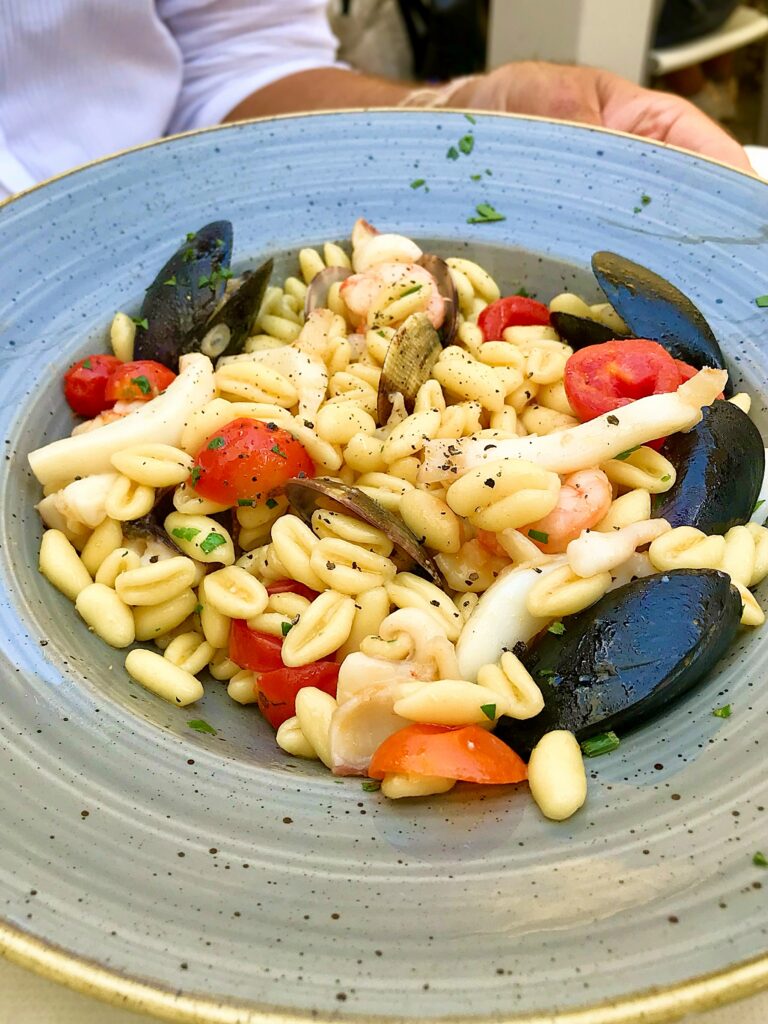
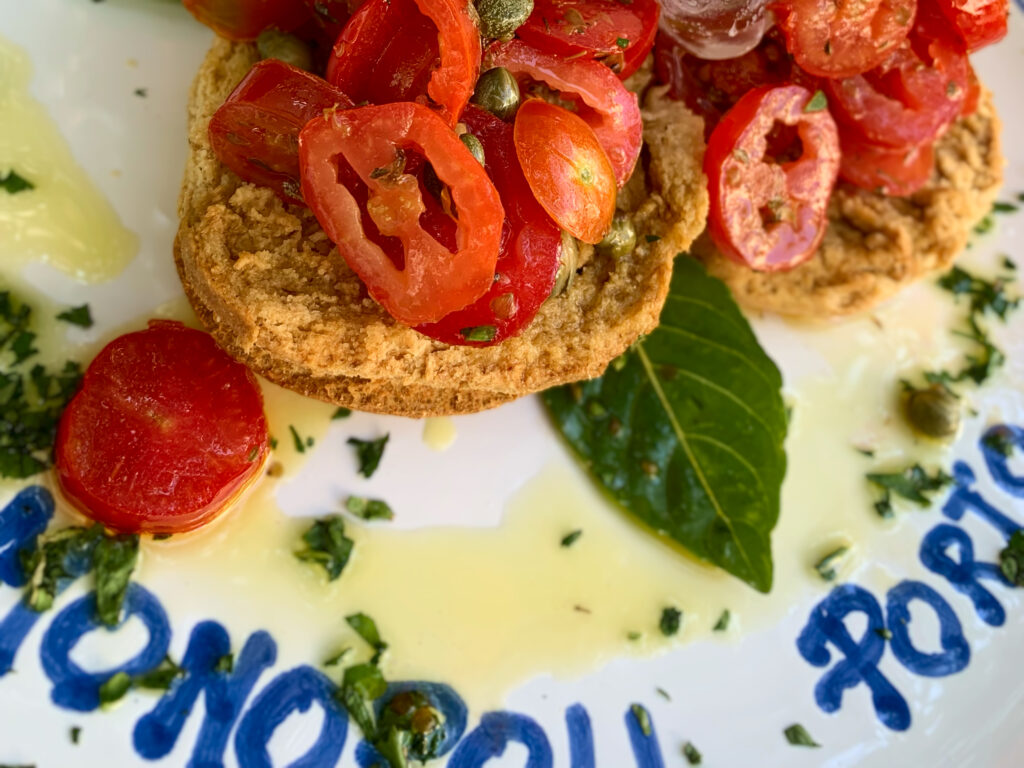
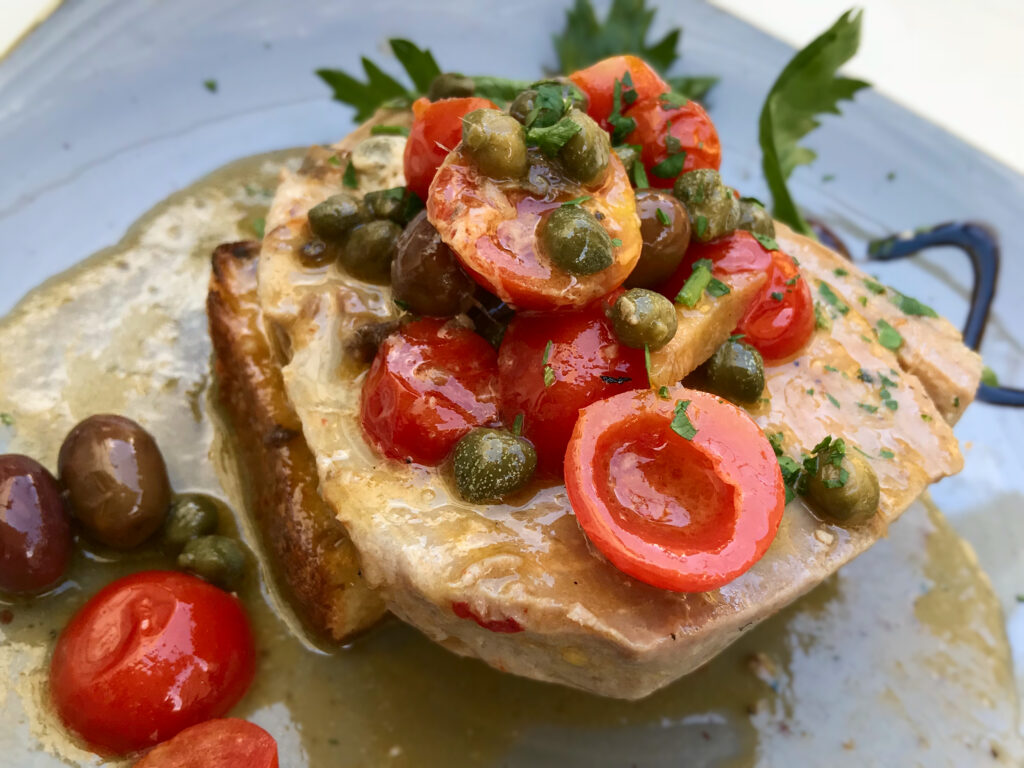
The word you’ll encounter on many Monopoli menus is mareterra – the interplay of mare (sea) and terra (land). This reflects the town’s genuine position on the boundary between Adriatic fishing culture and the rich agricultural interior of the Valle d’Itria. Expect raw seafood (crudi di mare), pasta with clams and mussels, and grilled daily catch alongside hearty inland dishes: rabbit braised with wild herbs, pork bombette from the macellerie, braised artichokes, and pasta with fava cream. The combination of maritime precision and countryside generosity is what makes Monopolitano cooking distinct.
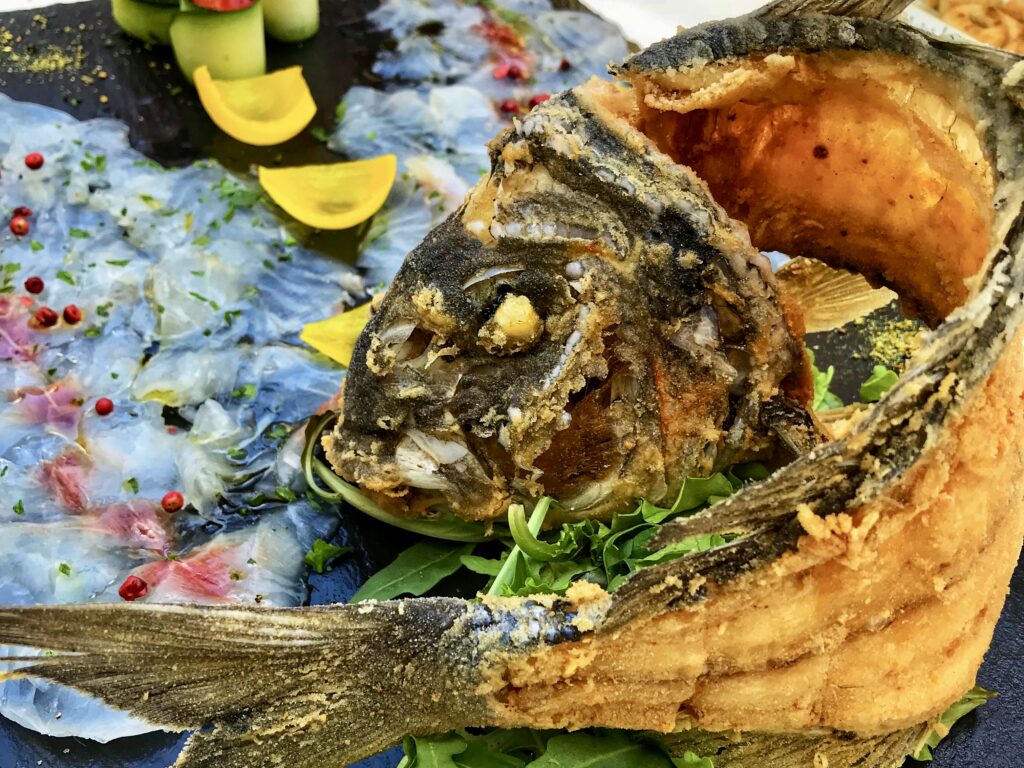
Traditional osterie & home cooking
Osteria Perricci
Classic Monopolitano seafood · long-standing family favourite
The most-reviewed restaurant in Monopoli among Italian visitors, not because it is the most refined, but because it is the most trusted. This long-standing family osteria has been serving simply prepared seafood to locals and regulars for decades: mussels, pasta with clams, orecchiette with fresh tomato, grilled fish. The atmosphere is unpretentious and the kitchen doesn’t attempt anything beyond its brief. Exceptional value – dinner for two with wine at around €35 is the benchmark cited – while also noting that consistency can vary. Go for the crowd-pleasers: cavatelli with clams is the dish the kitchen does best.
Osteria Sangiovanni
Generous, traditional Puglian plates · local favourite
Tucked into a quiet backstreet, with a high-ceilinged interior lined with wine bottles and a shaded terrace that’s ideal for people-watching. The portions are generous; the cooking is rooted in Puglia. Seafood pasta, slow-cooked stews in tomato broth, polpette, grilled meats — honest dishes done with care. The bread is excellent. Make sure to fare la scarpetta: this is a kitchen that expects you to mop the plate clean.
sangiovanniosteria.it
Il Punto Cardinale – Trattoria Al Borgo
Authentic, soulful cooking in a relaxed setting overlooking Piazza Vittorio Emanuele II
Run by Sergio Cardinale and Antonella, this trattoria sits on the edge of the main square and delivers the kind of cooking that rewards careful reading of the daily specials board. Double-cooked artichokes, pasta mista with fava cream, aubergine ragù, salt cod in tomato broth, pork bombette – it moves between the maritime and the inland with confidence. A strong choice for those who want home cooking rather than restaurant performance.
Creative and contemporary
Il Guazzetto
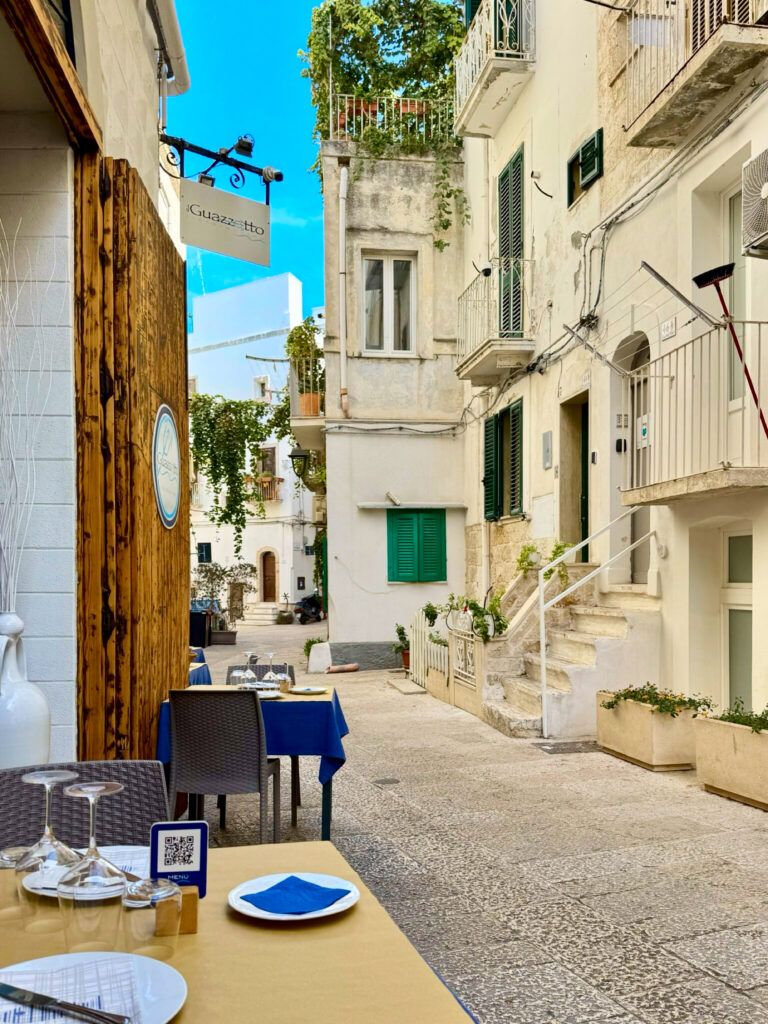
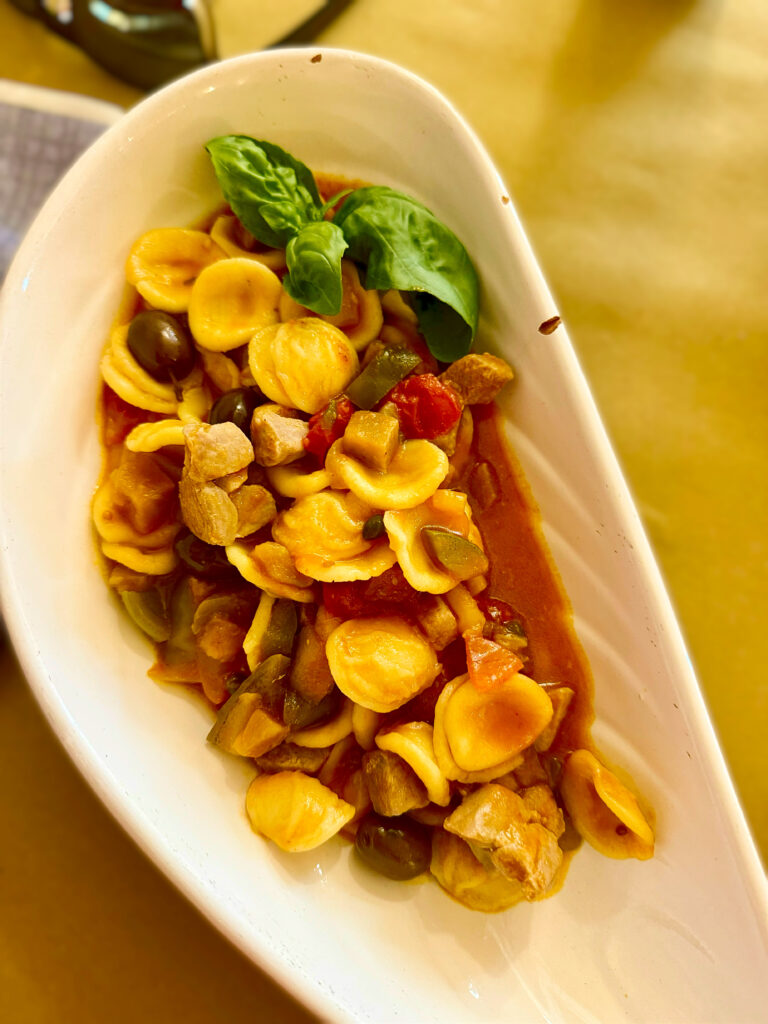
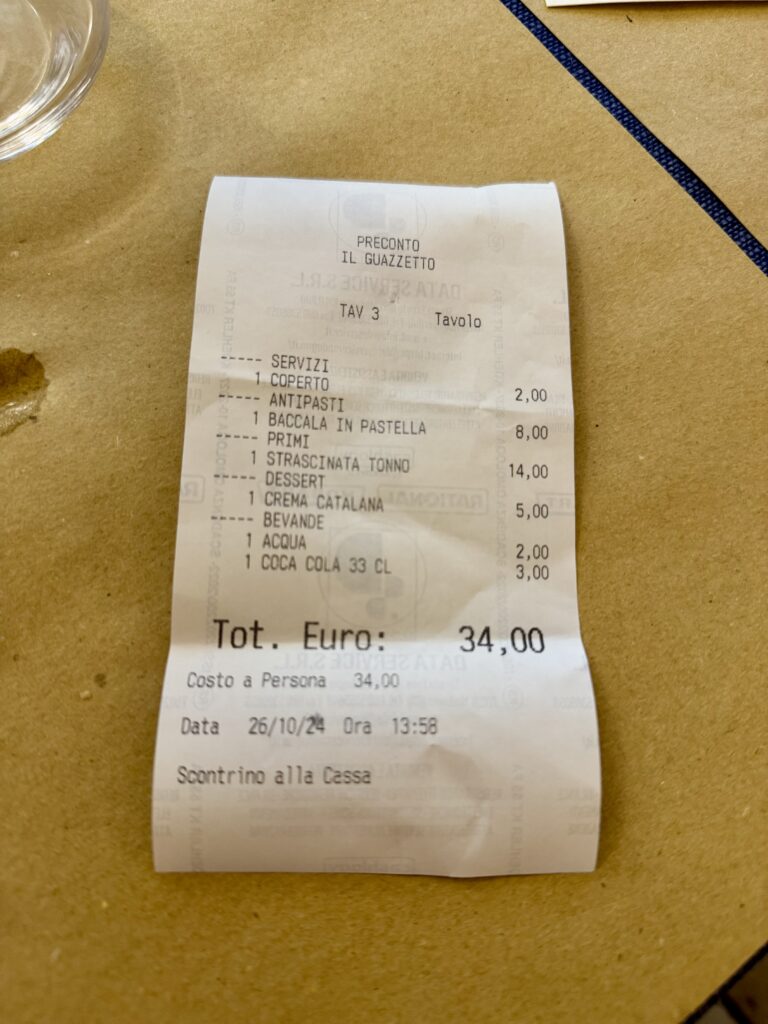
Seafood with contemporary Puglian flair · most consistently praised by Italian reviewers
The name that surfaces most reliably at the top of Italian rankings for Monopoli as the benchmark for quality fish in the centro storico. This is a young and inventive osteria with cheerful staff and a confident modern take on Adriatic seafood: tuna tartare, fish soups, pasta with crab, lobster preparations, seafood risotto, and a mixed grill that showcases the kitchen’s confidence with the daily catch. Start with the signature antipasto or the fried baby squid. Italian reviewers rate it as the most consistently excellent address in Monopoli for a proper seafood dinner.
ilguazzettomonopoli.com
Radimare
Refined contemporary Mediterranean dining
Chef Domenico Ungaro’s project represents Monopoli’s most ambitious culinary address – a restaurant that brings precision, elegance, and a clear creative vision to local ingredients. Italian food writers describe it as a serious, grown-up restaurant in a town not previously known for fine dining: the cooking is refined, the sourcing is seasonal and local, and the presentation is genuinely thoughtful. This is where you go for a special occasion dinner or when you want to understand what Puglian cuisine looks like when pushed to its full potential.
Pastanella
Modern trattoria · tradition reinvented for a younger audience
A buzzy contemporary address with roots in Bari’s food scene. Italian food writers single out the cavatelli with mussels, friggitelli, and pecorino shavings, and the creative cocktail pairings that accompany the menu. The atmosphere is livelier and younger than the traditional osterie, more aperitivo culture than slow Sunday lunch. A good choice if you want cooking that looks forward without abandoning its Puglian foundations.
Filo d’Olio
Vaulted stone interior · creative Puglian cuisine with cocktail pairing
Set in a beautiful stone-vaulted space that feels more masseria than city restaurant, Filo d’Olio occupies a slightly off-centre position on the lungomare. The kitchen delivers authentic Puglian cuisine with a creative twist, and the cocktail-pairing format has been enthusiastically received by Italian reviewers on TheFork. Popular for romantic dinners; book ahead at weekends.
Romantic & seaside dining
La Locanda sul Porto
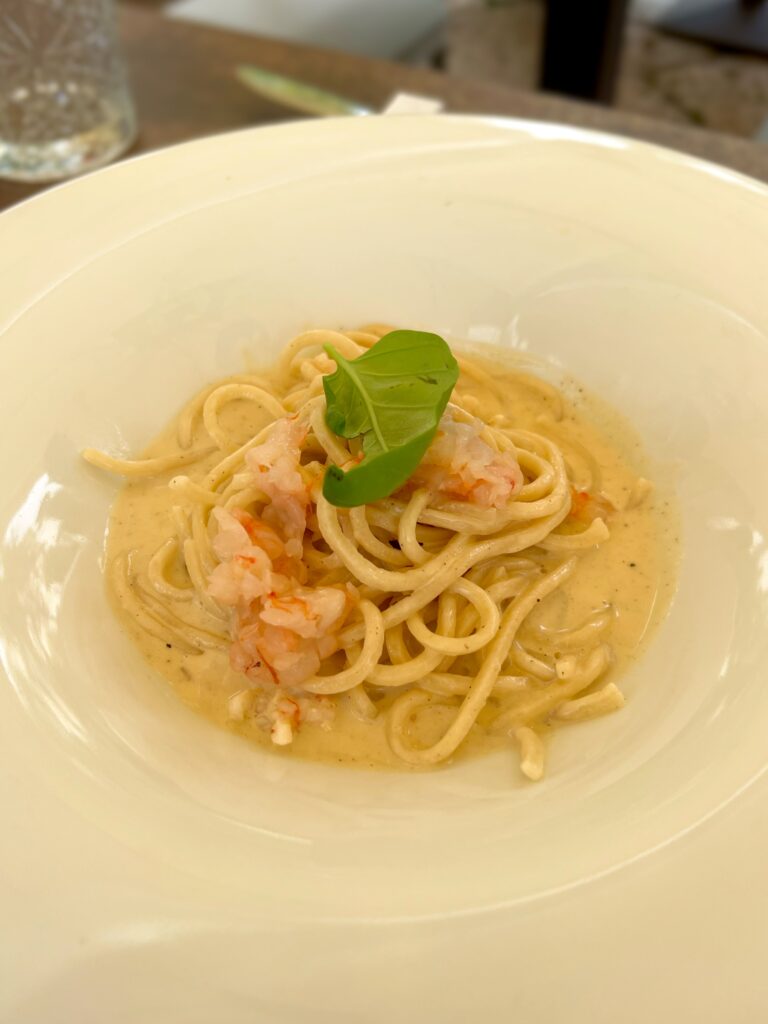
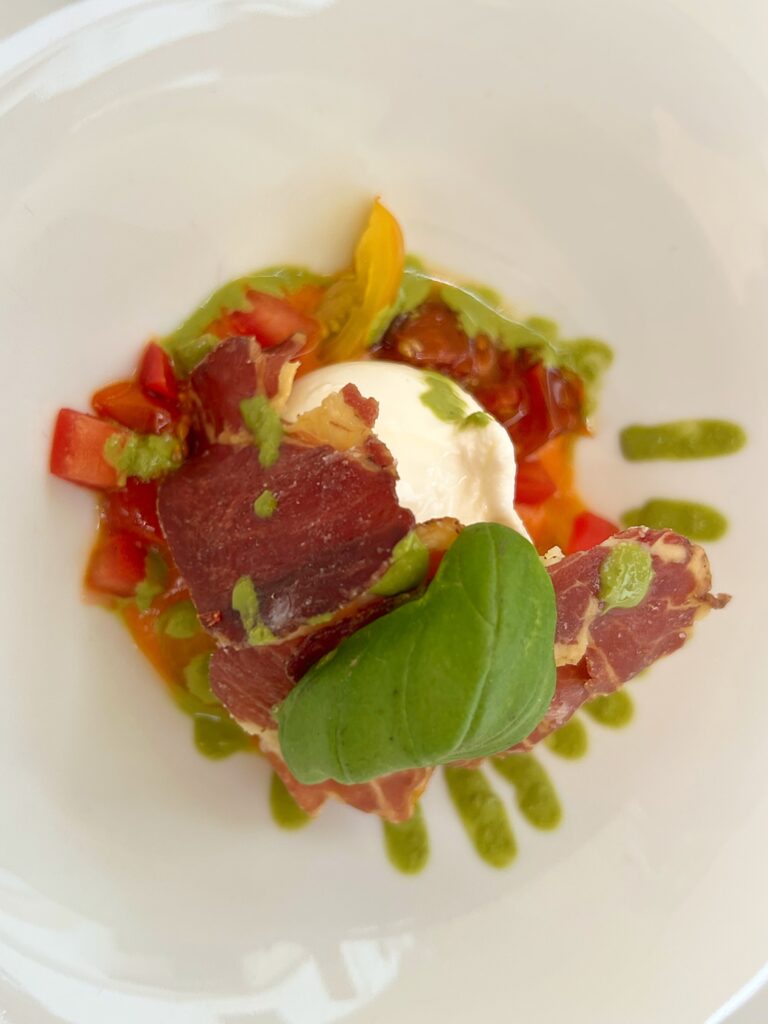
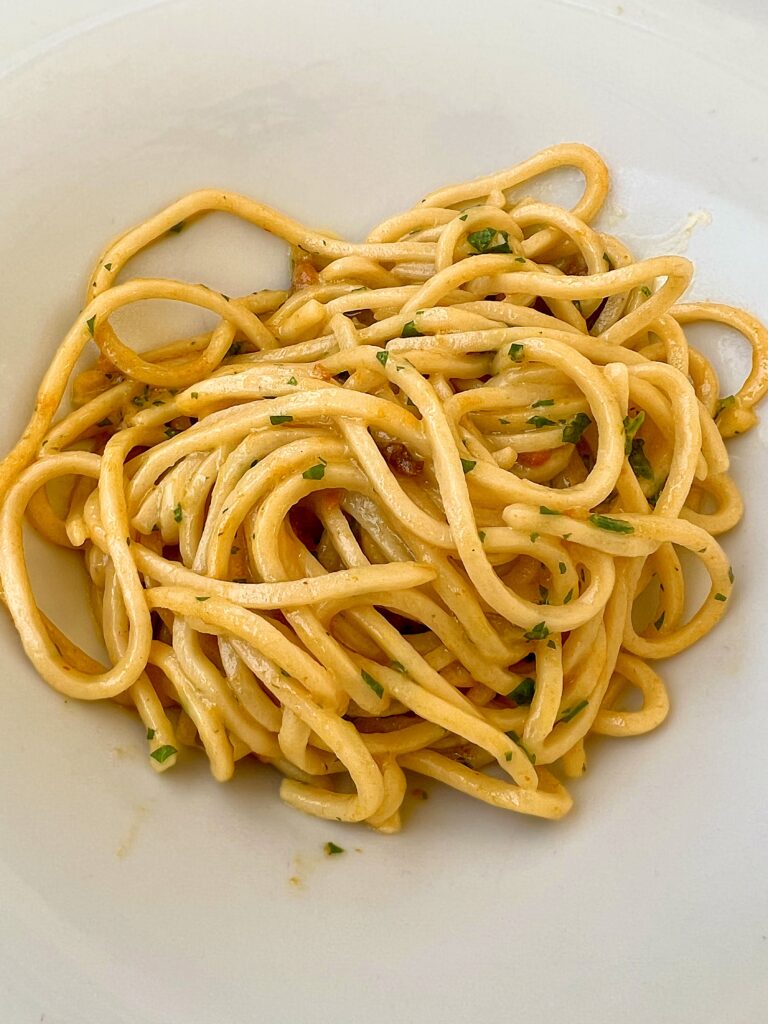
Atmospheric harbourside dining
Overlooking the Porto Antico, this atmospheric address pairs pasta and the freshest catch of the day with one of Monopoli’s most evocative settings: castle walls, sea views, and the sound of the harbour below. Spaghetti ai frutti di mare is the signature dish. The combination of honest seafood cooking and the visual drama of the location makes it a perennial favourite for first evenings in town or farewell dinners.
CarloQuinto
Fish and seafood · unique harbourside setting with Adriatic views
Set beside the port with sweeping views of the Adriatic and Monopoli’s golden bastions, CarloQuinto serves fresh fish on decorative ceramics in one of the town’s most theatrical settings. After dinner, take a cocktail outside and sit on the bastion wall with the locals as the town winds down. The kitchen focuses on classic fish preparations done well, and the setting justifies the price premium for a special-occasion dinner. | carloquinto.it
Ristorante Lido Bianco
Elegant Adriatic dining · floor-to-ceiling sea views
The most polished address on the Monopoli waterfront: elegant and modern, with floor-to-ceiling windows framing the sea, refined Mediterranean cuisine, and attentive service. A great choice for a long, unhurried lunch or a special-occasion dinner. The presentation is careful and the wine list well-chosen. Expect to pay more than at the family trattorie, but the overall experience – food, setting, and service combined – justifies it. | ristorantelidobianco.com
Casual bites & wine
Vini e Panini
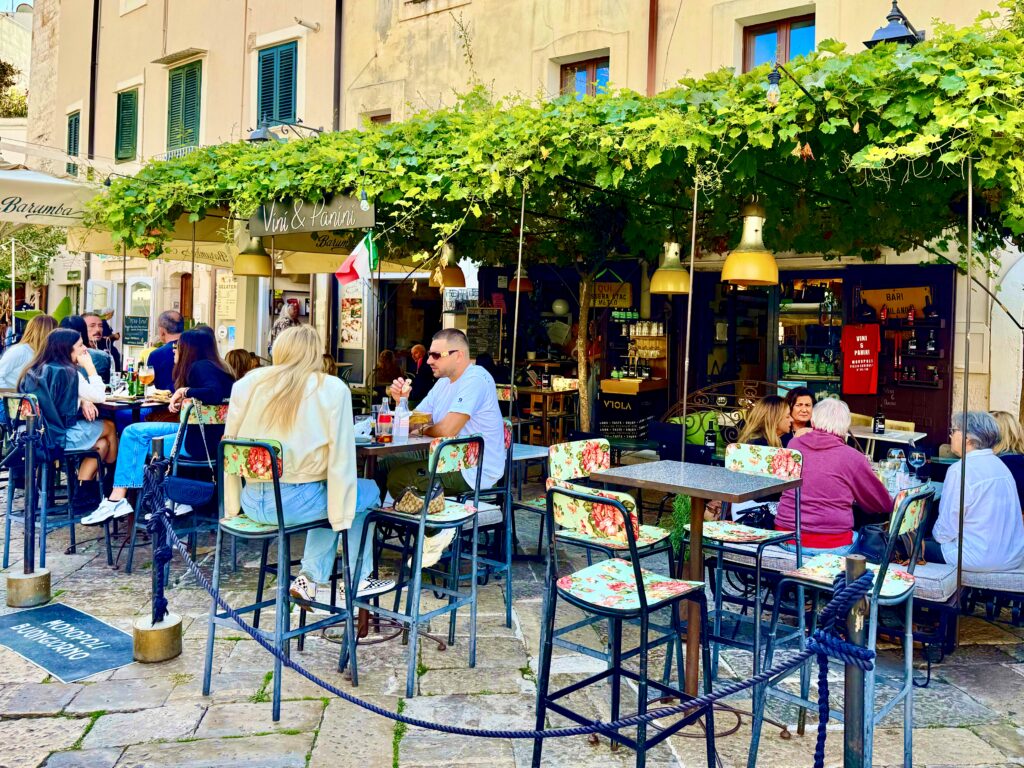
Old-town wine bar and small plates · ideal for aperitivo
A relaxed and unpretentious spot in the centro storico, perfect for a long aperitivo or a casual lunch of gourmet panini, Puglian cheeses, and cured meats paired with regional wines. The outdoor tables on Via Garibaldi are among the best places in town to watch the world go by. Simple, enjoyable, well-priced.
Beaches in Monopoli
Monopoli’s coastline stretches roughly 14 kilometres, and most of it is rocky shelves and coves, with sandy patches scattered between. The central town beach is compact and extremely popular. The best sandy options are to the south in the Capitolo district, where lidos and private beach clubs sit alongside free stretches. To the north, the coast is more rugged and quieter.
A frank assessment: Monopoli’s beaches, while attractive and convenient, are not the region’s finest. In peak summer they are genuinely very busy – by summer 2025 families were reportedly arriving at 4am to claim spots at Capitolo. If your holiday is primarily beach-focused, you may find the sand-to-crowd ratio more satisfying in Gallipoli or along the Salentine coast further south. But for a base that combines easy beach access with excellent food, history, and day-trip convenience, Monopoli works very well.
Overview
- Porta Vecchia – the town beach just below the old walls, sandy and convenient, popular with families.
- Cala Porta Vecchia to Cala Paradiso – a string of small coves south of the centre, each with clear water and a mix of sand and rocks. Easy to walk to, but busy in summer.
- Cala Susca, Cala Verde, Cala Sottile – slightly further out, rocky coves with transparent waters, good for snorkelling.
- Capitolo – Monopoli’s seaside resort area, about 10 minutes’ drive south. Here you’ll find long sandy stretches, beach clubs, and free beaches. Lively in July and August, quieter off-season.
- Cala Paradiso – a sandy cove with shallow water, ideal for families, though it gets crowded in summer.
- Piscine Romane – don’t miss these natural “Roman Baths” near Torre Cintola at Capitolo.
Over the last few years Puglia has become very, very popular – especially now that tourists from the USA have “discovered” our region. Many choose Monopoli as a seaside smart base for its “beaches”, and combined with weekend visitors from Bari, space gets tight. By summer 2025 it made the news that families were arriving at 4am to claim the best spots at Monopoli Capitolo!
Town beaches
Spiaggia Cala Porta Vecchia
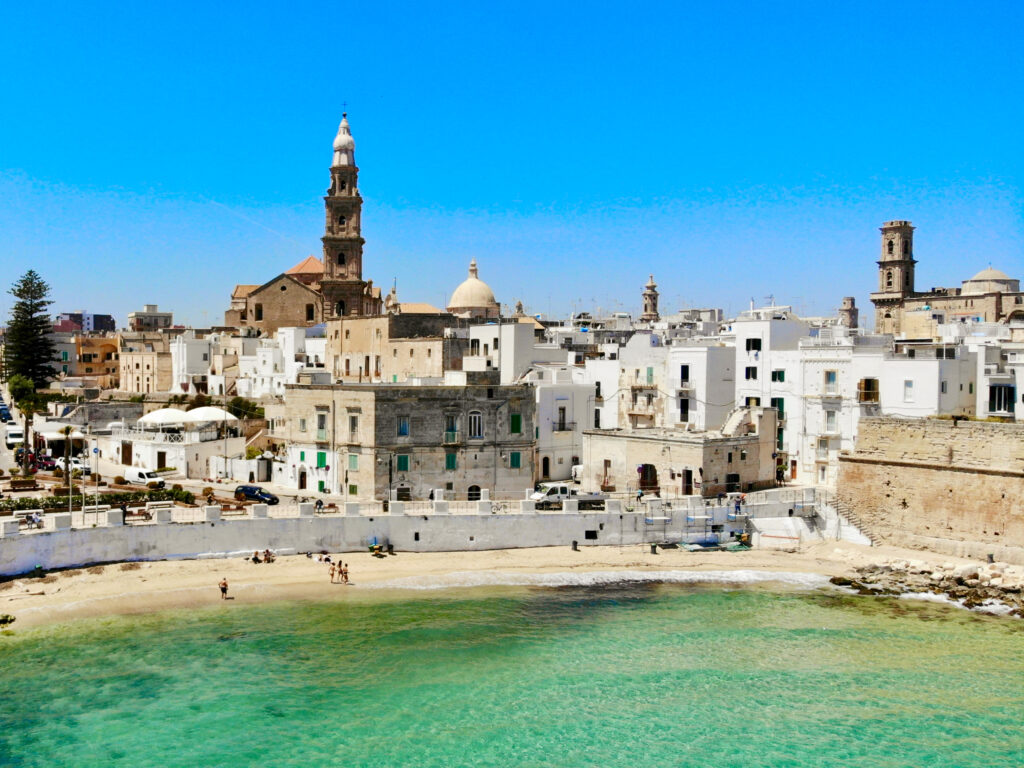
The main city beach: a narrow strip of sand running along the base of the old defensive sea wall, immediately beneath the old town. Hugely popular, fills fast, and best visited early in the morning or out of high season. A small bar and car park sit near the southern access point. The views of the old walls from the water are genuinely beautiful, even when the beach is packed.

Cala Porto Bianco

Sandwiched between Cala Porta Vecchia and the slightly larger Cala Porto Rosso, with a popular pizzeria restaurant looking over the Adriatic.

Cala Porto Rosso
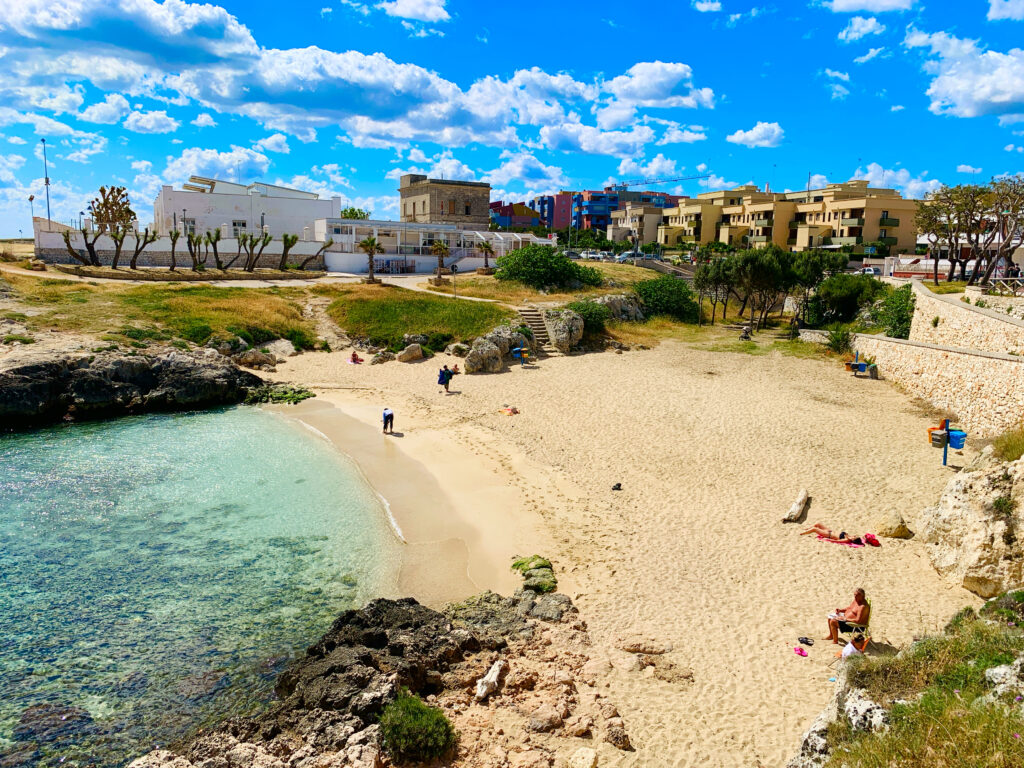
A small sandy cove about 10 minutes’ walk from the old town, with stunningly clear water. The beach itself gets crowded, but swimmers also spread out across the rocks. The Red Beach Bar is on hand for food and drinks. Public beach, no facilities beyond nearby bars and restaurants.
Beaches to the south
Cala di Porto Verde
A tiny local cove, popular with Monopolitani.
Cala Paradiso
Close to Porto Verde, with a bit more space. Part free beach, part beach club (seasonal facilities). About 2 km or a 20-minute walk from the centre.
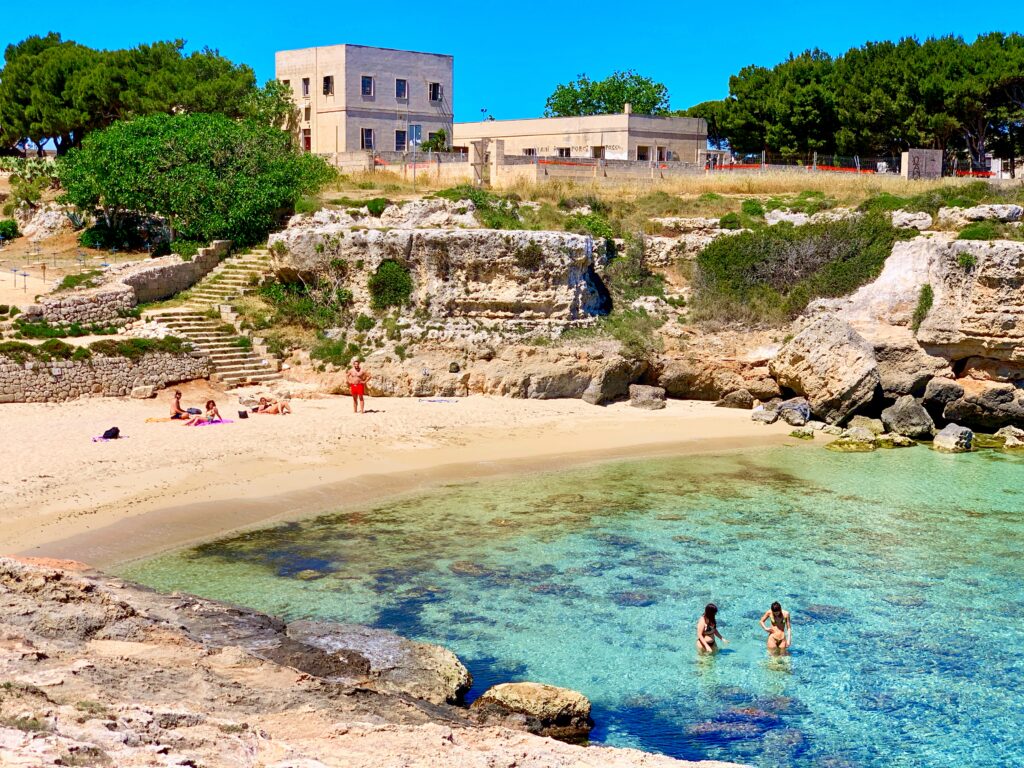
Lido Colonia
Compact sandy beach with a bar and facilities. Parking along the road. About 2.5 km from town.
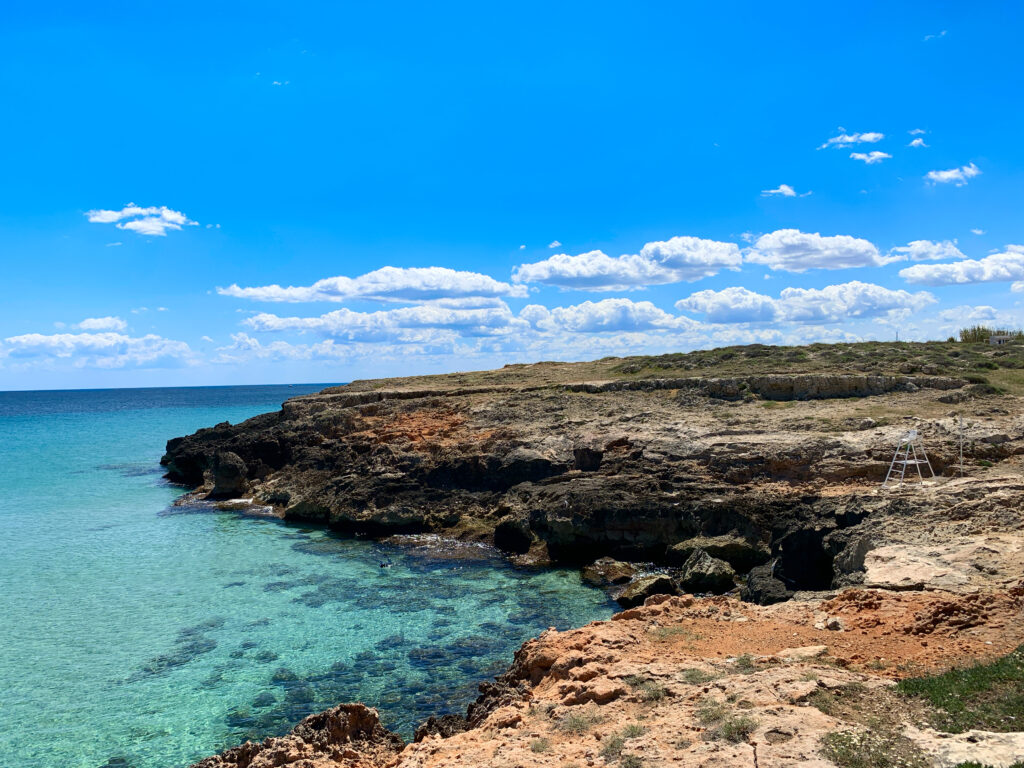
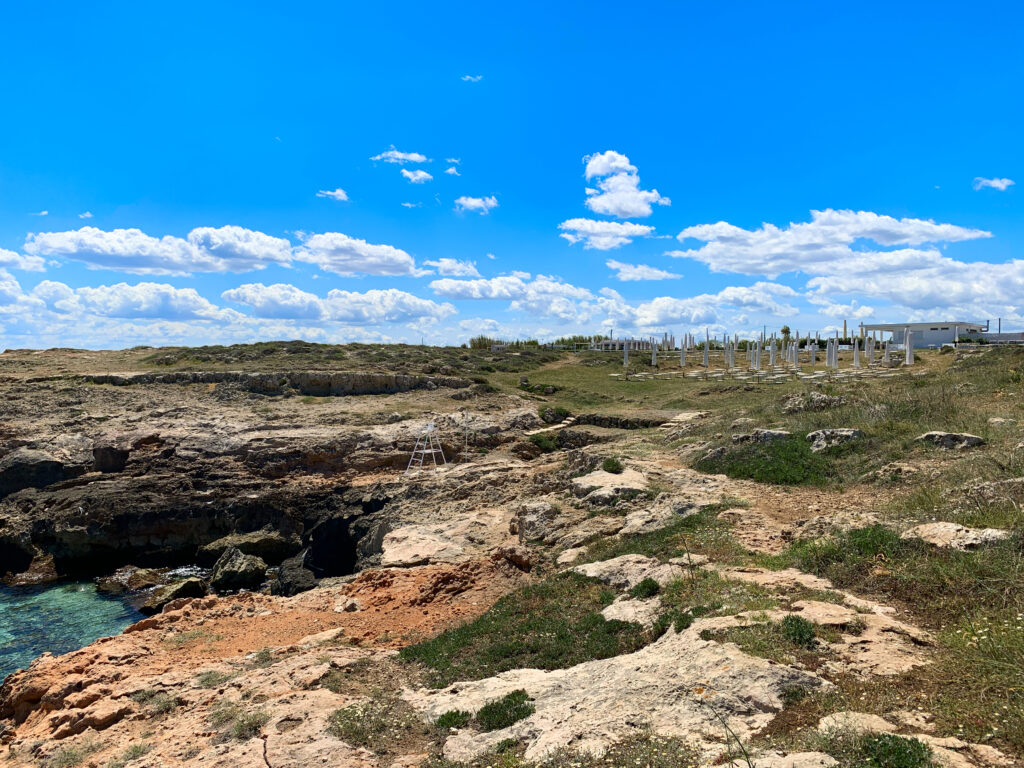
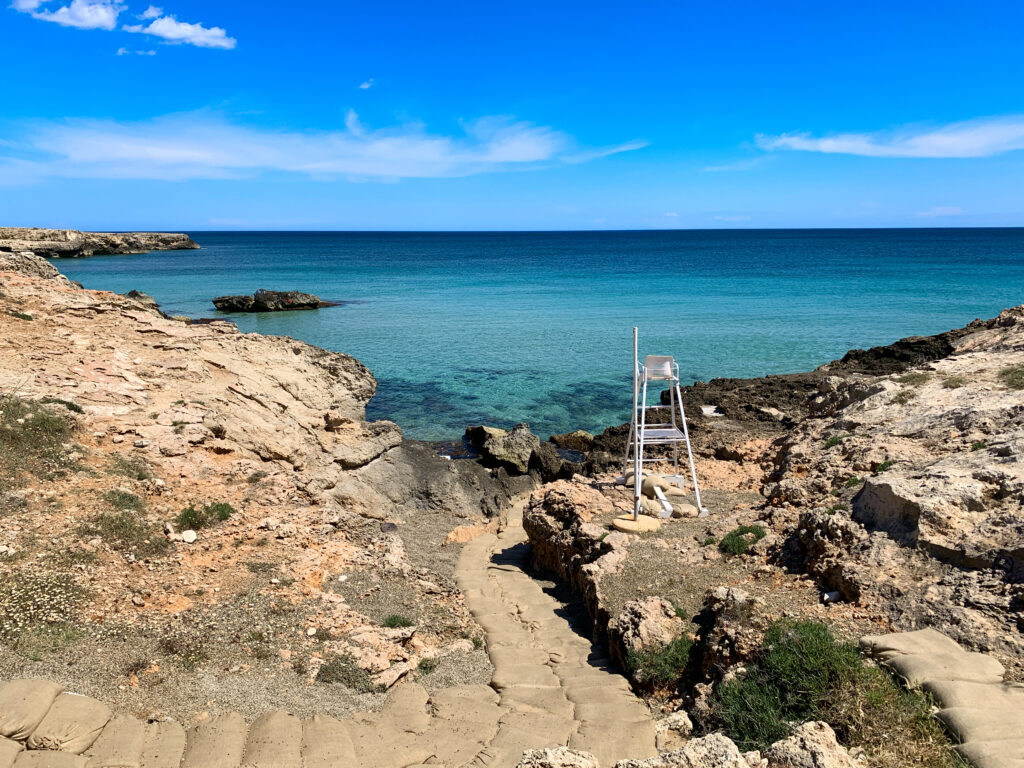
Calamarena
Mostly rocky shelves, with loungers and a small bar available in peak season. Also 2.5 km from town.
Spiaggia di Porto Marzano
Around 4 km south. Small sandy beach with a seasonal bar and free parking.
Spiaggia di Porto Ghiacciolo
A lively sandy cove below the abbey of Santo Stefano. Very popular and not especially peaceful, but there’s a good bar/restaurant renting sunbeds and parasols. 4.5 km from the centre.
Lido Santo Stefano
A sterile enclosed lido with sandy beach, but in a striking setting with views of the medieval Castello di Santo Stefano. Look out for the friendly cat colony in the car park. 4.5 km from the centre.
Capitolo
Monopoli’s seaside resort district, about 10 minutes’ drive south of the centre. The sandy beaches here are longer and more open than those in town, with beach clubs (lidi) alongside free public stretches. In July and August it is very lively; outside peak season it quiets down considerably. The Piscine Romane – natural rock pools near Torre Cintola that fill with seawater – are worth seeking out and are one of the coast’s hidden highlights.
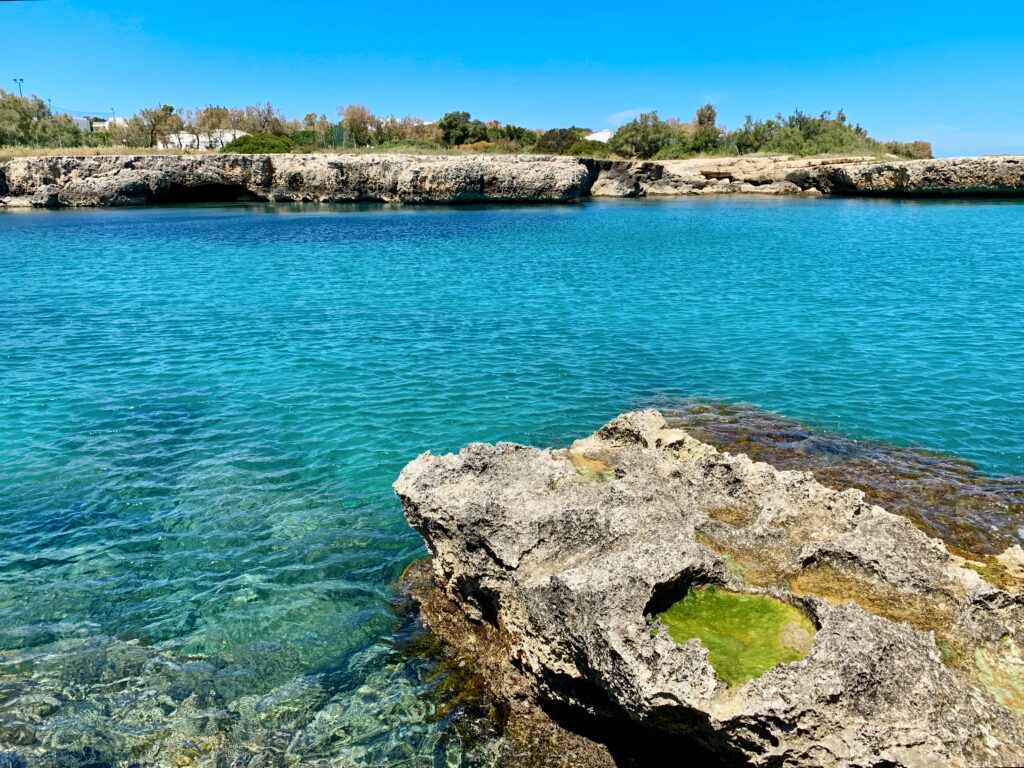
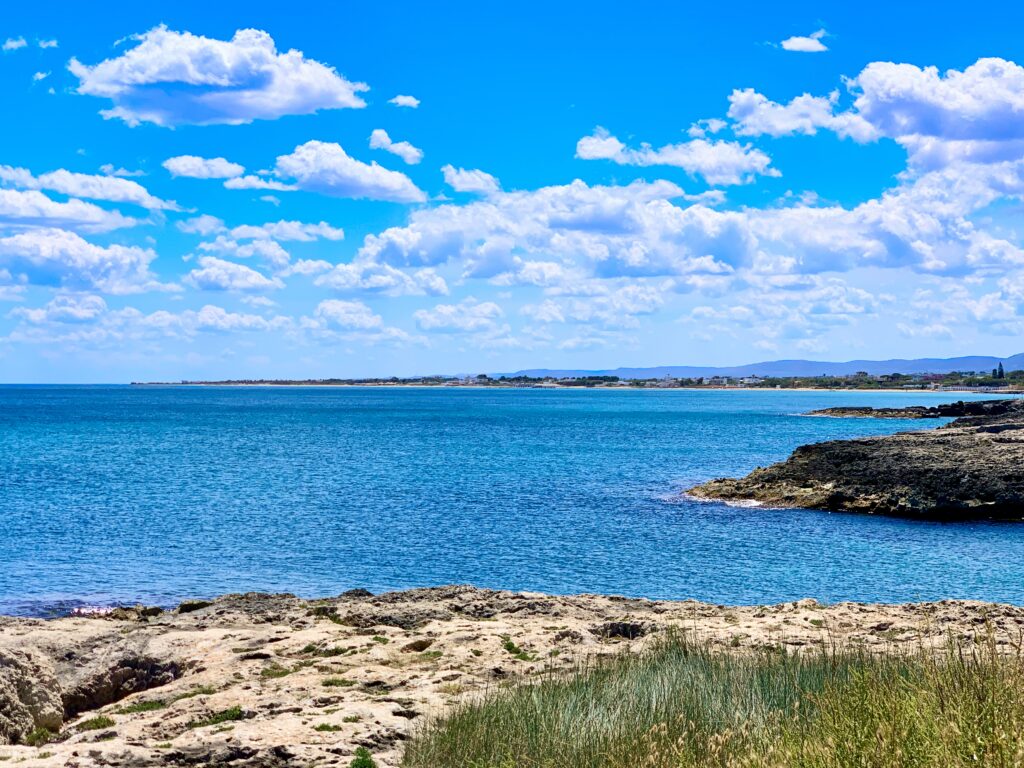
Torre Cintola Coves (Capitolo)
In Capitolo, just south of Monopoli, the Torre Cintola Coves are a secret swimming spot loved by locals. What looks like a maze of rock pools was actually carved out by tuff quarrying, later reclaimed by the sea. Now the Adriatic fills the old cuttings, forming sheltered inlets where the water shimmers between limestone walls, watched over by the ruins of the semi-collapsed tower.
Good to know: there are no facilities, and the rock is sharp underfoot – sturdy water shoes are a must.
Right next door are the Piscine Romane. Despite the name, they’re not Roman baths but another series of pools, named because the Via Traiana – the Roman road built by Emperor Trajan in the 2nd century AD – once passed nearby. Today they’re a favourite with locals for cliff diving and swimming in clear turquoise water, one of the coast’s most atmospheric spots.
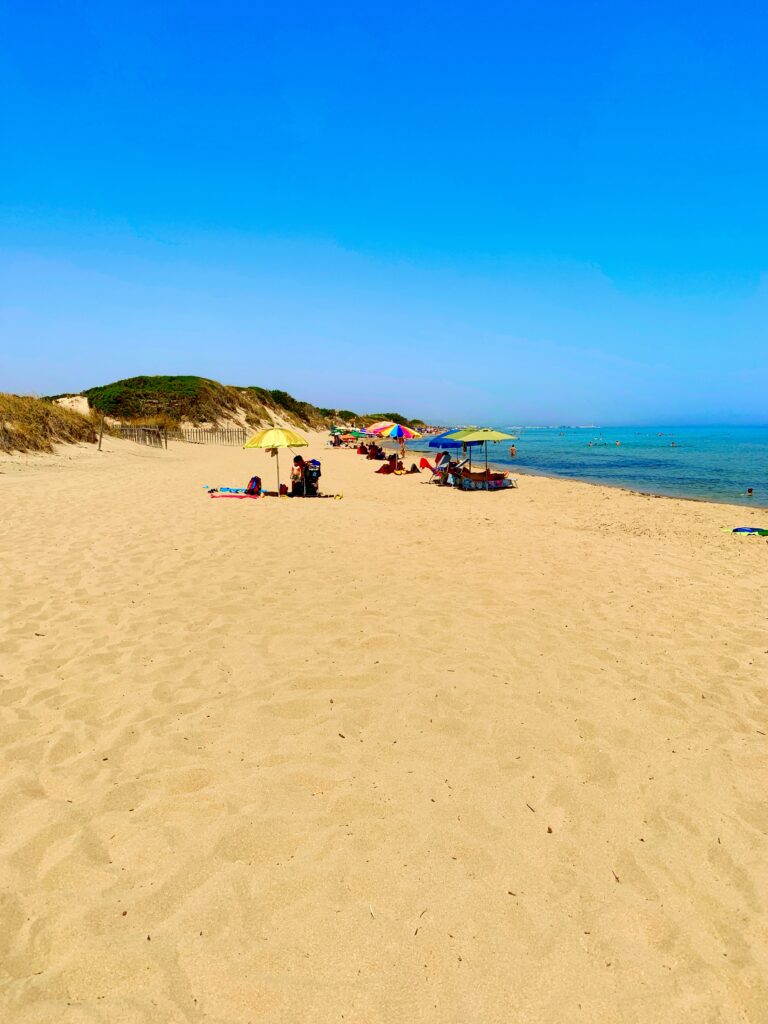
Continuing south from Capitolo you find the first extended sandy beach south of Bari, stretching towards Savelletri, Torre Canne, Specchiolla and Torre Guaceto. Expect a mix of beach clubs for all budgets and some smaller free sections. About 7 km south of town, near the archaeological park of Egnazia.
Beaches to the north
Torre Incina (Cala Incina)
Just over 5 km north, this rocky cove is a very popular bathing spot. Park near the tower after exiting the SS16 at Monopoli Nord. A short walk north leads to a gay and nudist beach towards Polignano.
Beach focus: claiming your patch (the Italian way)
Beach culture in Monopoli is serious business. With limited sandy stretches and a surge in visitors, especially from Bari on summer weekends, competition for space is fierce. Don’t be surprised to see families setting up umbrellas before sunrise. If you’re visiting in high season, either arrive early, embrace the rocky shelves, or book into a stabilimento (private lido) where loungers are guaranteed. Outside July and August, the beaches return to their calmer, more local rhythm.
Beach Warnings and Practical Notes
- Arrival time in peak season: At the most popular Capitolo beaches in July and August, free spots are claimed very early. Arriving after 9am on a hot weekend in high season means either paying for a lido spot or accepting limited space.
- The maestrale wind: When the northwesterly blows, it can bring in seaweed and roughen the water along the Adriatic coast. Check the forecast – on maestrale days, the Ionian coast around Gallipoli is sheltered and far more pleasant.
- Theft: Italian visitor forums flag beach theft as a concern at busy Monopoli beaches, consistent with the broader pattern across Puglia’s most popular coastal spots. Never leave valuables unattended on the beach.
- Lido pricing: A two-sunbed-plus-umbrella lido arrangement typically costs upwards of €15–25 per day in 2025. Most lidos include basic shower and toilet facilities.
Boat Trips in Polignano a Mare and Monopoli
The coastline between Polignano and Monopoli is also worth knowing as a continuous stretch — several operators run routes connecting both towns, meaning you can depart from Monopoli and take in the Polignano caves en route, or vice versa. See our Polignano a Mare guide for recommended operators based in Polignano. Prices for group tours run from around €25–40 per person for a two-hour shared trip. Private charters typically start from €200–250 for up to six passengers.
Book ahead in July and August. Good operators at peak season sell out days in advance.
Monopoli Boat — Top recommendation, best for personalised experience
A one-man operation that generates an extraordinary volume of warmth in the reviews. Luciano runs Monopoli Boat from the port, offering private and small-group tours along the Monopoli-Polignano coastline, and the review profile is consistently exceptional. Multiple reviewers describe the tour as the highlight of their entire trip to Puglia, language that appears repeatedly and independently across different review platforms.
The tour runs from Monopoli’s port north along the coast to the Polignano caves, with swimming stops in the clear water of hidden coves, prosecco and focaccia Barese on board. The personalised, flexible format (this is essentially a private charter operation rather than a set-departure group tour) makes it better suited to couples and small groups than large parties.
📍 Porto di Monopoli | monopoliboat.com
Apulian Boat Tours — Best structured option departing Monopoli
A slightly more formal operation than Monopoli Boat, with a website, structured tour menus and fixed departure slots, making it easier to book ahead and plan around. Reviewer accounts describe guide Donato as kind, well-informed and skilled at putting nervous first-time passengers at ease, with commentary on the towns and coastline throughout. Tour capacity is capped at around 10 passengers, keeping the group size intimate. Options run from a two-hour shared cave tour to a four-hour private charter with aperitif.
📍 Porto di Monopoli | apulianboattours.it
The Monopoli-to-Polignano route — a note
Several operators run the coast between both towns as a single itinerary, departing Monopoli, heading north to the Polignano caves, and returning. The shared gozzo tour on this route consistently receives strong reviews, with guide Francesco specifically praised for winning over first-time young sailors and multi-national groups alike. If you’re basing yourself in Monopoli and want the Polignano cave experience without travelling to Polignano first, this is the most efficient solution – and the approach from the sea south of Polignano, watching the old town emerge above the cliffs as you arrive, is one of the great views of the Adriatic coast.
Where to stay in Monopoli
Staying inside Monopoli’s old town is a different proposition from booking a seafront hotel on the outskirts. The centro storico is pedestrianised – cars cannot enter – which means arriving with luggage requires a short walk or a transfer. The lanes are narrow, and the buildings are centuries old. None of this is a problem; all of it is the point. You will want to have the Porto Antico a few minutes’ walk in one direction and Piazza Garibaldi in the other.
The options below are all within the historic centre or immediately on its edge. We usually stay at Albergo Diffuso; the other entries draw on the experiences of friends and visitors we have interviewed for our guides. We have stayed in other accommodation in Monopoli, but because we would not go back, we do not include them in this guide!
| Practical notes for all old-town properties: free public parking is available just outside the old town walls. Air conditioning is essential in summer – the stone lanes retain heat at night. Always confirm AC is included before booking, and read arrival/check-in instructions carefully, as most properties operate with limited or no 24-hour reception. Many buildings do not have elevators, some only for luggage, so be sure to check! |
Albergo Diffuso Monopoli
★★★★☆ Via Chiasso Carmelano 1 · Largo Giuseppe Garibaldi albergodiffusomonopoli.it
The old town as your hotel — scattered suites, central reception, tuk-tuk transfers
The concept of the albergo diffuso as a hotel whose rooms are distributed across multiple historic buildings within a single neighbourhood, unified by one reception, was developed in Italy as a way to restore depopulated historic centres without replicating them as stage sets. Monopoli’s version is among the better executions of the model in Puglia.
The project was founded by a group of friends committed to offering visitors an experience of authentic local life, living door-to-door with residents rather than sealed off in a conventional hotel. The buildings, ranging from former fishermen’s houses to grander palazzi, were renovated with care for their original architectural character, while being fully equipped with modern amenities. No unit is more than 200 metres from the central reception on Via Chiasso Carmelano, which also houses the café and breakfast room.
Check-in takes place at reception, after which staff accompany guests to their rooms. The portfolio of rooms and apartments covers a range of sizes and positions across the old town, from quiet lanes near the sea walls to the prime location on Largo Giuseppe Garibaldi.
The Garibaldi Suites
The suites in the building on Largo Giuseppe Garibaldi are the standout accommodation in Monopoli for visitors who want to be at the centre of town life. However, there are no rooms on ground floor and the building does not have a lift (an elevator), an important consideration for guests with luggage or mobility considerations. The second-floor suites have private balconies directly overlooking the piazza: the ideal position for breakfast, an evening aperitivo, or watching the passeggiata unfold below. We enjoyed the combination of a well-appointed interior – spacious bedroom, modern bathroom, sitting room, coffee and tea provision – with the balcony view. Request these suites specifically at the time of booking.
What guests consistently praise
• The tuk-tuk transfer. The complimentary three-wheeled shuttle service between the free public car park outside the walls, the train station, and reception is both practically useful and a warm introduction to the property. It removes entirely the stress of arriving in a pedestrianised old town with luggage.
• The staff. Guests describe them as going well beyond logistics – helping arrange taxis, research train times, recommend restaurants, and solve problems, the kind of reception that makes a stay.
• The breakfast and café courtyard. A buffet of fresh fruit, cereals, baked goods, and cakes, served until late morning in the reception courtyard. A better start to a Monopoli day than most alternatives.
• Location within the location. Being inside the old town rather than adjacent to it changes the experience of a place. Guests consistently note the pleasure of stepping directly from their door into the medieval lanes, the harbour, and the piazza.
| Worth knowing Room quality varies across the portfolio – some units are simpler and accessed by steep, narrow stairs. This is not a property for guests with significant mobility limitations, though the Garibaldi building had a wider staircase that was easier to negotiate. Arrival time must be communicated in advance, as the property does not operate a 24-hour reception. The tuk-tuk service makes the car park transfer straightforward, but factor in the coordination required. |
| The Puglia Guys’ view We stayed in three suites in the Garibaldi building and found the concept genuinely well realised – the tuk-tuk from parking, and the breakfast courtyard make this the most practically comfortable way to stay inside Monopoli’s old town. For wow factor, book the Garibaldi piazza suites specifically; they are the reason to choose this property over the alternatives, though the reception building was cute (and we recollect had rooms on the ground floor). |
Palazzo Fiscaiolo
★★★★☆ Via Cristoforo Colombo · Centro Storico palazzofiscaiolo.it
A beautifully restored early-20th-century palazzo with rooftop sea views
A small, intimate guesthouse occupying a carefully restored palazzo from the early twentieth century, tucked into a quiet narrow lane in the heart of the centro storico. The renovation respected the building’s original architectural details throughout, with individually furnished rooms, Frette linen, memory-foam beds, and a rooftop terrace that earns its own reviews.
A great location: a few steps from Cala Porta Vecchia beach, easy walking distance from the Porto Antico and the Cathedral, but on a lane quiet enough that guests consistently report sleeping well even in the height of summer – no small feat in a popular Italian coastal town.
Returning guests note the same attentiveness and enthusiasm on second and third visits; first-time guests describe being helped with restaurant bookings, local tips, and onward logistics as a matter of course. The breakfast, served on the rooftop, is a particular pleasure – straightforward in the Italian manner, but with the terrace views doing much of the work.
What guests consistently praise
• The rooftop terrace. Views over the Cathedral and out to the Adriatic. Multiple reviewers describe spending far longer here than planned. The combination of morning breakfast, afternoon sun, and evening sea air makes it the defining feature of a stay.
• The location. Genuinely central, genuinely quiet. The lane position gives the property an intimacy and calm that seafront addresses cannot offer.
• Andrea’s hospitality. Personal, consistent, and practical. The kind of host who improves a trip.
• Value. One of the most fairly priced quality options in the old town.
| Worth knowing A small number of reviews flag occasional inconsistency in room cleanliness – we suggest checking the most recent reviews on your preferred platform before booking. The property is small, with limited rooms, so availability in peak season goes quickly. Limited reception hours; arrival time coordination is required. |
| The Puglia Guys’ view One of the most charming and well-priced options in Monopoli’s old town. Best suited to couples and solo travellers who want character, personal service, and a rooftop view over one of Puglia’s finest historic centres. Book early for summer. |
Bianchemura B&B
★★★★☆ Edge of the Centro Storico · near the old town walls booking.com
Adults-only · garden · four-star quality B&B on the threshold of the old town
A note on position: Bianchemura sits immediately adjacent to the centro storico rather than strictly within it, on the edge of the old town walls, with the historic centre essentially at the front door. For most practical purposes this distinction is irrelevant; the piazza, the port, and the beaches are all a short walk. We mention it for the sake of accuracy, and because guests who want to step directly from their bedroom into the medieval lanes will find the Albergo Diffuso a closer fit.
What Bianchemura offers in exchange is a level of finish and ease that the more characterful old-town properties sometimes cannot match. The rooms are spacious, beautifully furnished, and meticulously maintained, with daily cleaning included. The garden and shared lounge give the property a calm, residential quality. It is adults-only, which keeps the atmosphere measured even at the height of summer.
Italian reviewers describe it repeatedly as a property that feels like a four-star hotel in everything but name: refined, quiet, and run with precision. International guests who have stayed across multiple Italian destinations in a single trip frequently name it as the highlight of their accommodation. Staff are praised consistently for being attentive, knowledgeable, and genuinely warm without being intrusive.
What guests consistently praise
• Room quality and cleanliness. Spacious, beautifully furnished, daily-cleaned. Consistently above the B&B norm.
• The garden. A rarity in this context. A calm, green space for the morning or evening.
• The staff. Ylenia and Helena appear by name in review after review. They are the property’s strongest asset alongside the rooms themselves.
• The breakfast. A varied buffet; Italian visitors note the breadth and quality, though some on longer stays suggest more variety over a week.
• Value at the quality level offered. Consistently described as exceptional value for the standard delivered.
| Worth knowing Not suitable for families travelling with children. Positioned just outside the old town walls rather than within them; guests wanting total immersion in the historic lanes should note this. No lift mentioned in reviews; stairs likely on upper floors. |
| The Puglia Guys’ view A good choice in Monopoli for couples who want a refined, beautifully kept B&B experience. The garden, the rooms, and the staff set it apart. If strict old-town immersion matters more than finish and ease, Albergo Diffuso is the alternative; if comfort and quality of service are the priority, Bianchemura leads the field. |
Palazzo Indelli
★★★★☆ Piazza Giuseppe Garibaldi 27 · Centro Storico palazzoindelli.it
Full-service four-star hotel on the main piazza · restaurant, 24-hour reception, tuk-tuk transfers
Palazzo Indelli occupies a renovated historic building directly on Piazza Giuseppe Garibaldi – the most central address in Monopoli’s old town. Of all the accommodation in the centro storico, it comes closest to conventional hotel infrastructure: 24-hour front desk, concierge, room service, an on-site restaurant and bar, daily housekeeping, and free breakfast included. For visitors who want old-town immersion alongside the ease of a full-service hotel, it is the only option in the historic centre that delivers both in the same building.
The 22 rooms are air-conditioned and individually furnished with parquet floors, minibars, and in-room safes. Room types range from standard doubles to junior suites with private terraces overlooking the piazza. The on-site Ristorante Indelli has earned strong reviews independently of the hotel – including from Italian guests, with the kitchen praised for quality sourcing and attentive service.
Tuk-tuk transfers from the free public car park outside the old town walls are available, as at the Albergo Diffuso – though unlike the Albergo Diffuso’s complimentary service, Palazzo Indelli charges €5 each way, with the exception of arrival and departure.
What guests consistently praise
• Location. Piazza Garibaldi immediately outside; Porto Antico and the lungomare a short walk in each direction. Guests with piazza-facing rooms describe the view as genuinely special – morning coffee on the balcony overlooking Monopoli’s main square is the detail that appears most often in positive reviews.
• Staff. Franco, Paola, and the front-desk team are named repeatedly for professionalism and willingness to go beyond the brief. The 24-hour reception is a meaningful differentiator from the B&B and smaller boutique options in the old town.
• Breakfast. A generous sweet and savoury buffet includes cold cuts, cheeses, pastries, cereals, fresh fruit, eggs to order, and strong coffee, served in the dining room each morning. Consistently rated above the standard expected at this price point.
• The restaurant. Ristorante Indelli functions as a proper standalone dining address, not just a hotel convenience.
• Room scale. Spacious layouts, particularly in the upper-floor units with the piazza terraces, are a recurring positive note. Guests travelling with families or seeking more generous proportions than boutique properties typically offer find the room sizing satisfying.
| Worth knowing Piazza-facing rooms are the draw but also the trade-off: Piazza Garibaldi stays lively until midnight, and in summer electronic music from the bars below can reach the upper floors. The hotel offers quieter rear rooms as an alternative, worth requesting if early nights matter. The four-star rating generates divided opinion: some guests feel the property meets and occasionally exceeds the standard; others find room sizes, the overall aesthetic (minimalist in aspiration but not quite fully realised in execution), and the price-to-performance ratio fall short of four-star expectations. Mattress firmness is a recurring split – half praise the beds; the other half find them too hard. Check your platform’s most recent reviews for the latest picture. |
| The Puglia Guys’ view Palazzo Indelli ranks mid-field on TripAdvisor (#11 of 21 hotels in Monopoli) – solid but not the town’s standout. Its genuine differentiator is what none of the other old-town options provide: conventional hotel infrastructure. If 24-hour reception, room service, an on-site restaurant, and full daily service matter to you, this is the only address in the centro storico that delivers them. If character, personal warmth, and value per € are the priority, the Albergo Diffuso on the same piazza or Palazzo Fiscaiolo a few streets away will serve you better. |
B&B Monopoli Old Town
★★★☆☆ Centro Storico booking.com
Well-priced self-catering in the heart of the old town · location score 9.8
A straightforward and well-priced option for guests whose priority is being inside the old town without paying a premium for palazzo character or boutique finish. Booking.com rates the location 9.8 – one of the highest area score in Monopoli – and the position bears that out: a quiet street in the centro storico, three minutes’ walk from the main square and its restaurants.
Rooms come with fully equipped kitchenettes, making this a practical choice for self-catering stays or visits of several days. Balconies are available on upper-floor units. Bicycle rental is available on site, which opens up the coastal coves and the inland countryside efficiently. The overall standard is comfortable and functional rather than characterful – a reliable base, not a destination in itself.
What guests consistently praise
• Location — as central as it gets, on a quiet lane away from the evening noise
• Value — one of the more affordable in-centre options
• Kitchenette — useful for longer stays or self-sufficient travellers
• Bicycle rental — a practical addition for coastal and countryside exploration
| Worth knowing Lower-floor apartments are smaller than the upper-floor units, so it is worth specifying a preference at the time of booking. This is a functional B&B rather than a characterful property; guests looking for design, personal service, or a strong sense of place will be better served by the Albergo Diffuso or Palazzo Fiscaiolo. |
| The Puglia Guys’ view Good value with an excellent location score. Works best for independent travellers who want a clean, central base and will spend most of their time outside. Not the choice for a special occasion or a first impression of Puglia. |
A general note on booking old-town accommodation in Monopoli
The historic centre fills quickly in July and August, and the best-reviewed properties at every price point book out weeks in advance. For peak-season visits, book as early as possible – the gap in experience between a well-chosen old-town stay and a last-minute option outside the walls is considerable. Shoulder season (May, June, September) offers better availability, cooler nights, and generally more attentive service as properties are less stretched.
For car-based visitors: all old-town properties require you to park outside the walls. Free public parking is available on the perimeter of the centro storico. The Albergo Diffuso tuk-tuk service is the most elegant solution to this; other properties will advise on the closest parking options at the time of booking.
Monopoli | city of churches
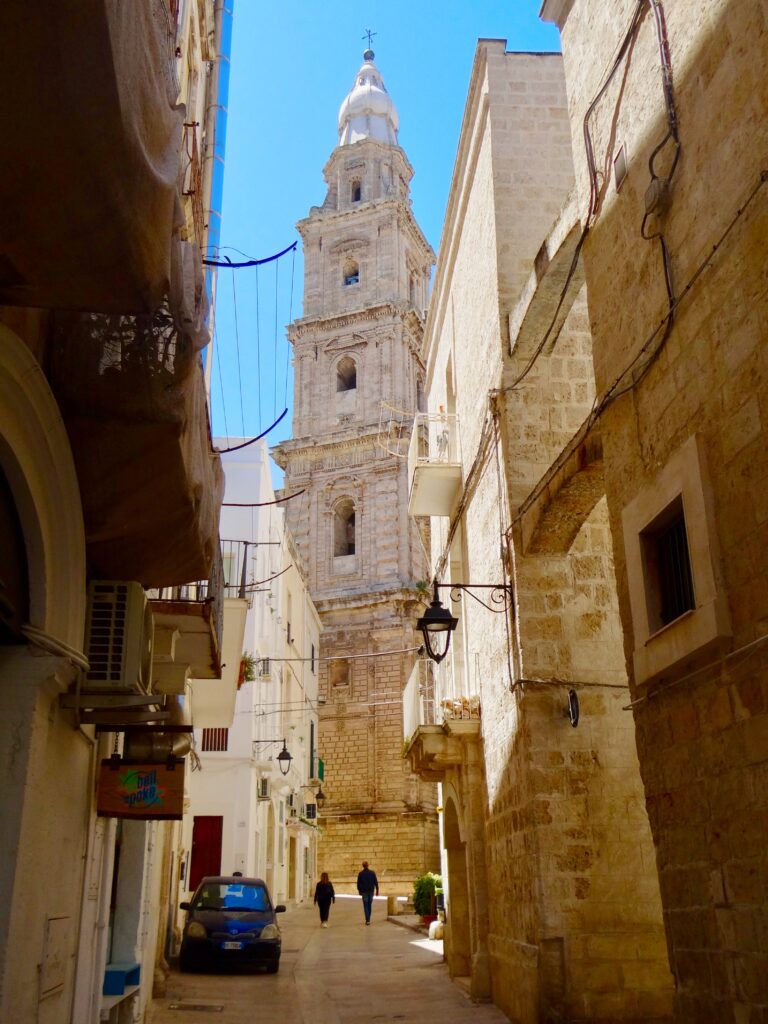
Monopoli is often called the “city of churches” — with more than 20 packed into its historic centre alone. As you wander the narrow streets, chapels and bell towers appear at almost every turn, each with its own story to tell. We’ve highlighted the ones most worth pausing at, and suggest a walking route that strings them together for a leisurely tour.
For those who want to dig deeper, we’ve also included a closer look at Monopoli’s most fascinating church — Il Purgatorio — with its macabre history of mummified “standing dead,” along with the Castle of Monopoli, a fortress-turned-noble residence that guarded the city for centuries. Together, they capture Monopoli’s blend of devotion, mortality, and defence — the three forces that shaped its historic core.
A walking route through Monopoli’s churches and the Castello di Carlo V
Start at the Cattedrale Maria Santissima della Madia, Monopoli’s spiritual heart. Step across to the nearby Chiesa di Santa Maria del Suffragio (Il Purgatorio), where the Triumph of Death portal and the “standing dead” tell stories of devotion and mortality.
From here, head towards the port to climb the broad steps of San Domenico, a fine example of baroque splendour. Continue to Santa Maria Amalfitana, one of Monopoli’s oldest churches with Romanesque roots, founded by Amalfitan sailors.
Loop back towards the seafront for San Francesco d’Assisi, with its asymmetrical façade and baroque interior. Follow the sea wall to the Cappella della Zaffara, a small chapel that once served seafarers, then on to San Salvatore, its fortress-like exterior hinting at its dual role as church and lookout post.
From here, follow the lungomare north to the castle of Monopoli (Castello di Carlo V), perched dramatically on Punta Penna. Explore its bastions, loggia, rock church, and restored halls — a reminder of Monopoli’s centuries as fortress, noble seat, and prison.
The full circuit takes around 90 minutes at a relaxed pace, not counting time spent inside churches or the castle. It’s the perfect way to absorb Monopoli’s layered history of death, devotion, and defence, all within its compact historic core.
Cattedrale Maria Santissima della Madia
The spiritual and architectural heart of Monopoli
Founded in the 12th century and rebuilt in Baroque style by 1772, the cathedral houses the revered icon of the Madonna della Madia. According to legend, the icon arrived miraculously in 1117, floating into the harbour on a raft of beams that were then used to complete the cathedral’s roof.
Piazza Tommaso Valeriano
Chiesa di Santa Maria del Suffragio (del Purgatorio)
A theatrical display of faith and mortality
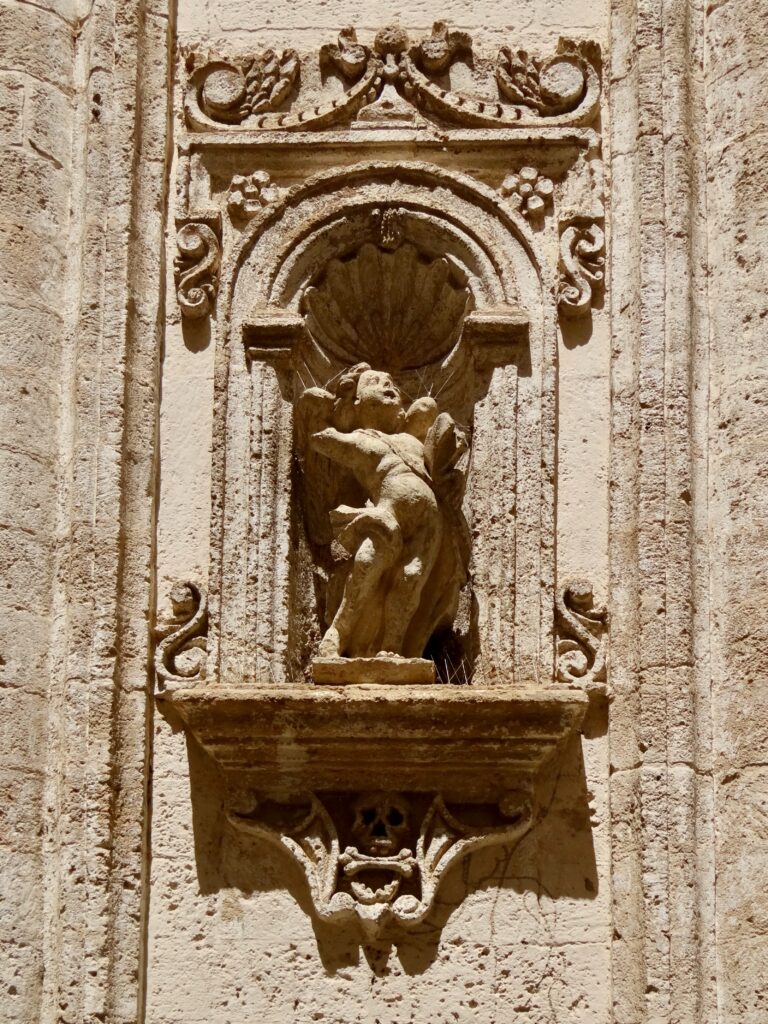
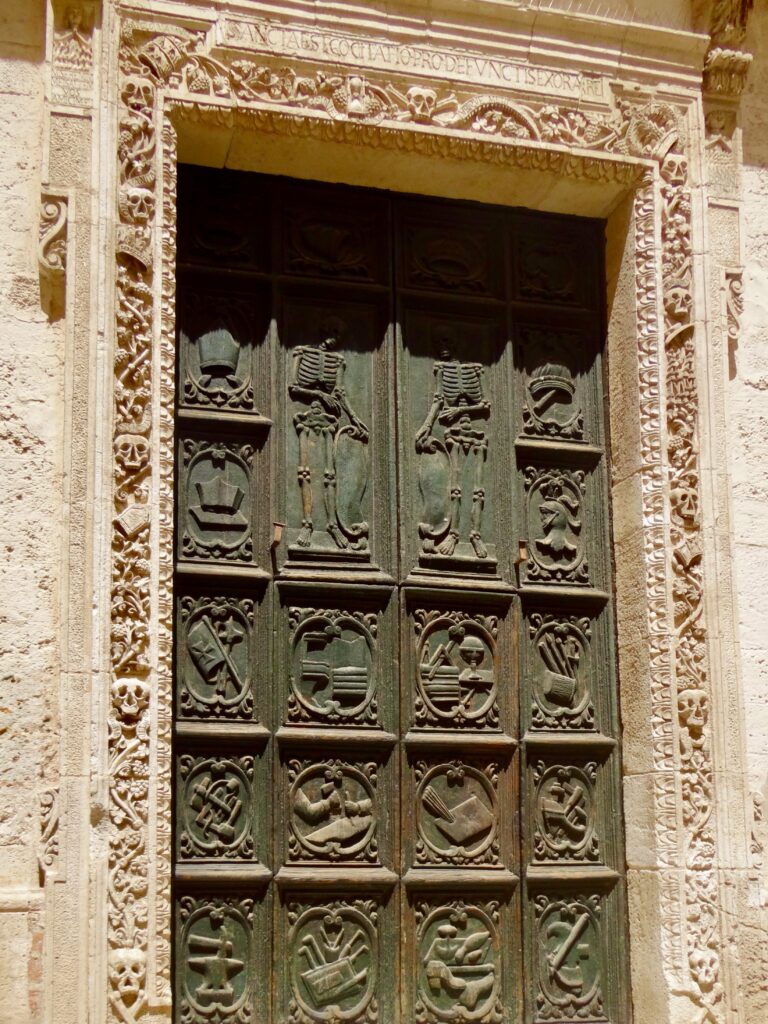
Built in the 17th century near the cathedral, this church is infamous for its eerie collection of mummified monks and noblemen on display. Founded by a confraternity that prayed for souls in purgatory, the interior is ornate and dramatic, with skulls and symbols of mortality carved into the façade.
Via Procaccia
Chiesa di San Domenico
Baroque splendour by the port
Set on a raised piazza with sweeping steps, this elegant church lies close to the harbour. Inside, richly decorated stuccoes and gilded altars speak of Monopoli’s baroque flourish.
Piazza San Domenico
Chiesa di Santa Maria Amalfitana
Romanesque roots and seafarers’ faith
According to tradition, Amalfitan sailors founded this church while fleeing Saracen raids. Its Romanesque features make it one of the oldest surviving churches in Monopoli.
Via Santa Maria Amalfitana
Chiesa di San Francesco d’Assisi
Baroque artistry by the sea
Rebuilt in the 1700s in Baroque style, this church is notable for its asymmetrical façade overlooking a quiet square near the seafront. The interior holds a collection of frescoes and religious artworks.
Piazza San Francesco d’Assisi
Cappella Santa Maria della Zaffara
A seafarers’ chapel on the sea wall
This small, round chapel stands beside the defensive walls. It once served Monopoli’s sailors, a lasting symbol of the town’s maritime devotion.
Lungomare Santa Maria
Chiesa di San Salvatore
A fortified church of the 12th century
Dating back to the 1100s, this church is notable for its stark, fortress-like exterior, hinting at a dual role as both a place of worship and a coastal lookout post.
Via San Salvatore
Death, devotion, and defence in Monopoli’s historic centre
The Church of Santa Maria del Suffragio (Il Purgatorio)
A window into baroque faith
Tucked along Via Argento in Monopoli’s historic centre, the Church of Santa Maria del Suffragio — more commonly known as Il Purgatorio — embodies the city’s baroque religious culture and its enduring confrontation with death.
Built in the early 1700s, the church is most famous for its wooden-panelled portal, the Trionfo della Morte (Triumph of Death). The door depicts a social pyramid overturned by mortality: symbols of power above, tools of labour below. At the centre, two skeletons mirror one another — one once a prince or cardinal, the other a pauper — reminding all who enter that death is the great equaliser.
Inside, the Latin cross layout holds five altars, the main one a baroque composition in Lecce stone. The high altar features a painting by Neapolitan artist Paolo De Matteis of Our Lady of Mount Carmel. A side garden leads to a crypt, once a confraternity burial chamber, where skeletal remains from the 18th and 19th centuries are still preserved in glass cases.
The Church of the Standing Dead
Il Purgatorio is sometimes called the “Church of the Standing Dead” because of the eight mummified bodies displayed upright in niches. These townsfolk — and one foreigner — died between 1172 and 1832. Originally buried under the sacristy, the remains were moved here after 1842, when burials in churches were banned. They remain a focus of devotion, especially in November, the month of the dead.
The Confraternity of Souls
Founded in 1668, the Confraternity of the Holy Souls in Purgatory (Anime Sante del Purgatorio) was born from a need to ritualise and confront death. Affiliated with Rome’s prestigious Archconfraternity of Santa Maria del Suffragio, it was granted the same privileges.
The confraternity’s original meeting place lay beneath the cathedral, but after the cathedral bell tower collapsed in 1686 — killing several — the brotherhood was allowed to build its own church on the site of the destroyed structure. By the Holy Year of 1700, part of the new church was complete, and the remains of deceased members were transferred to its crypt.
Members wore a green mozzetta (cape) symbolising equality before God. Beyond prayers, they also collected food and oil for the poor, ensured proper burials for members, and maintained strong devotion to the Madonna. Their emblem showed the Virgin with Child and a confraternity member pouring water over souls in Purgatory — a vision of mercy and intercession. Their most solemn observance was the Good Friday procession through Monopoli’s streets, honouring Our Lady of Sorrows.
Castello di Carlo V
From coastal fortress to noble residence
Rising on Punta Penna to the north of the old town, Monopoli’s medieval Castello di Carlo V once guarded the Adriatic shoreline. Originally outside the city walls, it was absorbed into the town during the 12th and 13th centuries. Its pentagonal form, corner towers and massive limestone tuff walls speak to its defensive power.
The south-western façade features the main entrance, later reinforced by a cylindrical tower with a drawbridge. Rosettes and arches decorate the upper edges. Traces of the old defensive walls are still visible nearby. The north-east side faces the sea, strengthened by a pentagonal bastion with a loggia and caditoie (machicolations). A carved coat of arms bears the date 1552 and the name of Don Pedro de Toledo, the Spanish viceroy who oversaw much of its enhancement.
A changing role
By the 17th century, renovations softened the fortress into a noble residence. In 1660 further reconstruction cemented its transformation from military stronghold to baronial seat. Later, in the 19th century, it became Monopoli’s district prison, a function it held until 1969.
Hidden treasures
Within its walls, the castle preserves layers of Monopoli’s history:
- The rock church of San Nicola de Pinna, founded in the 10th century by a Saxon nobleman.
- A mysterious arched doorway with a vertical slot, likely the oldest structure in the complex.
- A sloped medieval wall section in the L-shaped lower hall.
- A cistern chamber carved into earlier stonework, a rare survival of medieval infrastructure.
After mid-20th century neglect, the castle was carefully restored. Today it stands as a symbol of Monopoli’s layered identity: from seafaring republic to Spanish outpost, from fortress to prison, and finally a cultural landmark open to visitors.
Monopoli by festival
Festa della Madonna della Madia
Monopoli’s Maritime Miracle
Main feast days: 16 December, 14 August, 15 August (with additional celebrations in June)
In Monopoli, the sea delivers the Madonna not once, but three times — a miracle woven into the very soul of the city. The Festa della Madonna della Madia commemorates the legendary arrival of a Byzantine icon of the Madonna and Child, believed to have reached Monopoli on a wooden raft in 1117.
According to tradition, the raft carried not only the sacred image but also the beams needed to complete the roof of the city’s unfinished cathedral. The miracle is celebrated as both a moment of spiritual inspiration and the physical salvation of Monopoli’s most important building.
December: The Winter Celebration
The most solemn and moving festival falls on 16 December, the date of the miracle itself. Celebrations begin with a triduum of Masses and rosary prayers from 12–14 December, followed by a vigil on the 15th.
In the early hours of the 16th, a band procession starts at 4:00 a.m., winding through the silent streets. At Cala Batteria, where the raft is said to have landed, a prayer vigil is held as dawn breaks. A replica raft bearing the icon is guided into the old port by illuminated fishing boats, recreating the miraculous arrival.
At 5:30 a.m., a solemn procession retraces the icon’s path from the harbour to the cathedral, followed by an early Mass at 8:30 a.m. Services and celebrations continue throughout the day, ending with an evening concert and fireworks.
August: The Summer Processions
Summer visitors also witness the miracle, with twin processions held on 14 and 15 August, timed to coincide with Ferragosto, one of Italy’s most important holidays.
On the evening of 14 August, the Madonna is brought out of the cathedral and carried to the port in a candlelit procession. At nightfall, a replica raft once again brings the icon into the harbour, accompanied by flotillas of illuminated fishing boats and watched by thousands along the waterfront.
On 15 August, the celebration continues with a second procession through Monopoli’s old town and festive Masses. The August feast is less solemn than December’s — more of a summer spectacle — but it remains deeply rooted in the city’s identity and devotion.
June: The Commemorative Feast
In June, a quieter celebration marks the anniversary of the official recognition of the miracle by Pope Clement XI in 1718. Though less well-known, this commemoration reflects the enduring significance of the Madonna della Madia in Monopoli’s spiritual calendar.
The cycle of celebrations — December’s solemn dawn ritual, August’s vibrant Ferragosto processions, and June’s quieter commemoration — together make the Madonna della Madia not just a patroness, but the living heart of Monopoli. Few other towns in Puglia express their faith so dramatically, on land and sea alike.
Note: the timings given (such as 4:00 a.m. for the band procession and 5:30 a.m. for the land procession) are approximate starting times. This is southern Italy, where schedules are best considered “advisory,” to put it generously!
Using Monopoli as a smart base
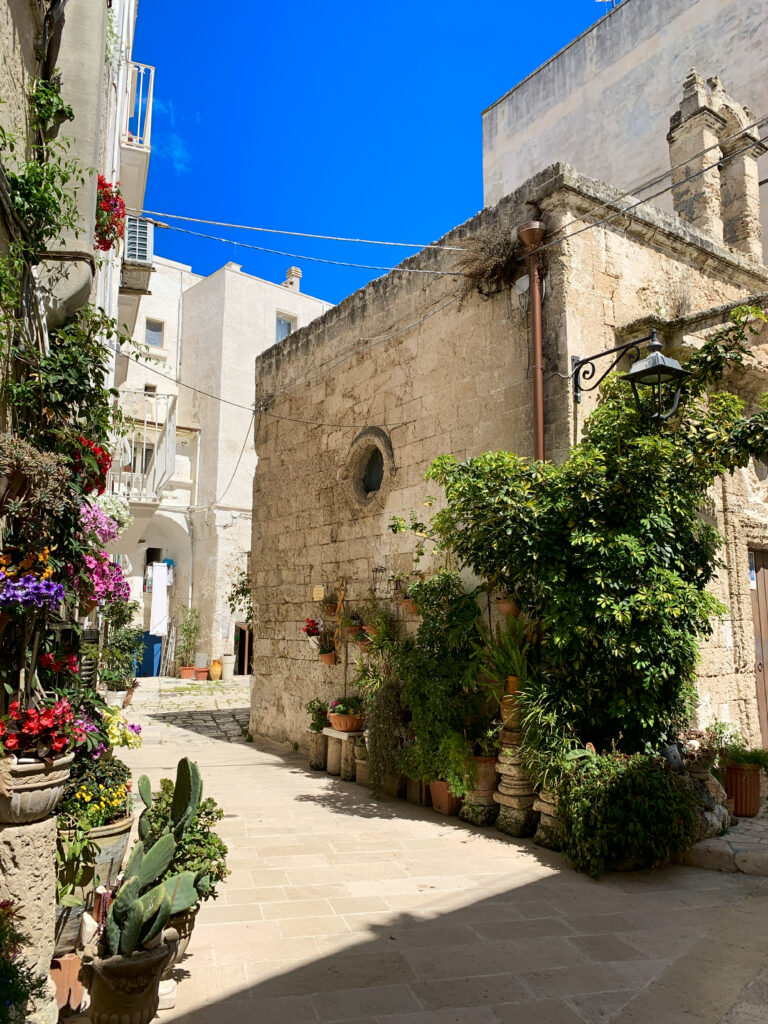
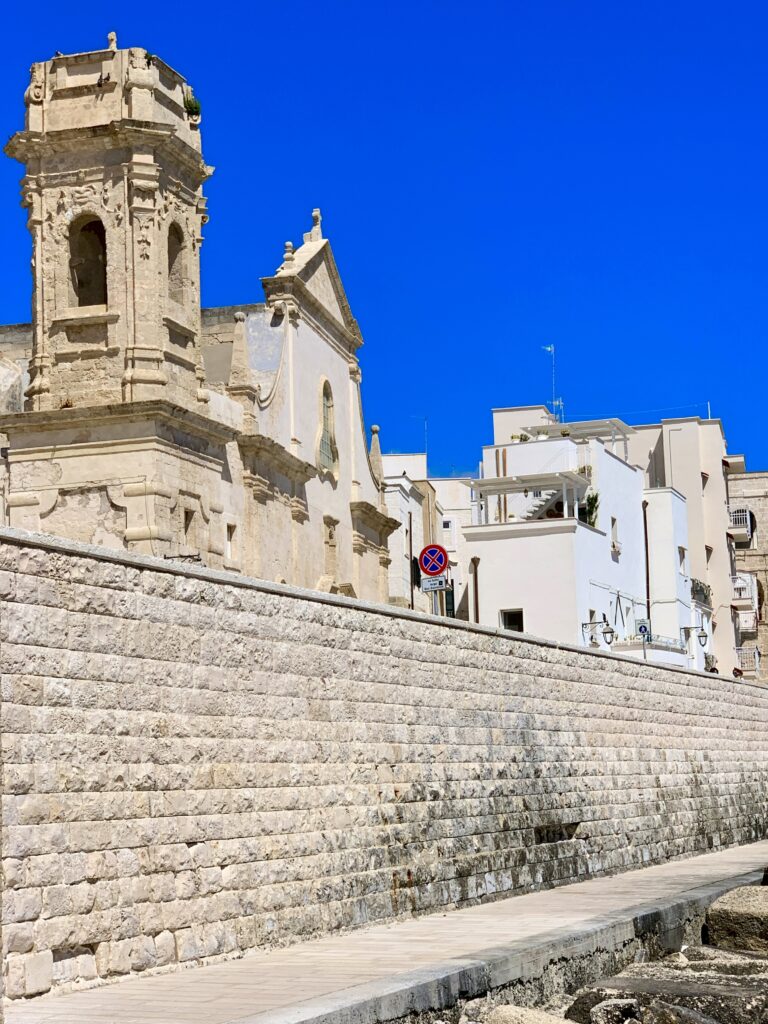
Monopoli works well if you want the sea on your doorstep and easy access to both the Adriatic rail line and the back roads of the Valle d’Itria.
- By train: Frequent, inexpensive services link Monopoli north to Bari and Polignano a Mare, and south to Brindisi and Lecce. Perfect for car-free day trips.
- By car: Inland towns like Alberobello, Locorotondo, Martina Franca and Cisternino are all within 30–40 minutes’ drive. Expect heavier traffic in summer, especially on weekends along the SS16.
Our golden rule? Don’t treat every town as a base. Choose one or two smartly located spots and explore from there. Monopoli pairs beautifully with a Valle d’Itria hilltown (Locorotondo or Martina Franca), or further south with Lecce or Galatina in Salento.
Why not Polignano? We love it, but Polignano is smaller, more crowded, and more expensive. Monopoli offers more space, a slightly less curated old town, better-value food and accommodation — and it’s only 5 minutes away by train if you want to dip into Polignano’s scene (and iconic Lama Monachile beach).
For more on planning your trip, see our Best Bases in Puglia Guide and Puglia Itineraries Guide.
Day trips from Monopoli
One of Monopoli’s greatest strengths: as a smart base for central Puglia and the Valle d’Itria, it’s exceptional. It avoids the worst of the overtourism that now affects Polignano and Alberobello, while still putting them within easy reach. The following are all comfortable day trips by car:
- Polignano a Mare (10 min) — spectacular clifftop old town; go early or out of season to avoid the worst crowds
- Egnazia (15 min south) — atmospheric Roman and Messapian ruins on the coast, often overlooked. The remains include city walls, necropolises, roads, and mosaics. The museum is small but excellent.
- Fasano and Savelletri (20 min) — Savelletri is a charming fishing village with a cluster of seafront restaurants, many specialising in raw seafood (crudi di mare). Fasano, inland on the slopes of the Murgia, is surrounded by olive groves and masserie, and makes a good base for agriturismo stays.
- Castellana Grotte (25 min) — Puglia’s most dramatic cave system, worth at least two hours
- Valle d’Itria Back Roads – Head inland towards Alberobello, Cisternino, and Locorotondo. While Alberobello is UNESCO-listed, it’s also the busiest town in Puglia; trulli are scattered all across the countryside, so you’ll see plenty on the back roads without facing the tour-bus crowds. Driving between Savelletri, Torre Canne, and Cisternino, you’ll pass UNESCO-protected dry-stone walls, millennia-old olive groves, and winding lanes perfect for cycling or walking.
- Alberobello (30 min) — the trulli capital; iconic and unmissable, but genuinely very busy in summer
- Locorotondo and Cisternino (30–35 min) — beautiful whitewashed hilltowns at the heart of the Valle d’Itria; Cisternino in particular for the bombette from the macellerie
- Ostuni (40 min) — the White City; impressive skyline, Its narrow lanes and viewpoints make it a rewarding day trip by train or car.
What Italian visitors say
Italian visitors, particularly those from other parts of the country rather than local day-trippers from Bari, offer a useful perspective on Monopoli that complements our own experiences. Their views are clear and consistent.
What they love
- Authentic everyday life: The quality most consistently praised by Italian visitors is that Monopoli still feels like a real town. The working harbour, the morning fish market, the local families in the piazza at golden hour – these are the details Italian travellers notice and value, and which they feel have been lost in Polignano, Alberobello, and high-season Ostuni.
- Exceptional day-trip position: Italian travellers with cars unanimously describe Monopoli as one of the best-positioned bases in central Puglia – close to everything, without being in the thick of the tourist hotspots itself.
- Food and value: Italian reviewers consistently find Monopoli’s restaurants offer better value than Polignano, with a wider range of options from honest family trattorie to genuinely ambitious contemporary kitchens. The mareterra culinary tradition – the blend of Adriatic fishing culture and Valle d’Itria countryside cooking – is specifically praised.
- The centro storico: The combination of the Porto Antico, the lungomare, the Castello di Carlo V, the labyrinthine old town, and the 20-odd churches is described repeatedly as a ‘spectacular’ ensemble, particularly striking in the morning before the crowds arrive.
What they caution about
- Beach overcrowding: The most consistent complaint from Italian visitors. The Capitolo beaches in particular get extremely busy in July and August, and the central town beaches are small relative to demand. Several Italian forum threads specifically address the 4am arrival phenomenon for Capitolo’s free beaches in summer 2025.
- Restaurant consistency: Italian reviewers are more discerning than international visitors about the gap between restaurant reputation and actual delivery. Several notes about dishes arriving cold, or a kitchen performing unevenly between visits, particularly at the busy traditional trattorie. The general advice: read recent Italian-language reviews carefully rather than relying on aggregate scores.
- High-season crowds and prices: While Monopoli remains better value than Polignano, Italian visitors note that it has lost some of its previous ‘hidden gem’ status. Accommodation in particular gets expensive in July and August, and the town can feel pressured at its busiest.
- The maestrale: Experienced Italian coastal visitors flag the north wind as a factor that can affect beach days on the Adriatic, and recommend having a fallback plan (typically a drive to Gallipoli or the Ionian coast) for blusterous days.
Practical Information
When to Visit
May, June, and September are near-universally recommended by experienced Italian visitors as the ideal months. The weather is warm and settled, the sea is swimmable, the restaurants are fully open, and the town retains some ease. July and August are hot, crowded, and expensive – Monopoli is at its most intense, though also its most lively. October and April are quieter still, cooler, and ideal for focussing on food, architecture, and the inland day trips.
Where to Stay
The centro storico is the obvious first choice: staying within the old walls puts you close to the Porto Antico, the best restaurants, and the evening passeggiata. Book as early as possible for July and August. Trullo rentals and masserie in the Valle d’Itria, 15–30 minutes’ drive away, offer an excellent alternative base if you want countryside character and cooler nights, with Monopoli as a day-trip destination.
Getting Around
Within Monopoli itself, the centro storico is entirely walkable – indeed, most of the old town’s streets are inaccessible by car. For the beaches at Capitolo and day trips into the Valle d’Itria, a car is strongly recommended. Taxis are available but should be booked in advance in high season.
Language and Practicalities
Italian is the working language of Monopoli; English is spoken at most restaurants and hotels in the tourist areas, less reliably everywhere else. As elsewhere in Puglia, cash is useful for smaller transactions, though most restaurants and shops now accept cards. The main post office and pharmacy are near Piazza Vittorio Emanuele II.
Car rental in Monopoli – quick guide
Monopoli punches above its weight for local car rental options, with two standout independent operators backed by substantive review evidence across multiple platforms. We have not used these services. But we are often asked for suggestions, and this section is based on our researches, interviews and feedback.
Rent Here is the clear top recommendation. Google reviews are consistently 5-star, with reviewers across multiple nationalities singling out Sergio and Cosimo by name for their professionalism, friendliness and fluent English. Insurance is included in the rental price with no hidden costs – a significant differentiator from the major chains. The location in the heart of Monopoli’s centre is a practical advantage, just minutes on foot from the train station and close to the historic walled quarter. Reviewers specifically highlight the absence of the stressful scratch-checking games common at larger operators when returning the car. Debit cards accepted; no credit card required. The obvious choice for anyone based in or passing through Monopoli.
Central Monopoli | renthere.it
Rental Cars Monopoli is a solid second option, particularly useful for those arriving by air. They offer delivery directly to Bari and Brindisi airports as well as Monopoli train station and home delivery, with transparent seasonal pricing published clearly on their website. Reviewers praise the owner Elena for helpfulness and flexibility, including accommodating last-minute bookings. Minimum rental is three days, so less suitable for short stays. No credit card required.
Monopoli | rentalcarsmonopoli.com
Mancini Rent (based in nearby Polignano a Mare) is worth mentioning as a third option, since they operate collection and drop-off points in Monopoli as well as their own offices, giving access to the region’s highest-rated local operator with the added flexibility of picking up in one town and returning in another.
Polignano a Mare | mancinirent.com
More
Planning your trip? These guides will help:
- Our Best Base in Puglia Guide – how to choose smartly and avoid changing accommodation too often
- Puglia Itineraries Guide – plan trips across the region, from Valle d’Itria loops to Salento road trips
- Bari City Guide – day trip or overnight stop at the region’s capital
- Eat Bari – where and what to eat in Bari
- Spaghetti all’Assassina – our step-by-step guide to Bari’s cult pasta dish

Hi guys,
Just wanted to share my feedback after finding your page. We recently stayed in Monopoli and based on your feedback on this page, we chose to dine at il Punto Cardinale – Trattoria al Borgo.
While the menu has changed, the food and service was absolutely fantastic and one of our favourite restaurants so far (we’ve been travelling 6 weeks).
Thanks to your page, we are very happy travellers & eaters!
Grazie – we appreciate the feedback. Glad you enjoyed your experience at Punto Cardinale. One of the reasons we like it is that their menu is seasonal and changes, depending on the produce available. It sounds like you had a great time all round.
Buona sera mi chiamo Rodolfo De Biaggi sono un cittadino italiano di origine puglise residente a Los Angeles CA USA da molti anni. sono adesso in pensione ho visto la vostra pagina web sono rimasto molto impressionato complimenti!!!!! vorrei ritirarmi in Puglia e sto cercando una citta tipo Brindisi o come Monopoli vicino al mare vorrei sapere se potete consigliare o approfondire un po di piu come ottenere informazioni tipo affitti negozi se ci sono supermercati ambulatori medici o ospedali vicinoect ect vi ringrazio e vi saluto cordialmente
rodolfo
Ciao Rodolfo,
Thank you for your kind words about our website, and for reaching out. We write about Puglia as a travel destination, but retirement brings with it very different considerations.
For example, the weather: whilst our winters are not “cold” in the sense of snow and ice, they are long, wet and damp. Because of the humidity, the “feels like” temperature can be just 2–4°C, and that damp chill can be difficult to live with. Away from the main cities, smaller towns often go into a kind of hibernation compared with the summer – bars and restaurants may close, festivals stop, and daily life can feel much quieter. There can be little to do. That’s why we often joke that in Puglia there are only two seasons: estate, e non-estate.
We did speak to a real estate investor who shared some perspectives on retiring to Puglia, and we wrote about that in an article. The piece is password-protected, but if you drop us an email we’ll gladly share the password with you. The key takeaway is to be prepared for winters that are less pleasant than you might imagine – wet, damp, and without the summer vibrancy.
As for practicalities, cities such as Brindisi, Monopoli, Bari, Lecce and Taranto all have supermarkets, shops, doctors’ surgeries and hospitals. The difference comes down to scale and services: in smaller towns you may find the basics, but for specialist medical care or a broader range of shopping you will need to travel to the nearest provincial capital.
On retirement, we are not experts and its not our field. But we hope that gives you some food for thought.
LuigiM.