

When is the best time to visit Puglia?
Puglia may be known for its postcard-perfect beaches, whitewashed towns, and olive grove-studded landscapes, but choosing the right time to visit is key to getting the best from Italy’s heel. While each season has its charm, your experience of the region can vary dramatically depending on when you come. Here’s a detailed breakdown of what to expect – from weather and crowd levels to local life and activities – so you can decide the best time to visit Puglia.
Understanding Seasonality in Puglia
When deciding when to visit Puglia, three factors really matter: weather, tourist numbers, and whether your chosen destination is open for business.
From November to Easter, life in much of Puglia slows right down. Away from the main cities (and to a lesser extent, Monopoli) many restaurants, bars, and masserie close or reduce their hours. The region slips into hibernation mode. For visitors, the experience changes dramatically. There’s less open and less happening: fewer dining options, reduced transport options.
Puglia is, at heart, an outdoors destination. Its appeal lies in long lunches eaten al fresco, evenings spent in lively piazzas, and time on the coast or in the countryside, not in museums or galleries — which, with a few notable exceptions, are not our region’s main draw.
We live in Puglia all year round and provide practical tips on getting around, cultural insights and unique local experiences. Follow us on Instagram for frequent video stories, reels, photos, ideas and other information to inspire your stay in Puglia.
The Puglia Podcast
The real divide: summer and “not-summer”
We joke that Puglia only really has two seasons: estate and non-estate — summer, and not-summer.
From November to Easter, life shifts indoors. The weather turns cold and damp — the kind of chill that seeps through stone walls and straight into your bones. Even when daytime highs hover around 10–13 °C, humidity makes it feel far colder. Rain is frequent, skies stay grey, and daylight is short.
It’s not just the weather. Once the clocks go back, smaller towns and popular destinations fall quiet and the buzz of al fresco life fades away. Beach clubs, popular masserie and private rentals close. Many of our favourite bars and restaurants reduce their hours or shut completely until spring.
A shift toward year-round travel
Puglia’s tourism follows a familiar pattern: a spring awakening, crowded beaches in July and August, quieter roads by mid-September, and a long winter sleep that lasts until Easter.
The regional tourism authority wants to change that. Destagionalizzazione — extending the visitor season beyond summer — is now a strategic priority, with efforts to promote the olive and grape harvests in autumn, winter festivals and Christmas lights in the villages, and spring cycling and hiking routes when wildflowers blanket the countryside. Puglia wants to be a destination for all seasons. And while its most authentic side can often appear outside the summer crush, the reality doesn’t yet match the ambition.
Tourist numbers
Visitor numbers peak over July and August, dropping either side, with a significant reduction in tourist numbers between August and September. If you want to avoid crowds August is best avoided.
These are the official tourism statistics from PugliaPromozione. Arrivi = number of tourist arrivals. Presenze = number of overnight stays.

The full extent of seasonality is also reflected in the low number of tourists (for the reasons we have explained) visiting in January, February, March, November and December.
Winter in Puglia (November–March): quiet, damp, and chill-to-the-bone cold
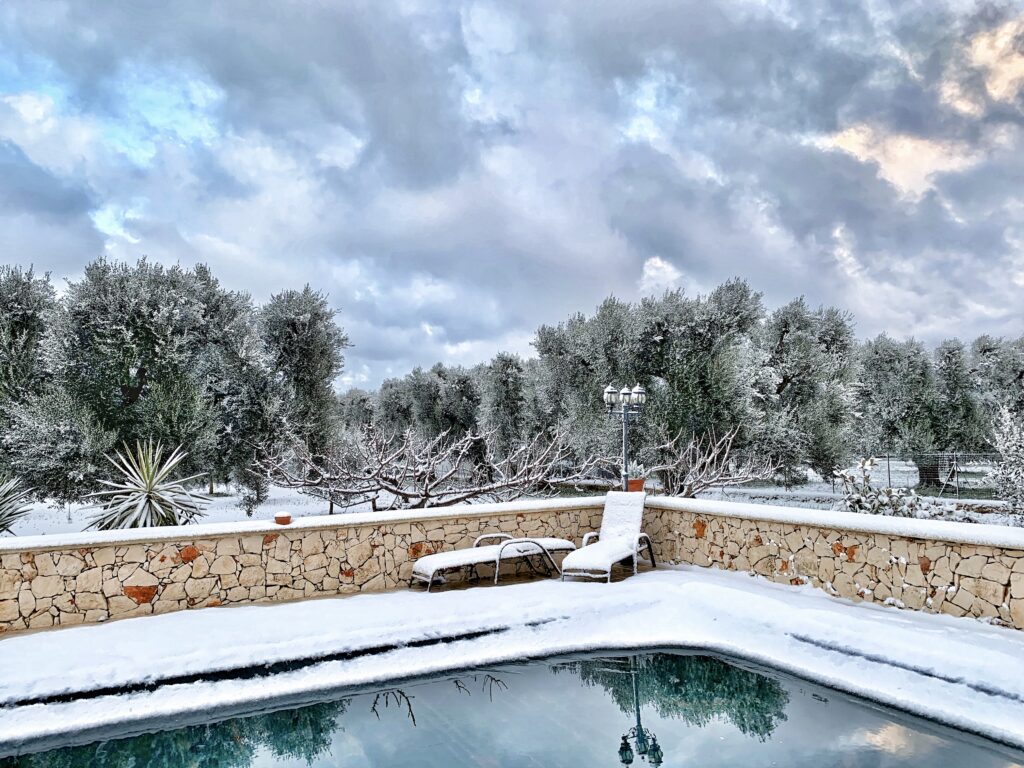
The off-season begins in earnest around early November and lingers until Easter.
While “Southern Italy in winter” might sound mild, the damp cold can surprise first-time visitors. Humidity clings to Puglia’s limestone towns, where the chill seems to settle inside you. “Feels like” temperatures can drop well below the thermometer reading, particularly when the wind blows in from the Adriatic.
This is also the wettest part of the year, with around 10–12 rainy days per month. Days are short, evenings long and quiet. By January, many towns feel almost deserted, their shutters closed tight. February sometimes brings a few clear, sunny days when you can lunch outside — but only when the sun shines.
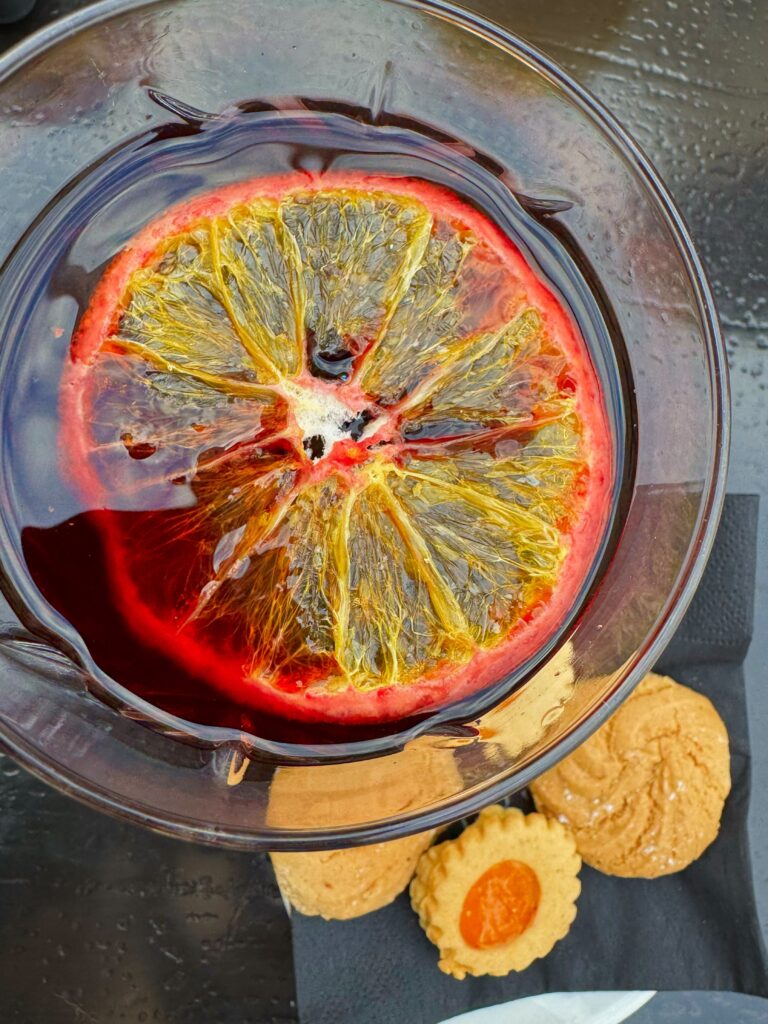
This is a time for a short city-break stay, rather than an extended visit to tour around the region. A time for vincotto, and festive Christmas lights that bring a cosy magic to the old town. Just remember to wrap-up warm!


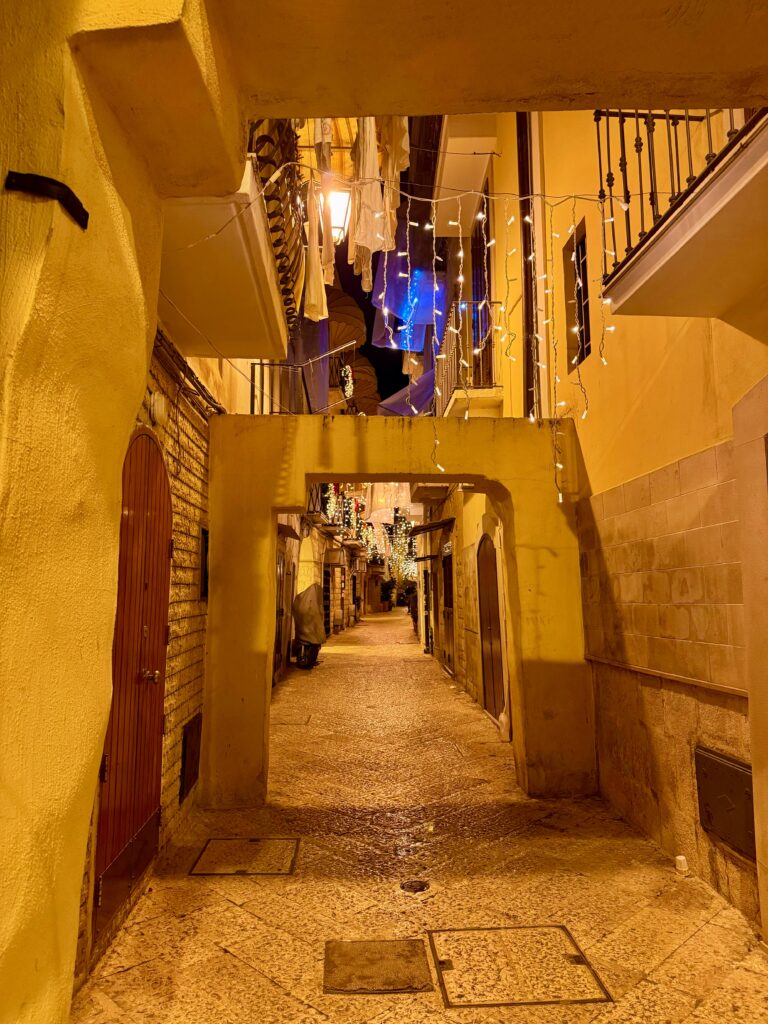
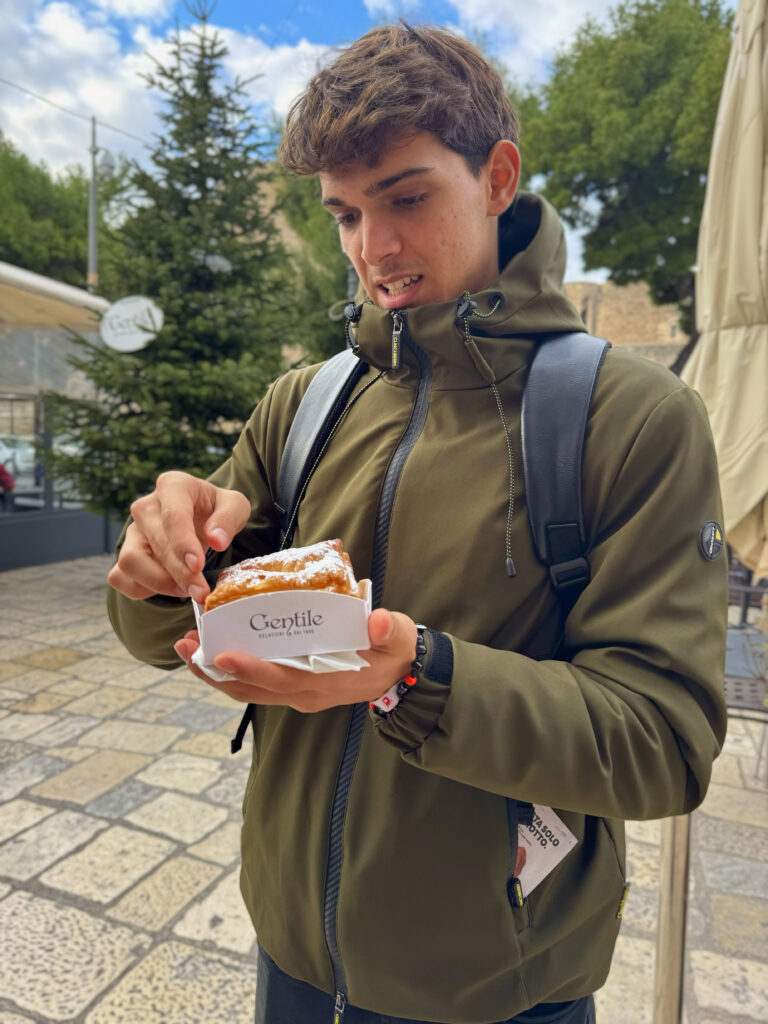
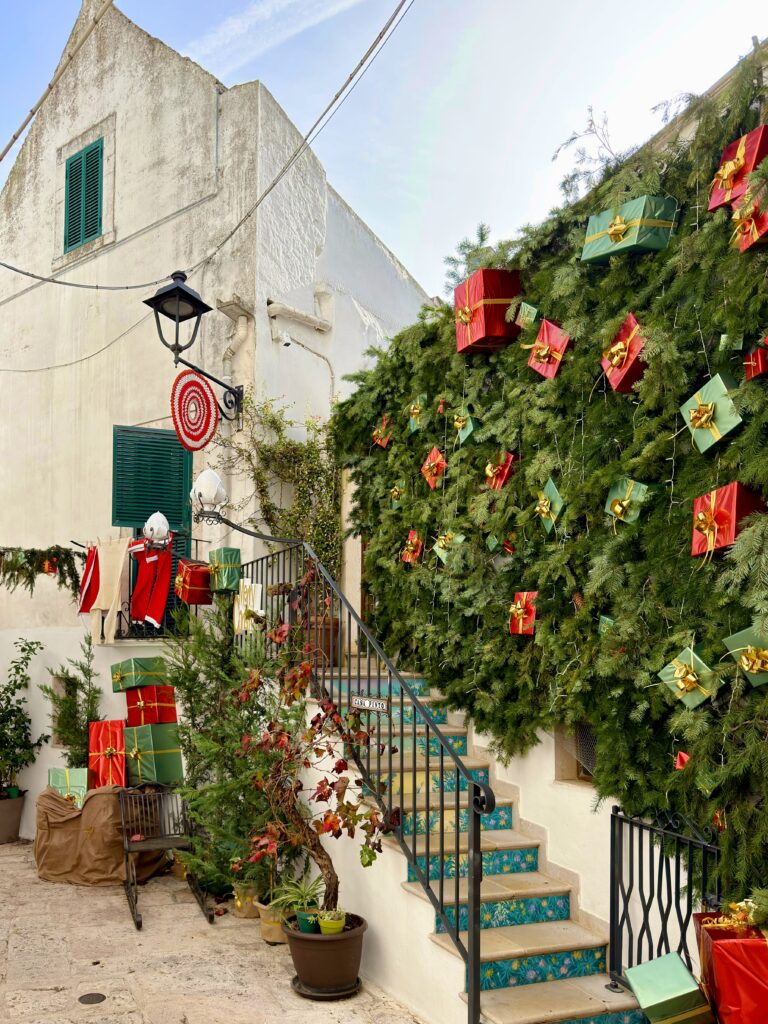
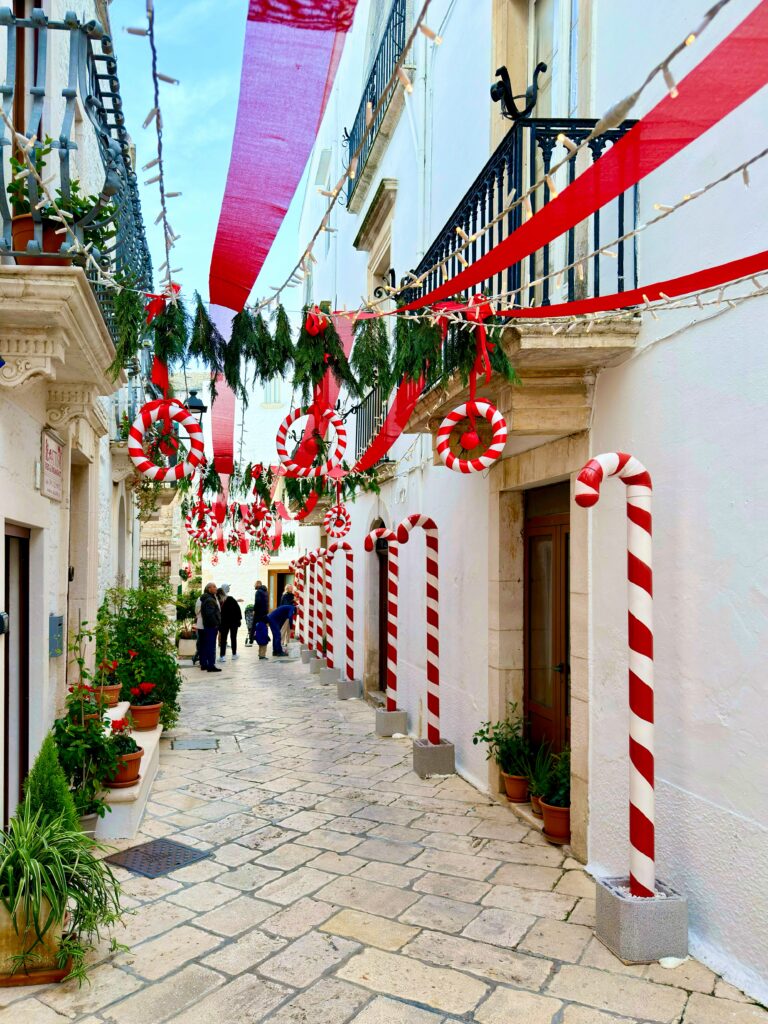
Away from the main cities, towns that buzz with life in summer — Polignano a Mare, Gallipoli, even Ostuni — can feel ghostly as tourist-facing businesses shut down or operate on reduced hours.
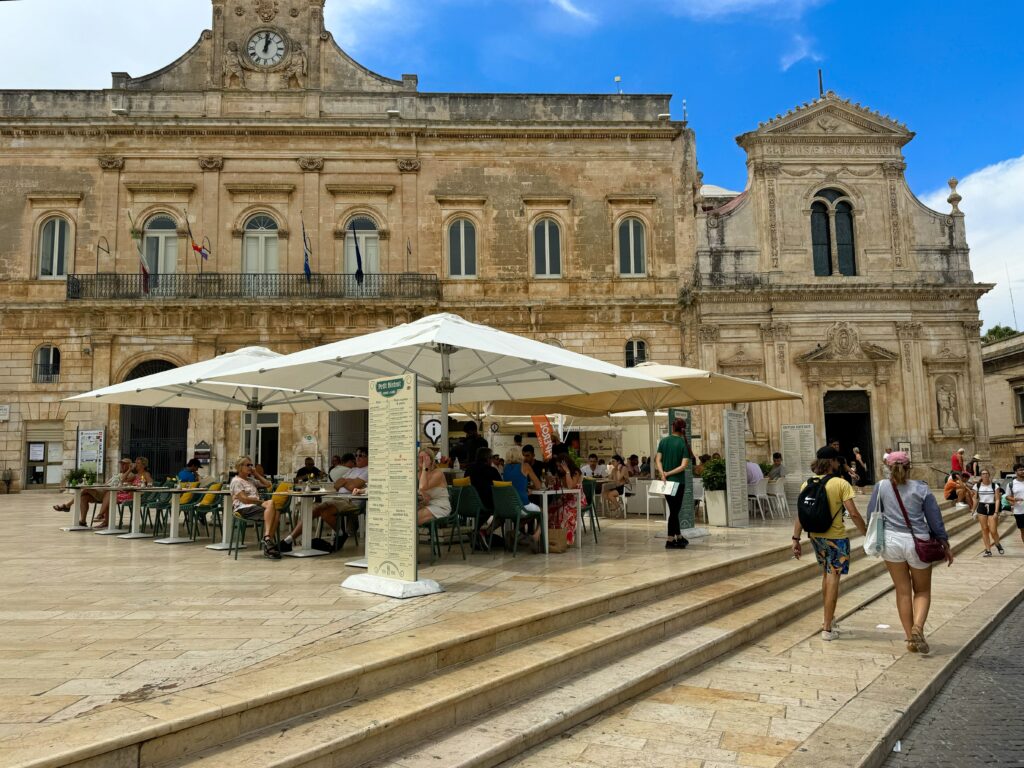
From Easter to October, Ostuni’s main piazza and surroundings are packed with restaurants, bars and gelaterie open late into the night. By December, only one restaurant and a couple of bars remain open — mostly empty, since locals tend to socialise elsewhere. We often see visitors wandering the empty piazza — often in the rain — puzzled that everything seems closed, wondering where everyone has gone. Life moves indoors, behind closed doors into kitchens, homes and family gatherings.


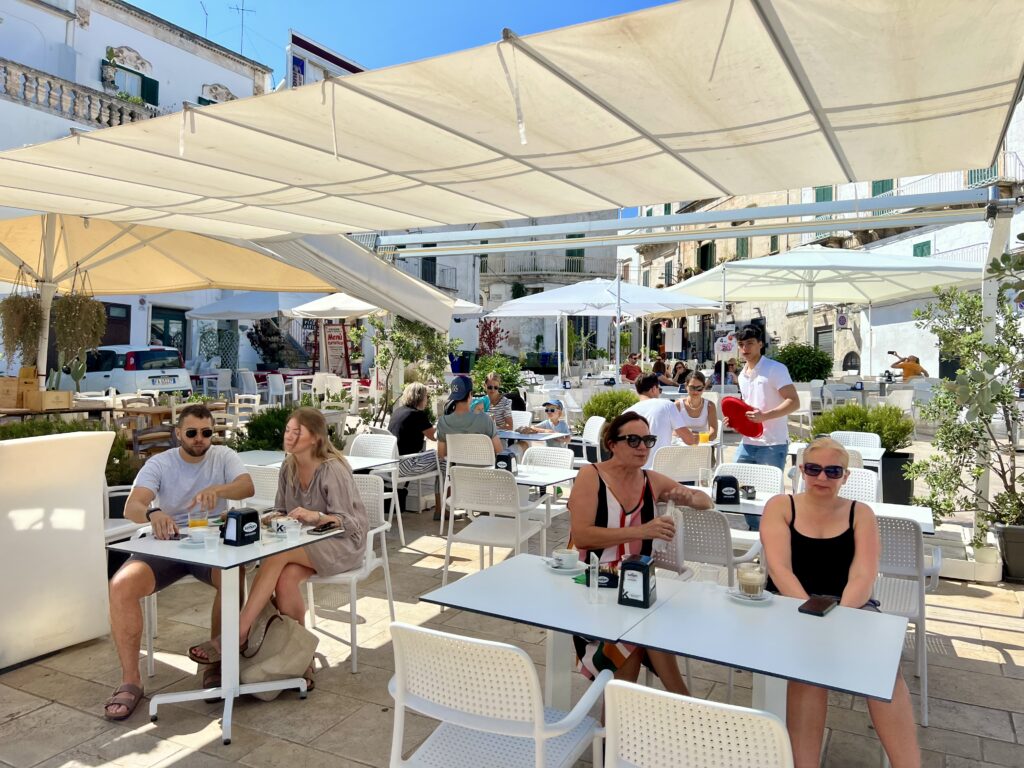
Bari Vecchia — the lived-in old town — stays vibrant, with bakeries, butchers, pasta shops, grocers and trattorie open as usual. It’s a wonderful time to explore the narrow streets, follow the scent of simmering ragù di braciole, and settle into a warm trattoria for a slow lunch. From there take a day-trip to Matera, or enjoy an overnight stay. Monopoli, feels a little more lively, and is still worth a day-trip from Bari.
Likewise, Lecce offers a similar year-round appeal with its baroque architecture, and still lively cafés. Taranto’s old town is still well-worth visiting. Locorotondo over the festive period (mid-November to 6 January) is well-known for its Christmas lights and is especially lively.
Monopoli and Gallipoli can still be interesting places to visit.
Apart from visiting churches, fewer indoor activities are on offer. Puglia isn’t museum-rich. Notable exceptions are Taranto’s Museo Archeologico Nazionale (MaRTA) — one of southern Italy’s most important Magna Graecia collections — and Brindisi’s small but excellent Museo Archeologico Provinciale Francesco Ribezzo.
Beyond that, limited cooking classes, wine and olive oil tastings may be available. Otherwise time is spent lingering in cafés and trattorie.
Weather snapshots
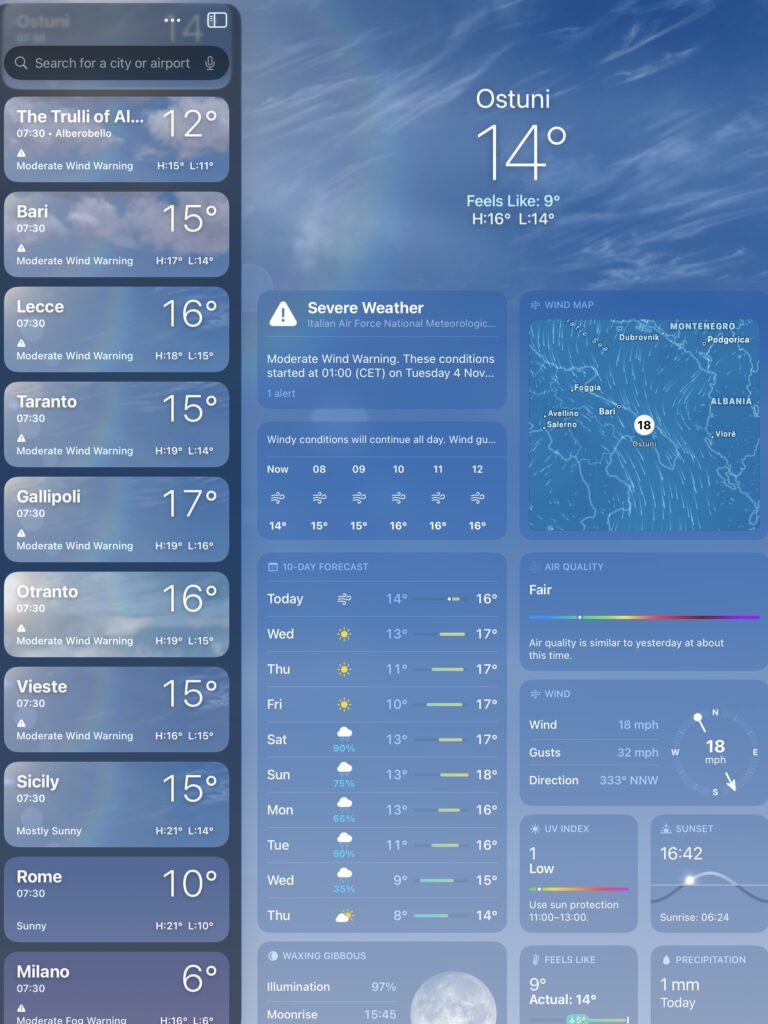
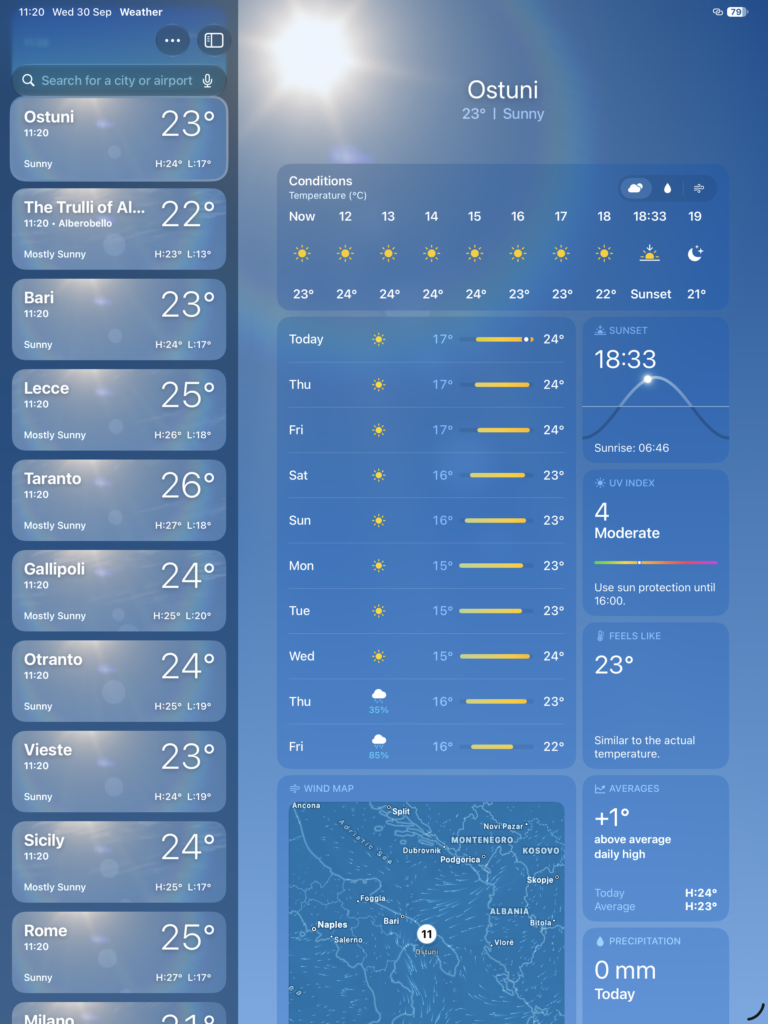
The main temperature shown is that at the time the screenshot was taken – check the high and low for the maximum and minimum daily temperature, and the 10-day forecast.
4 November 2025
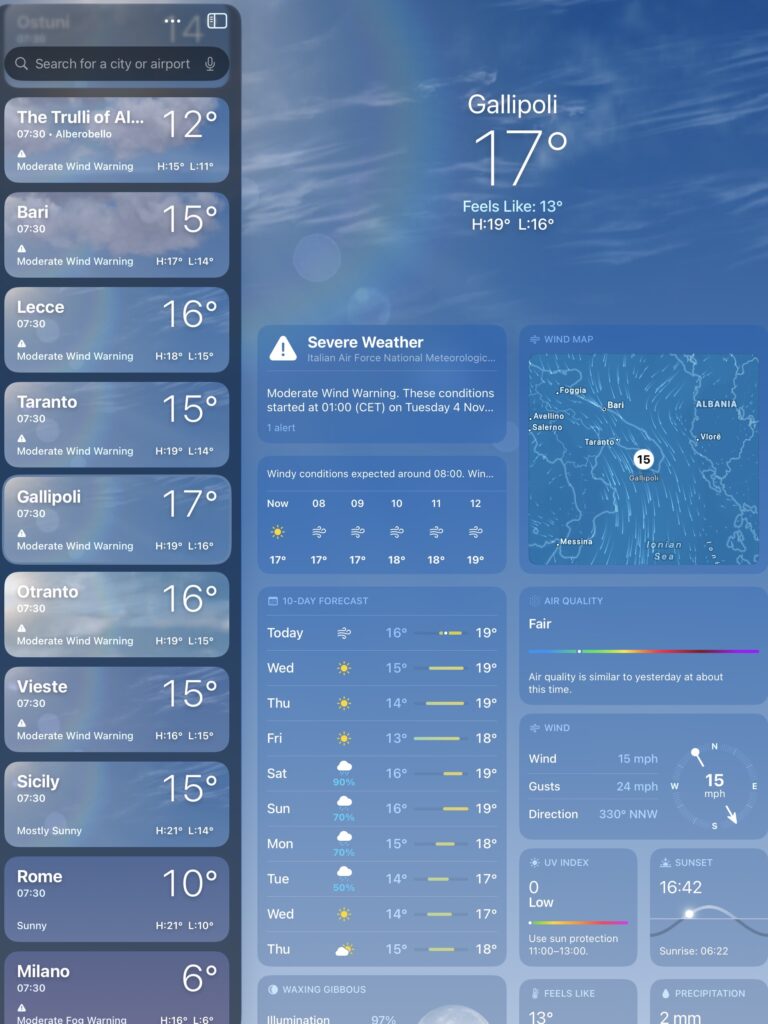
16 November 2025
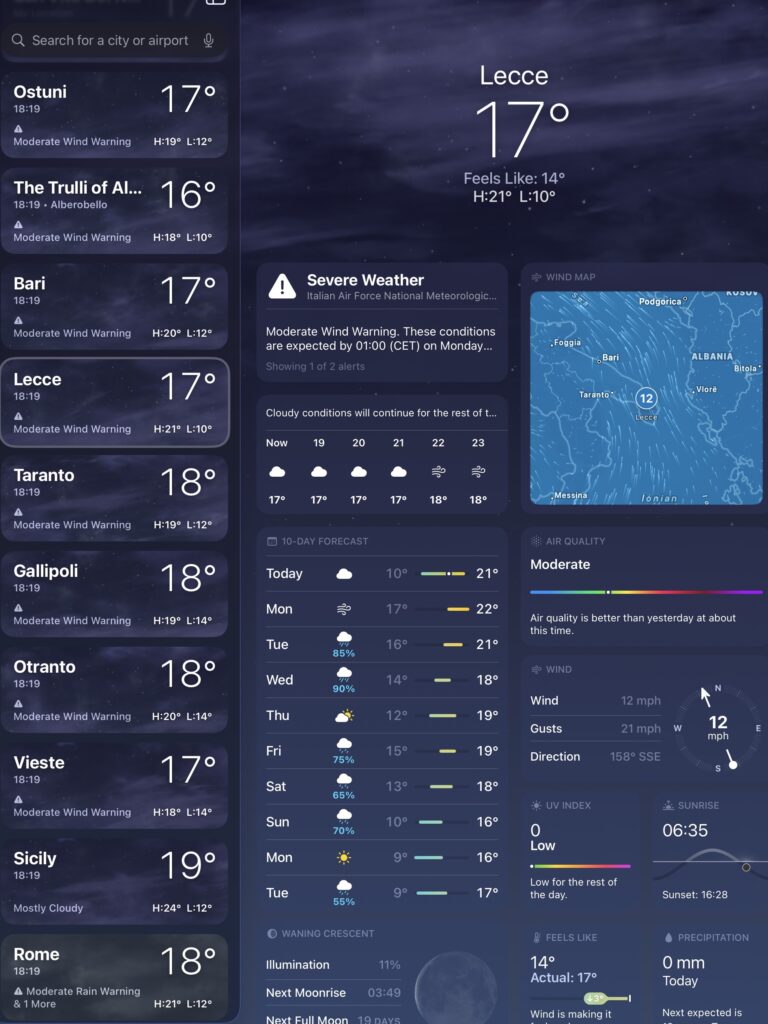
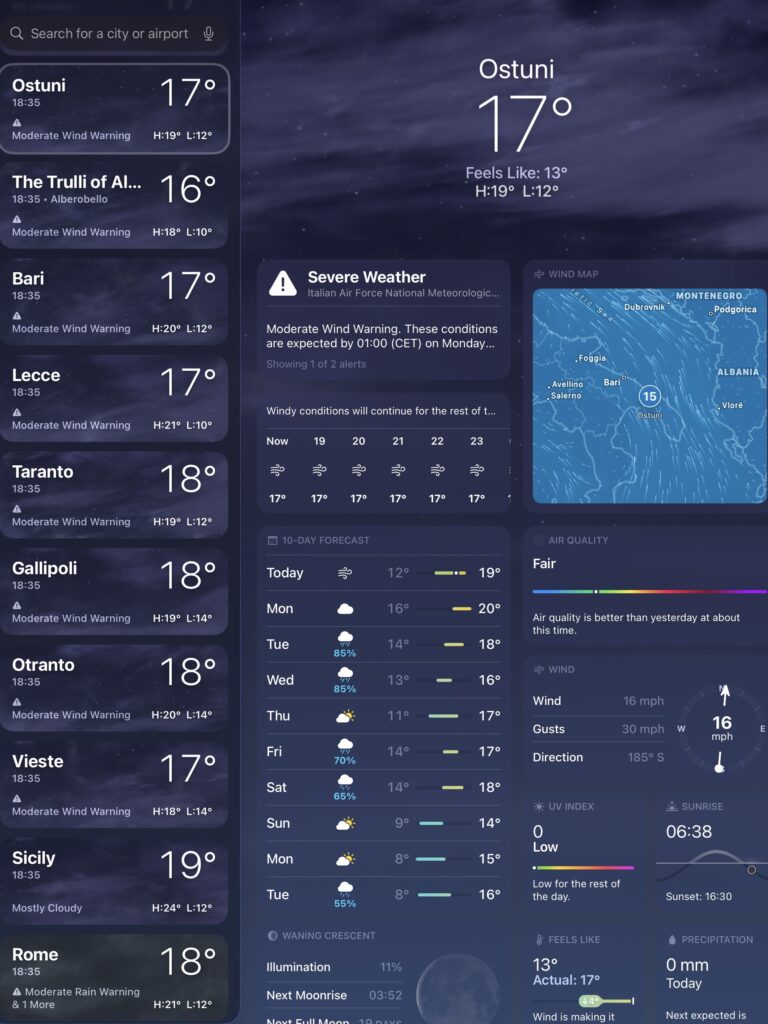
15 December 2025


29 December 2025


12 January 2026


25 January 2026
Severe weather ahead, and plenty more rain forecast!


1 February 2026
Plenty of rain still forecast, and some more severe weather alerts! But when the sun shines, the light is brighter and it definitely a little warmer (though not in the shade).


12 February, 2026
More severe weather alerts, and more rain!


25 February 2026
Finally, extended periods of sunshine, with more to look forward to. Yesterday in Ostuni we sat on a small piazza in full sun for lunch.


11 March 2026
After warming up a little, and some sun, temperatures will be dropping mid-March. It still feels cold, and damp. The heating is on 24/7 at our Ostuni HQ at the moment.
1 April 2026
And so, the last of our weather screenshots, as we come to the end of a year’s worth of them (we loop back to April 2026 below). And we end as we started, with more rain! And there’s another severe weather warning alert sent by SMS:
Allianz Allerta Meteo: Pioggia in aumento, attesi ulteriori 60-100 mm | 31/03 10:00 – 02/04 08:00
Allianz Weather Alert: Rainfall increasing, another 60-100 mm expected | March 31, 10:00 AM – April 2, 8:00 AM
For those who have been reviewing the weather over the past year (end March 2025 to April 2026), and looking at the non-summer months, we are told that this has been Puglia’s wettest winter for many, many years. For us, it really is only in the last few weeks that it has felt like this. Otherwise November to February for us was a wet and damp (humid) Puglia winter, like any other!


Christmas in Puglia

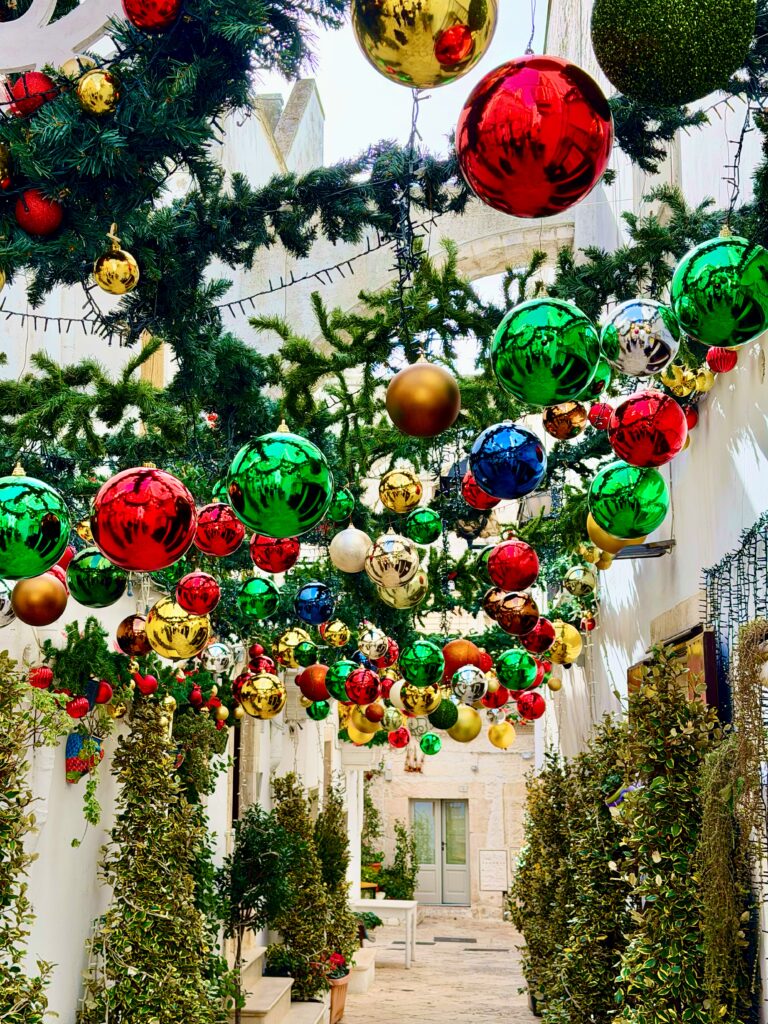
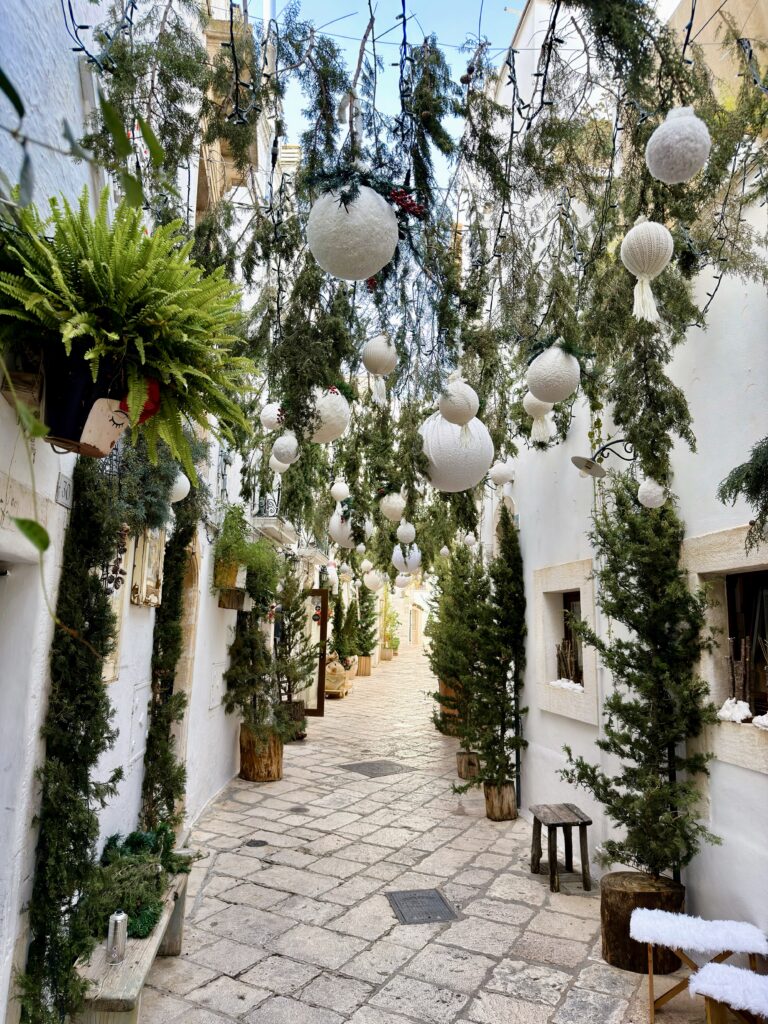
From late November through early January, towns and villages across Puglia light up for Christmas — quite literally. The region has developed an informal rivalry for the most spectacular festive displays, particularly around the Valle d’Itria and along the Adriatic coast.
Locorotondo’s whitewashed old town becomes a glowing maze of lights and decorations. Polignano a Mare draws local visitors for its luminarie di Natale, when tunnels of light transform its streets and seafront terraces. Alberobello joins in too, illuminating its trulli with colourful projections.
We recommend staying in Bari’s old town or visiting Lecce for a winter city break. Here, life continues as usual, the narrow old streets taking on a cosy charm, the inviting smells of trattorie drifting, tempting us with warm hostelry and delicious food.
Locorotondo’s small and compact centro storico is lively. The town buzzes with Italian visitors from mid-November through to 6 January, and is certainly worth considering for a more intimate stay.


Carnevale in Puglia
Carnevale takes place across Puglia in the three weeks ending on martedì grasso (Fat Tuesday). The most famous in Puglia – and also the oldest in Italy, 632 years in 2026 – is in Putignano (from 29 January to 17 February 2026).


Across the region many local bars, restaurants and delicatessens close for annual ferie (vacation) around mid-January, or just after carnevale, coinciding with the start of Lent, adding to the sense of smaller towns and cities around Puglia being in hibernation.

Spring in Puglia (April–June): warming up nicely
The best time to visit Puglia?
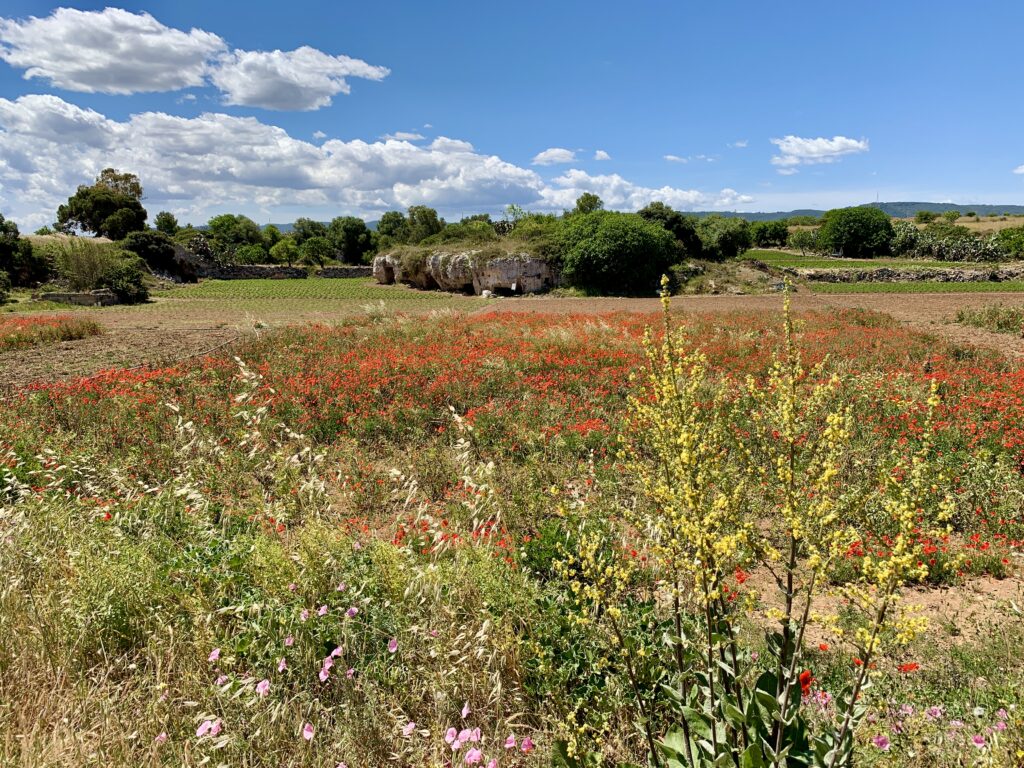
Spring is certainly one of the most pleasant times to visit Puglia. By April, the days start to lengthen a little, and the countryside bursts into colour with wildflowers and almond blossoms. May and June are particularly lovely—dry, sunny, and warm without being oppressively hot. Expect temperatures in Ostuni to range from 18°C in early May to 28°C by the end of June (as we write this we are experiencing highs of 33°C in the shade). Humidity is low, and sea breezes keep coastal areas comfortable.
The sea starts to become swimmable by mid-May and is usually pleasant by June. Importantly, these months are also relatively crowd-free. You’ll find most towns beginning to open up again, but without the crush of peak-season tourism. Restaurants, beach clubs, and shops are welcoming visitors, but there’s still space to breathe and enjoy.
Insider tip: Before late May, many lidos will still be closed. Beach clubs and lidos in Puglia typically open in mid to late May, with full operation running from June 1st through September 30th. While peak season is July and August, many establishments remain open until mid-October, weather permitting. Public beaches are accessible all year round.
The best time to visit Puglia for: Active holidays (walking, cycling), photography, relaxed beach days, and local festivals starting to reappear.

Easter in Puglia
Weather snapshots
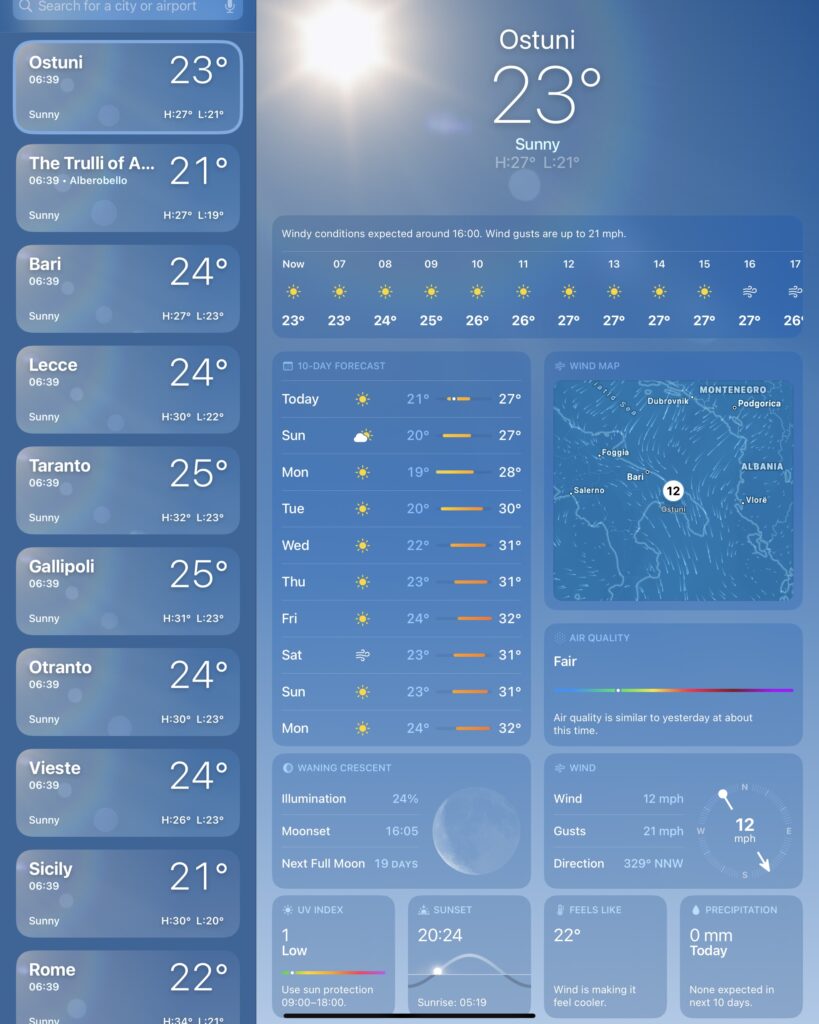
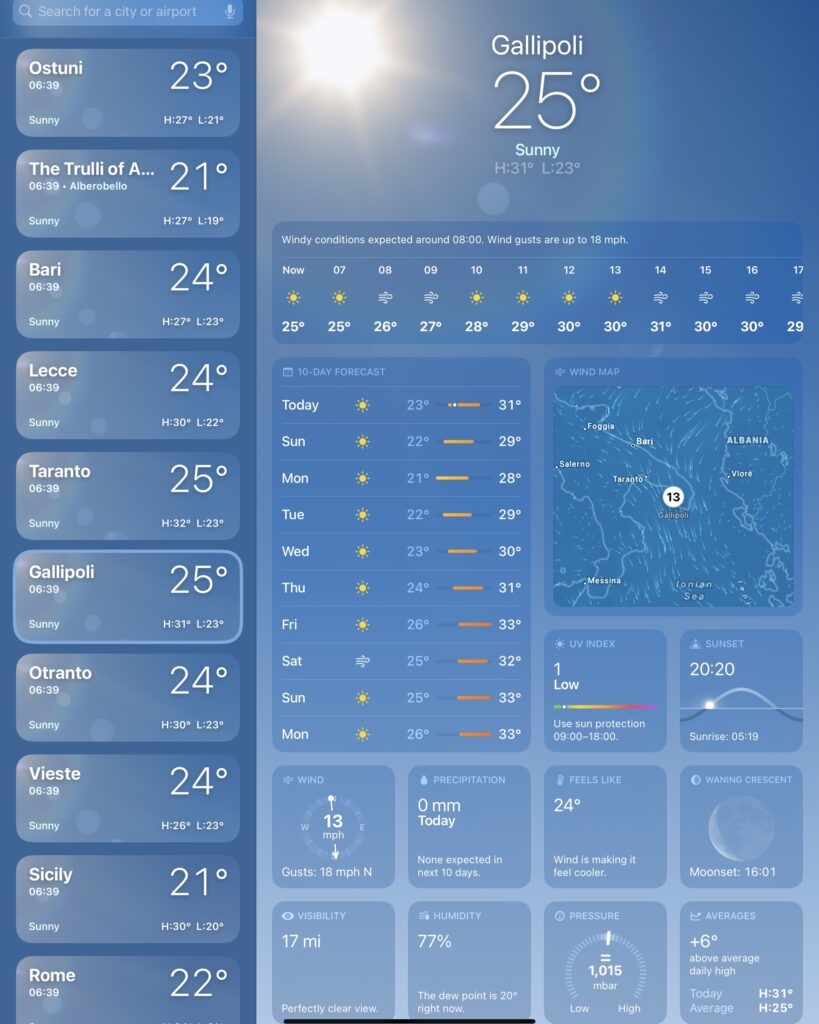
The main temperature shown is that at the time the screenshot was taken – check the high and low for the maximum and minimum daily temperature, and the 10-day forecast.
23 March 2025
Note the “feels like” differential. The humidity makes the actual temperature feel much colder: 4°C in Alberobello. And the damp chills to the bone!
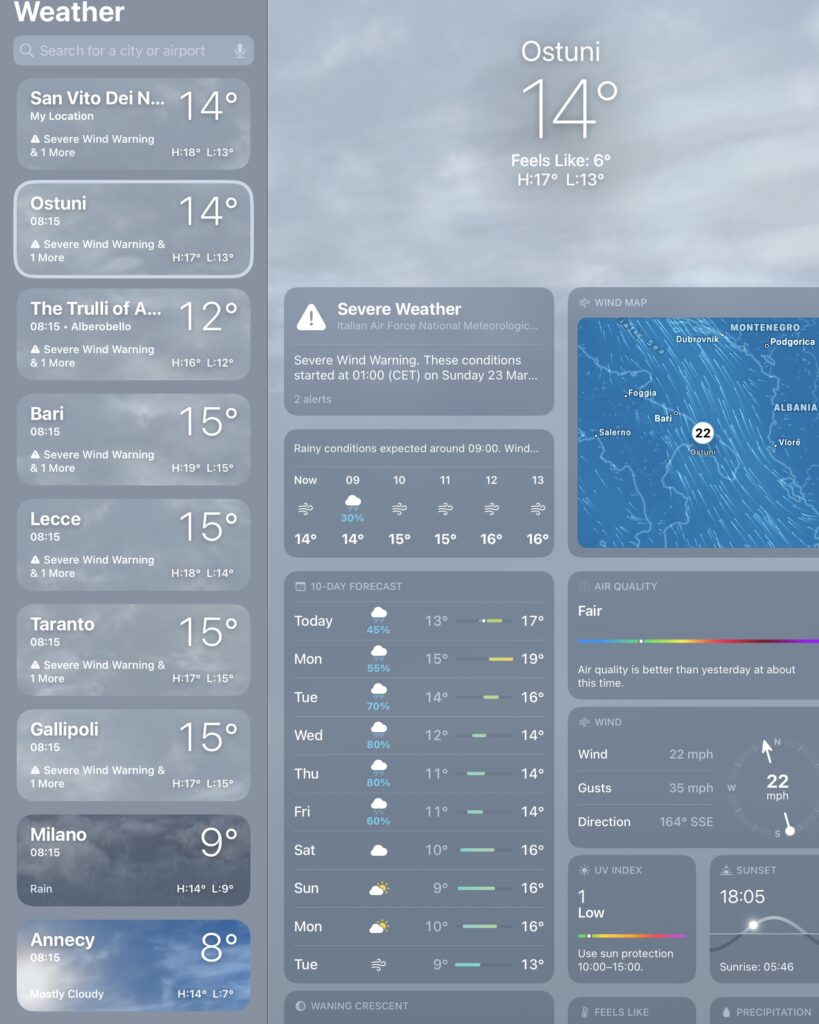
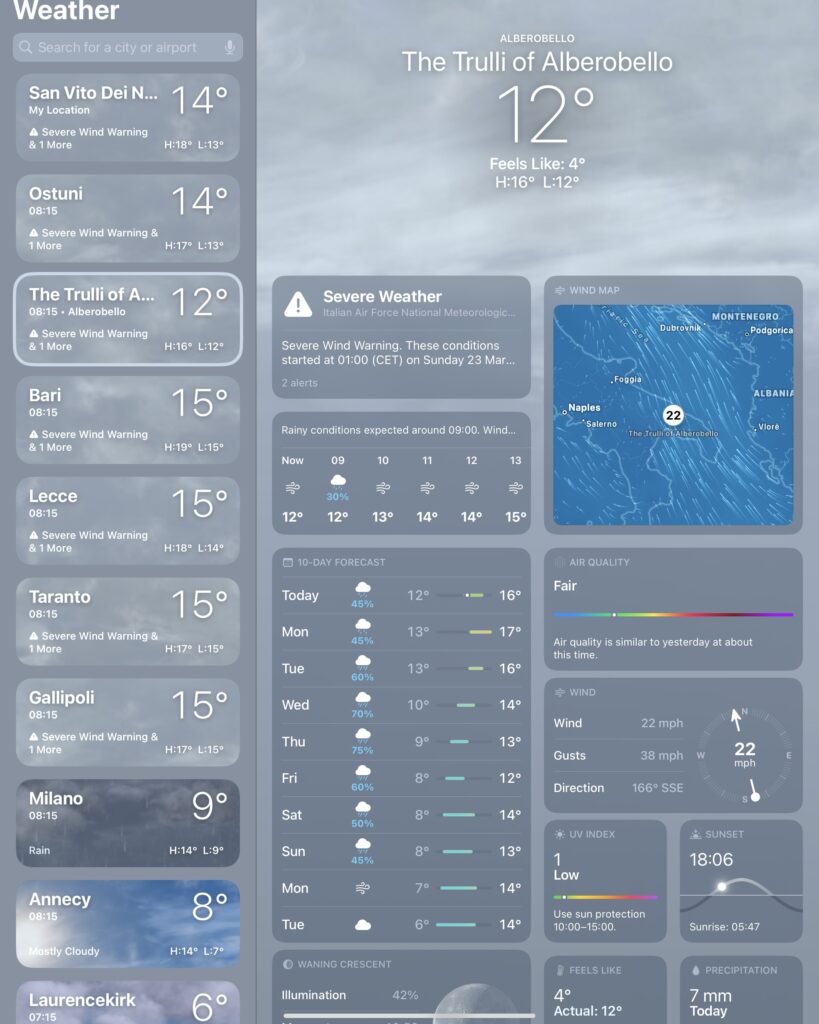
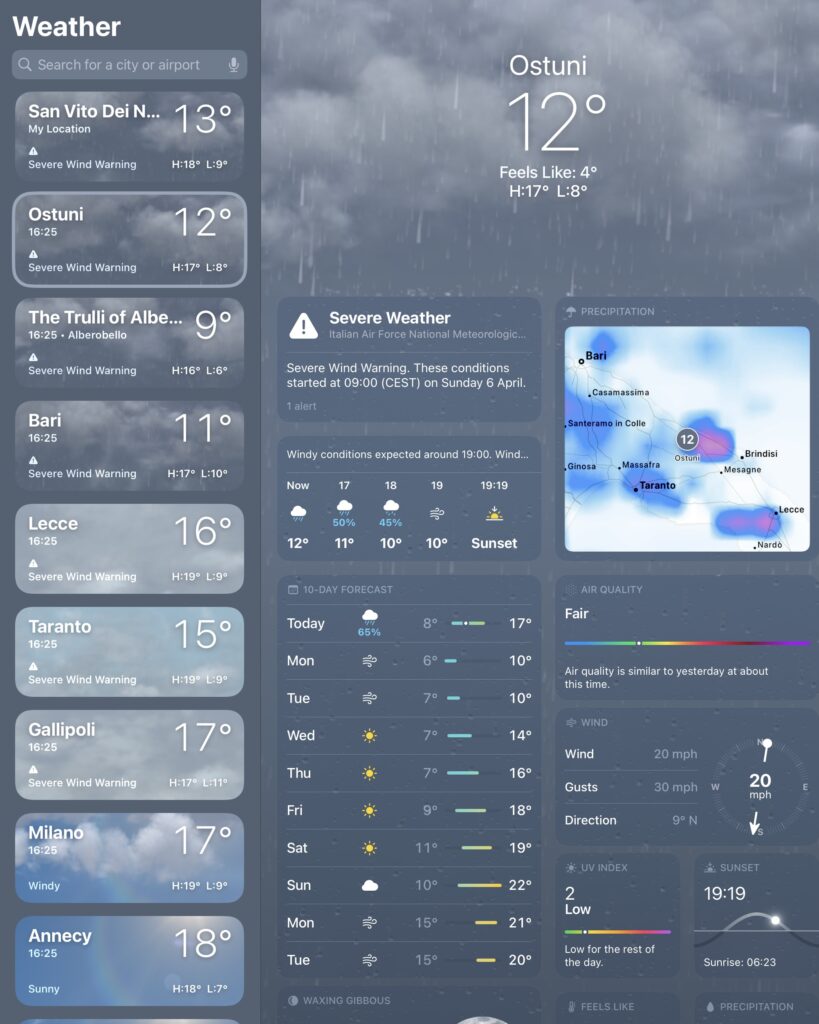
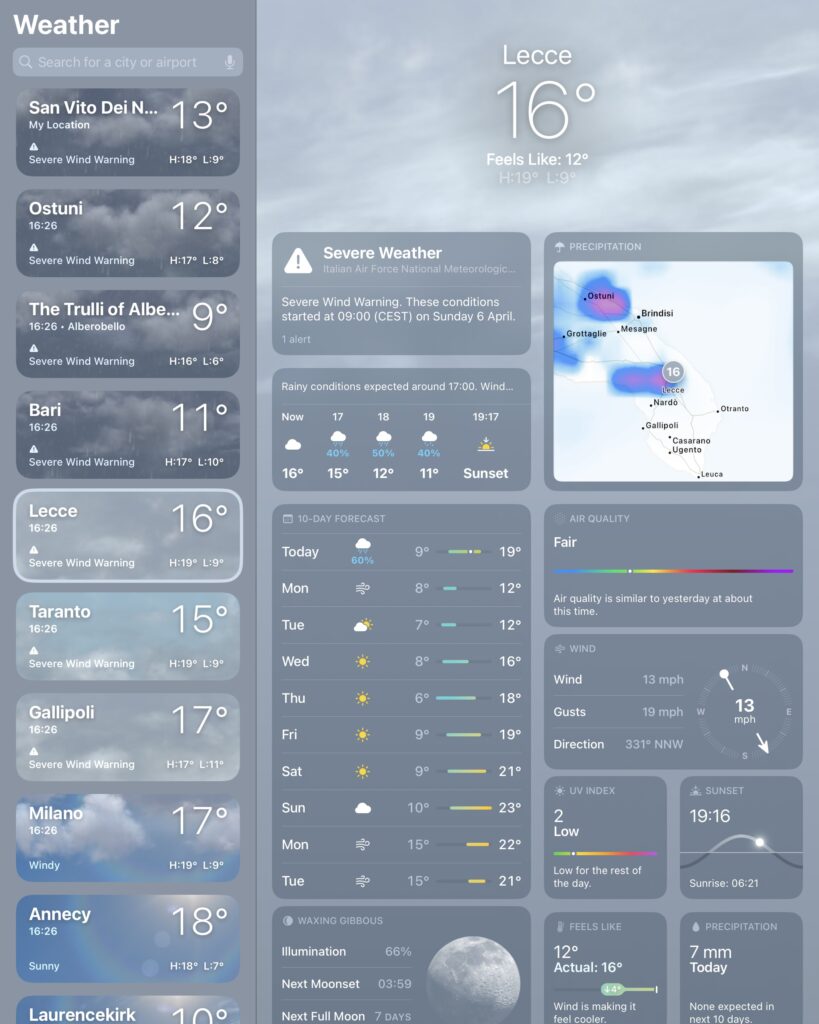
6 April 2025
April showers, with humidity once again making it feel much colder feel than the actual temperature in Ostuni (12°C feels like 4°C). Further south the weather is warmer.
26 April 2025
Forward forecast for the week ahead promises sun and warmer weather (finally)!
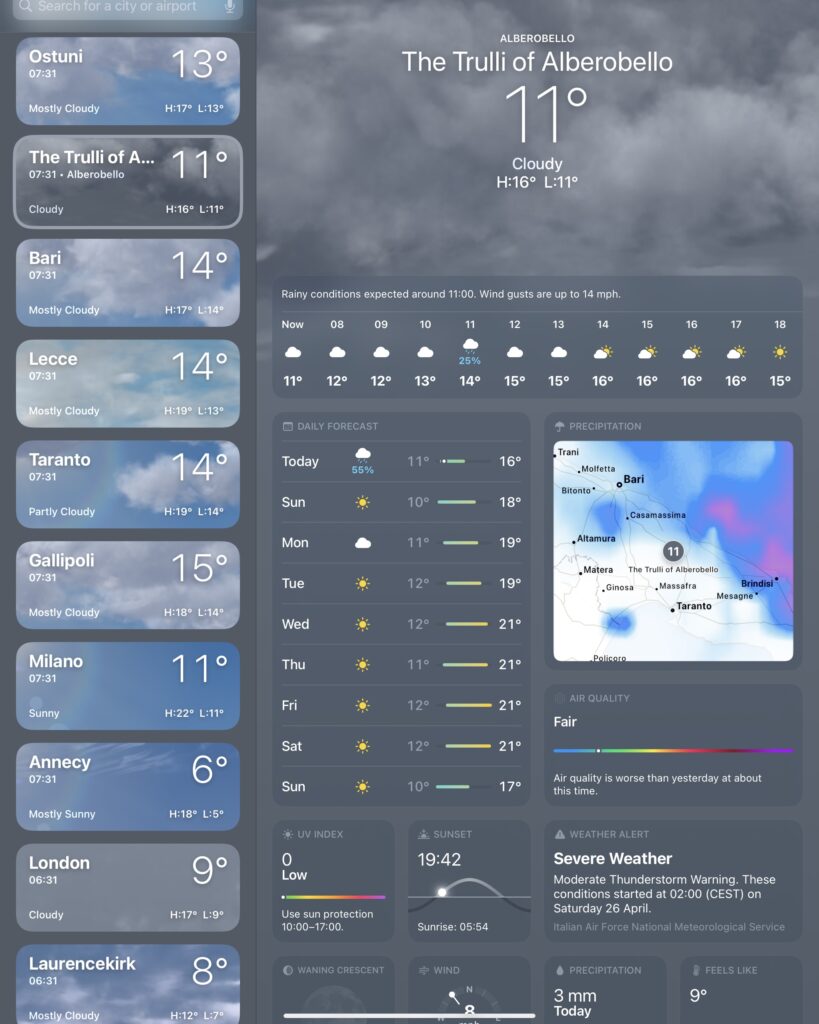
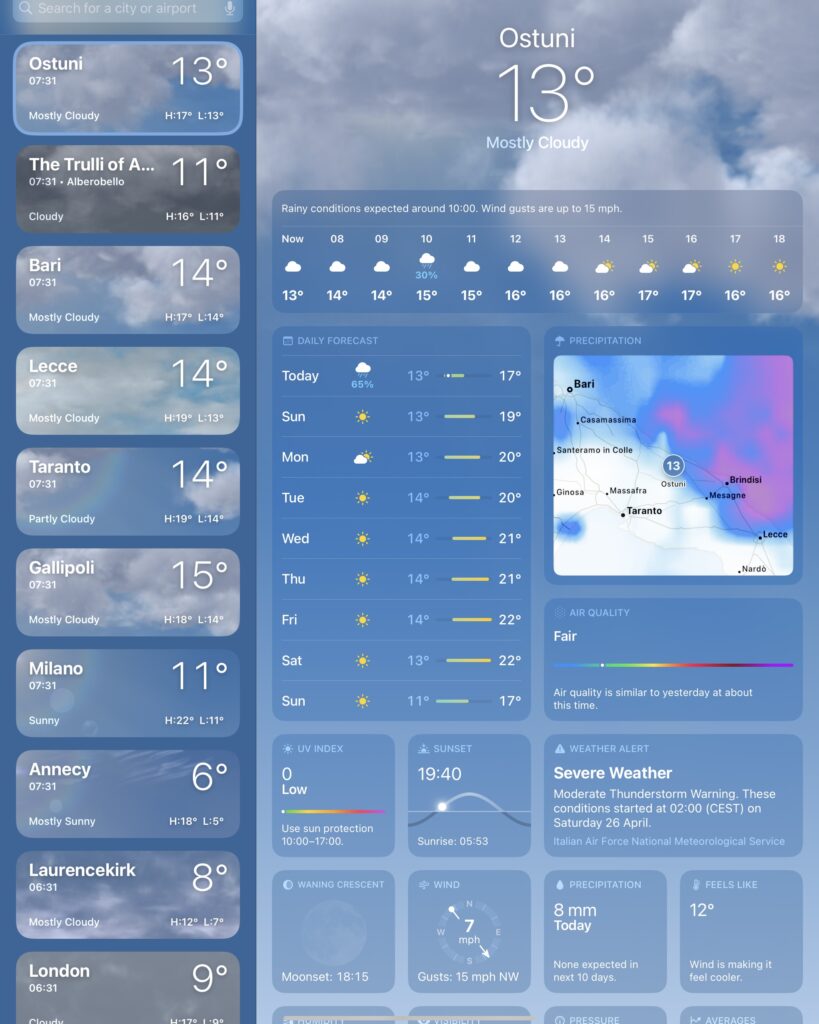
11 May 2025
Spring showers and cooler temperatures return. The weather is still changeable at this time of year. Bring warm clothing.
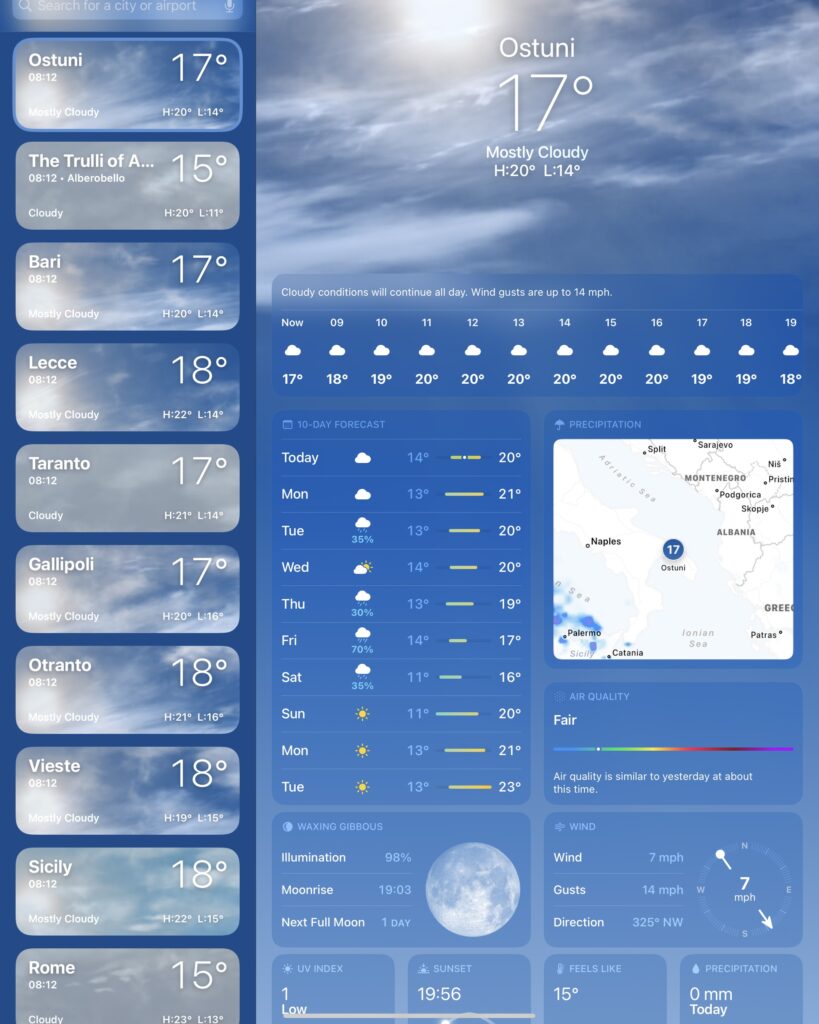
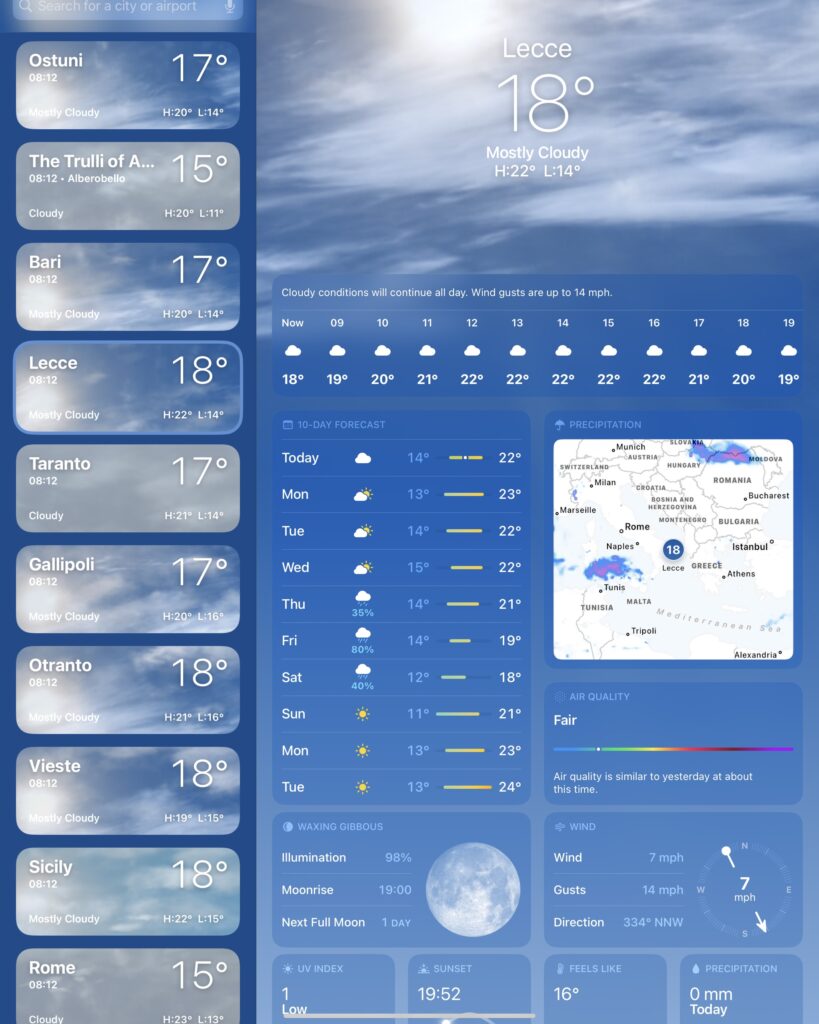
26 May 2025
As we come to the end of May, the weather is sunnier (and warmer) and becoming more stable. Nevertheless we received a severe weather alert on 24 May: Wind storm from N with peaks at 80-90 km/h (05/25 11:00 AM – 05/25 8:00 PM).
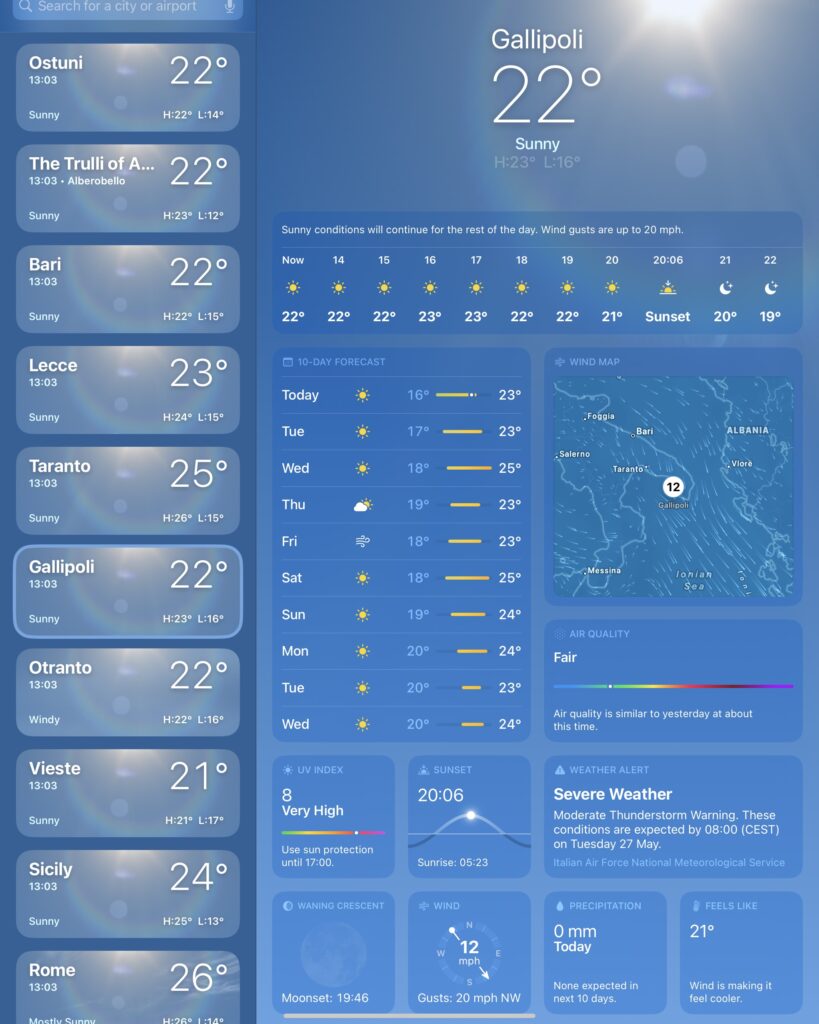
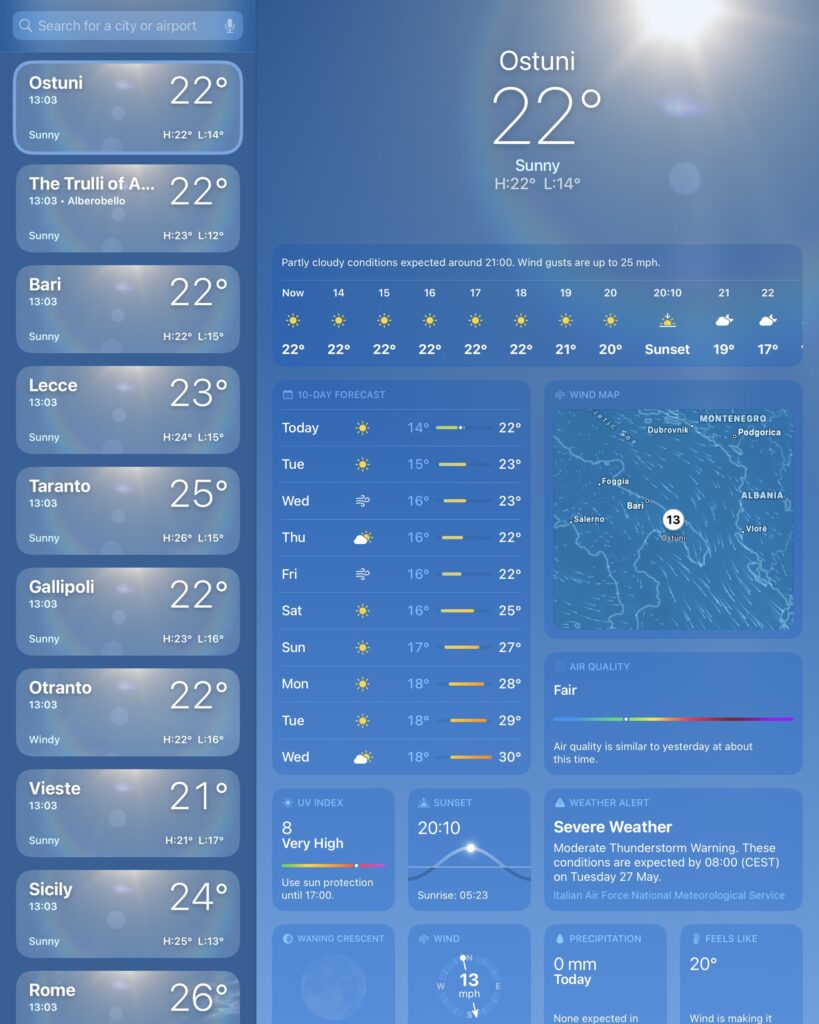
14 June 2025
With the arrival of June, the weather is much more dependable. Of course, we still have the famous winds. But temperatures will continue climbing. We start hitting 30°C +.
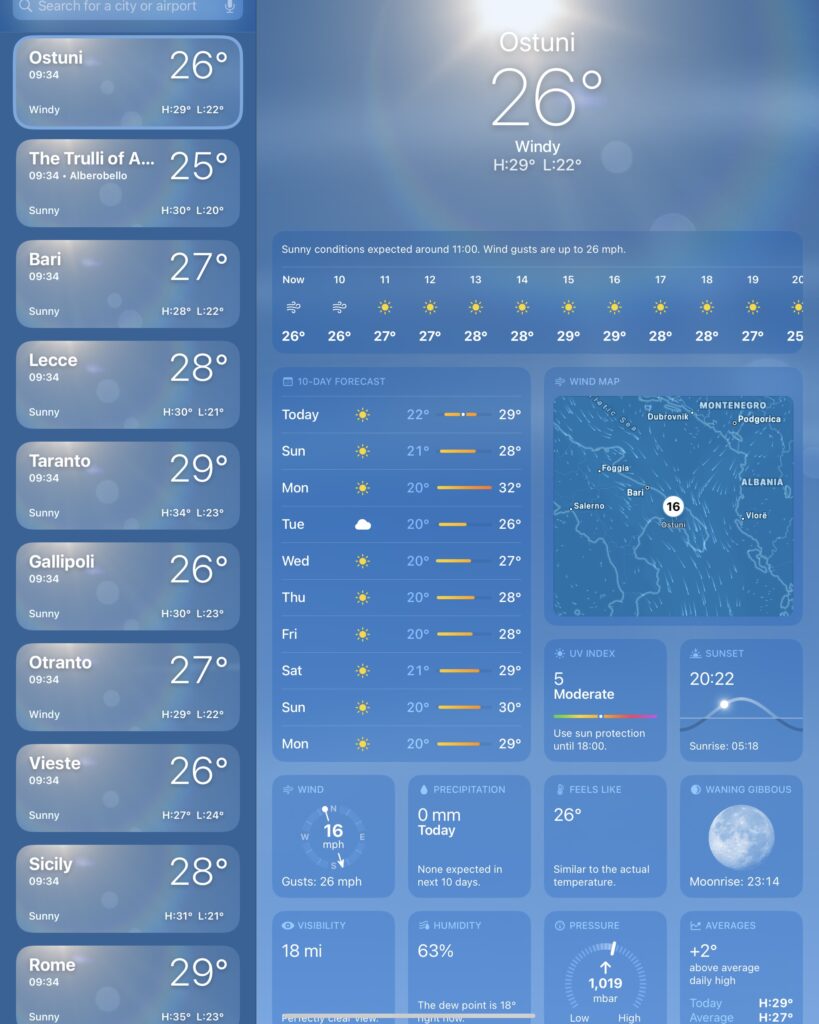
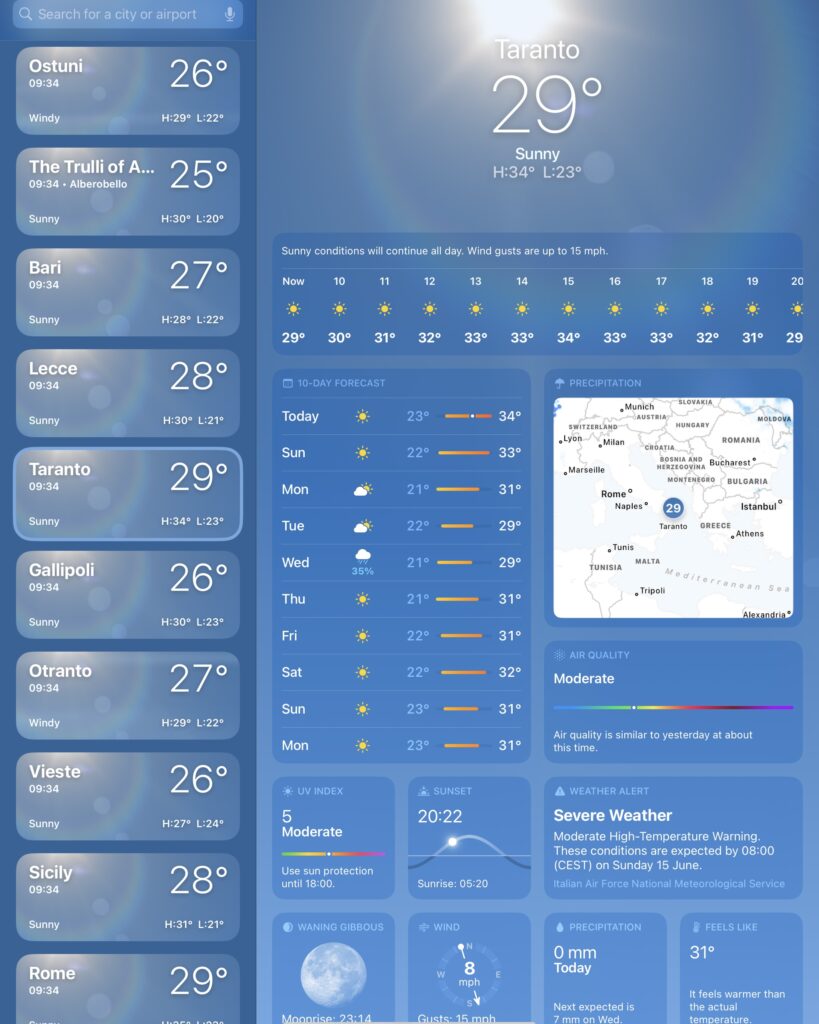
21 June 2025
Reliable sunshine, with highs reaching the mid-30s.
Summer in Puglia (July–August): heat, crowds and holiday energy
If your idea of a holiday is buzzing beaches, long warm Mediterranean nights and the energy of peak-season crowds, July and August are for you.
July often experiences the year’s most intense heatwaves, while August temperatures are often a little lower. Around mid to late August, short-lived thunderstorms can also bring heavy rain, providing temporary relief from the humidity.
These are also the busiest months of the year. Accommodation prices soar, restaurant reservations are a must, and beaches fill up early.
But there’s an undeniable energy in the air. Towns come alive with festivals, sagre (food fairs), and late-night passeggiate. If you don’t mind the crowds, or can escape to lesser-known inland areas or uncrowded beaches, you’ll find this season full of colour and life.
The best time to visit Puglia for: Beach holidays, nightlife, festivals, and people-watching.
August in Puglia: understanding what to expect
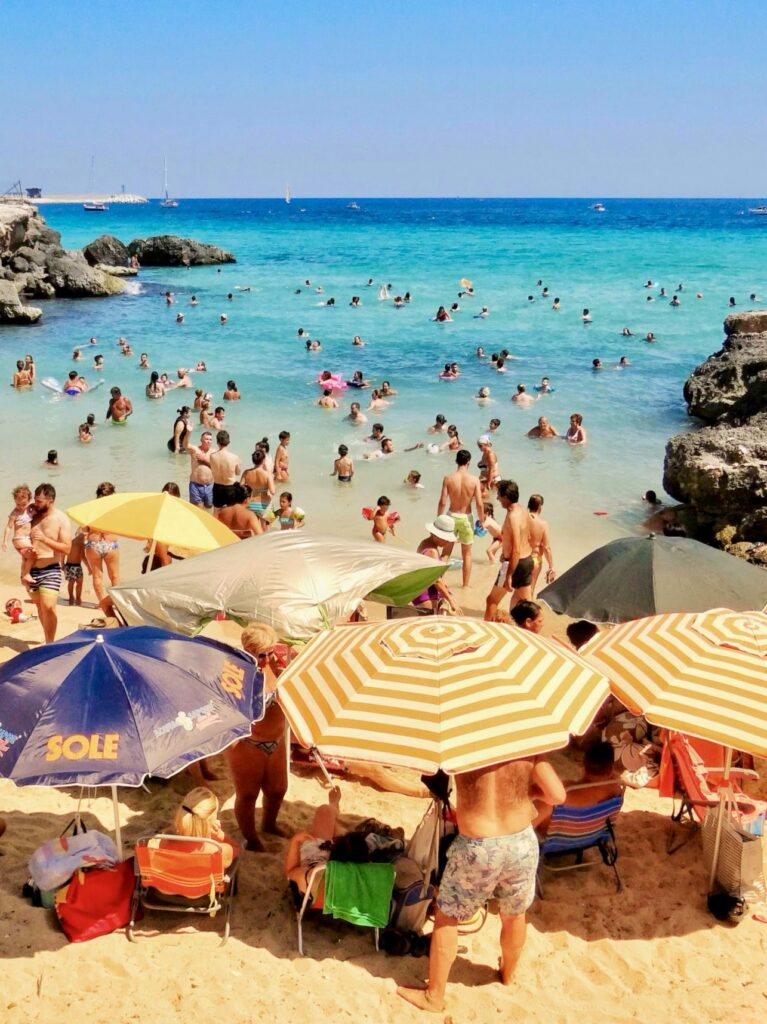
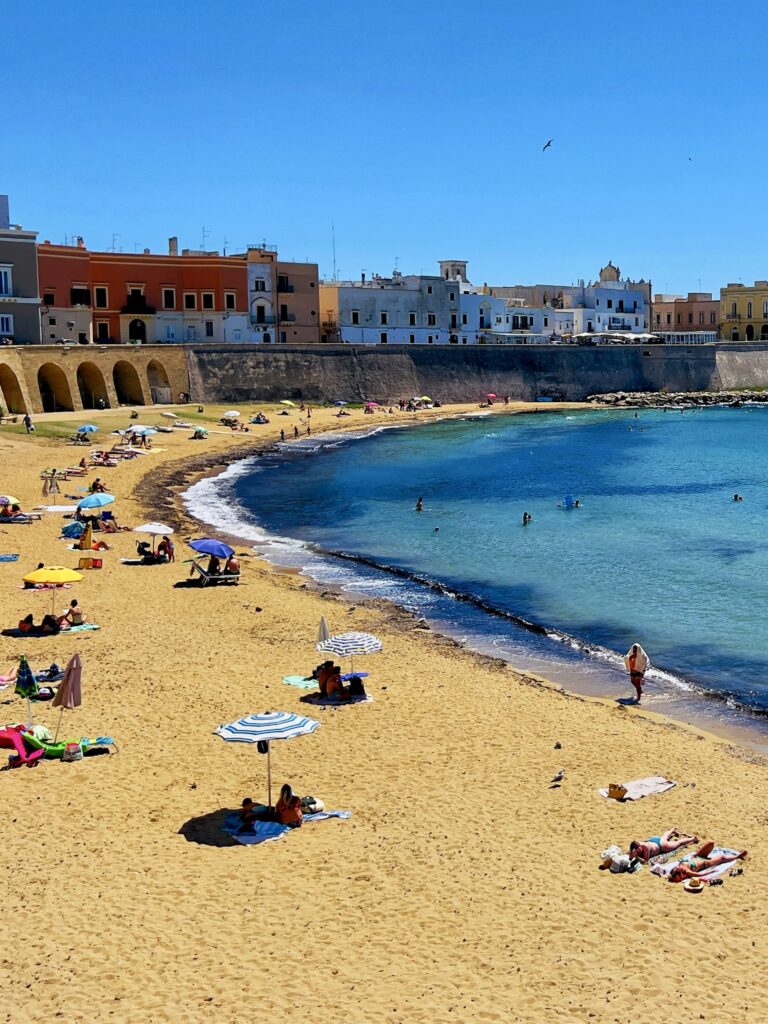
August is unlike any other month in Puglia. If you’ve read that Puglia is Italy’s “undiscovered gem”, it’s worth putting that into context. While the region may still feel like a new discovery for some international visitors, Italians have known about it for generations. Puglia is one of Italy’s favourite summer holiday destinations, and every August hundreds of thousands of Italians arrive to spend their holidays here, joined by many more returning home to visit family.
The result is a region operating at full capacity. Roads are busier, accommodation prices reach their annual peak, beaches fill early, and popular towns such as Ostuni, Monopoli, Polignano a Mare, Otranto and Gallipoli are noticeably more crowded than at any other time of year.
The pressure on infrastructure affects local businesses too. Many licensed tour guides choose not to offer tours during August, preferring to take their own holidays rather than guide visitors through packed historic centres and crowded attractions. If you’d like to explore Puglia with a licensed guide, it’s worth checking availability well in advance, or considering another time of year.
At the centre of the month is Ferragosto (15 August), Italy’s national summer holiday. For Italians it’s a time for family, barbecues and days at the beach. For visitors, however, it can come as a surprise. Many businesses close, restaurants may operate reduced hours or be fully booked well in advance, and much of the country seems to pause as locals head to the coast. If your visit coincides with Ferragosto, it’s worth planning ahead and making reservations wherever possible.
If your travel dates are flexible, we’d generally recommend choosing June, early July, September or October. But if August is the only time you can visit, don’t be discouraged. Thousands of visitors have wonderful holidays here every year. The key is understanding what makes August different and planning accordingly.
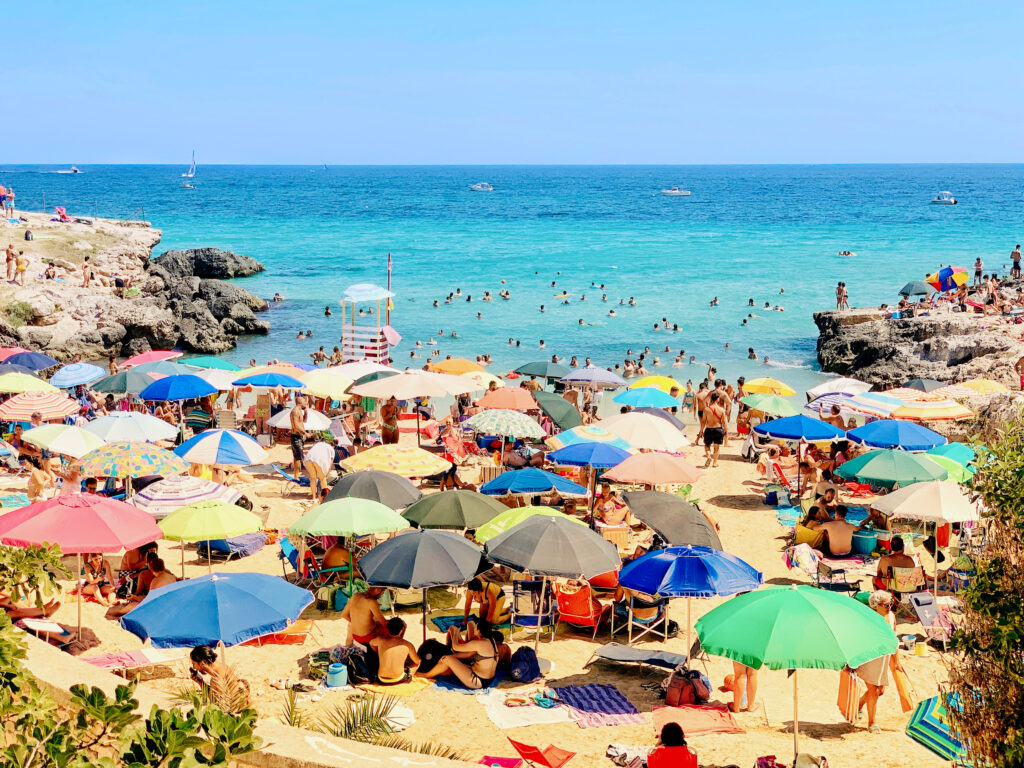
How to enjoy Puglia in August
Plan your driving around the busiest periods, if possible, especially on the main Adriatic highway. Traffic increases significantly at the beginning of August as Italians head south for their holidays (particularly if 1 August falls close to a weekend), again during the days leading up to Ferragosto on 15 August, and over the final weekend of the month as the summer exodus heads home. Weekend traffic throughout August is also noticeably heavier as local families make day trips to the coast.
The secret to enjoying Puglia in August isn’t trying to see everything – it’s slowing down. Rather than changing accommodation every couple of nights or attempting an ambitious road trip, choose one beautiful base, ideally a masseria with a swimming pool and an excellent restaurant. Spend the hottest hours relaxing by the pool with a good book and a cocktail, venture out early in the morning or later in the evening to explore nearby towns or beaches, then return to the tranquillity of your accommodation while others remain caught in the crowds.
It’s also worth remembering that Puglia is a large region. Stretching around 400 km (250 miles) from north to south, with approximately 850 km of coastline, there is plenty of space to escape the busiest hotspots. While famous destinations naturally become crowded, quieter beaches, inland villages and less-visited corners of the region can still offer the slower, more authentic Puglia that so many visitors are looking for.
August isn’t the easiest time to experience Puglia – but with the right expectations and a slower pace of travel, it can still be one of the most rewarding.
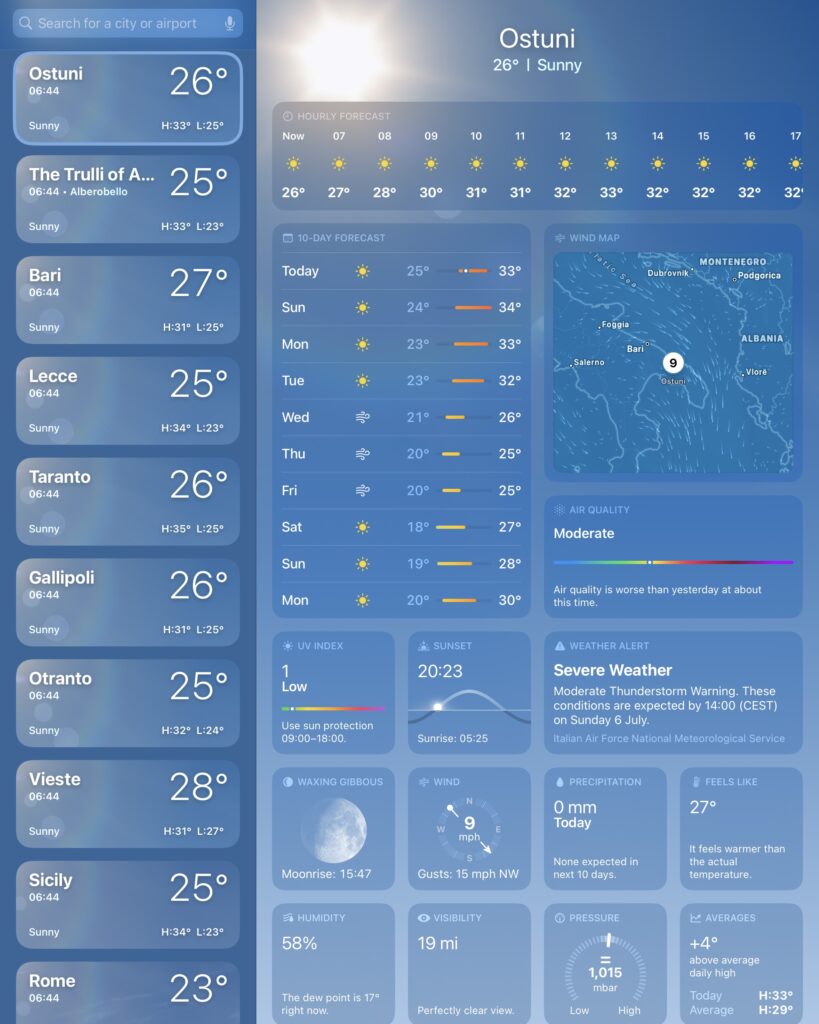
Weather snapshots | 5 July 2025
The main temperature shown is that at the time the screenshot was taken – check the high and low for the maximum and minimum daily temperature, and the 10-day forecast.
For the last three or four years, July has been the hottest month. We usually hit a heatwave around the third week of July that lifts temperatures well into the 40s — in some cases as high as 46°C. Yes, it’s hot. But we have the beach.
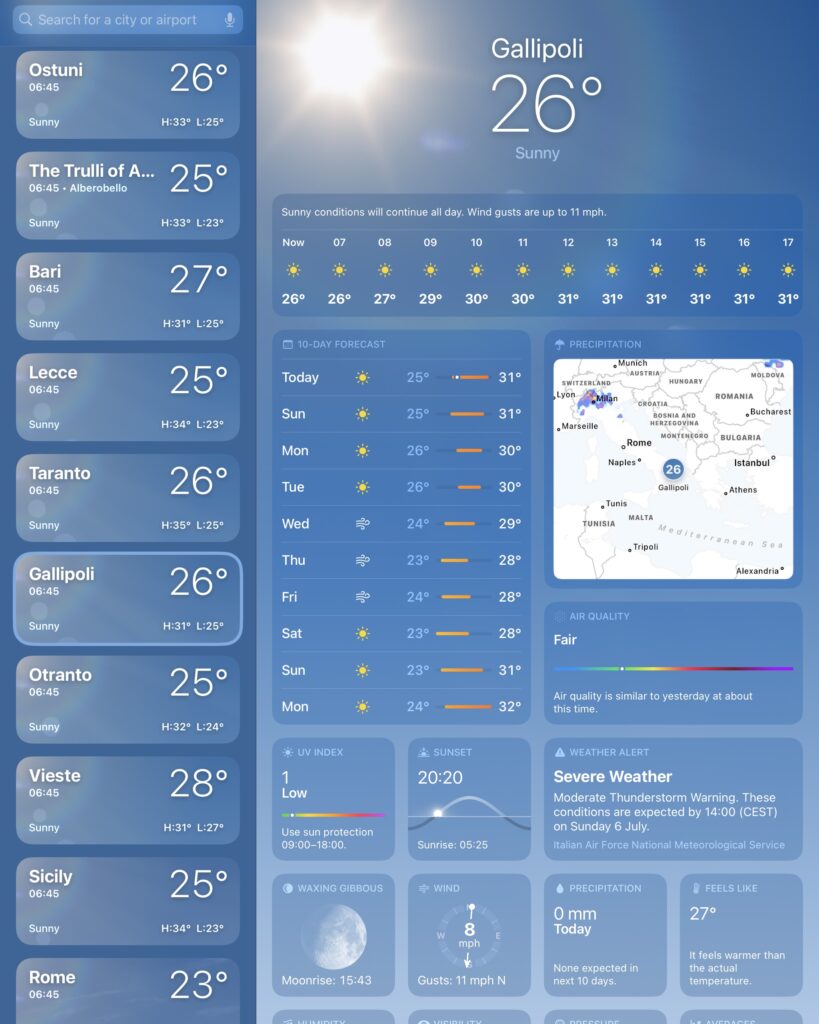
4 August 2025
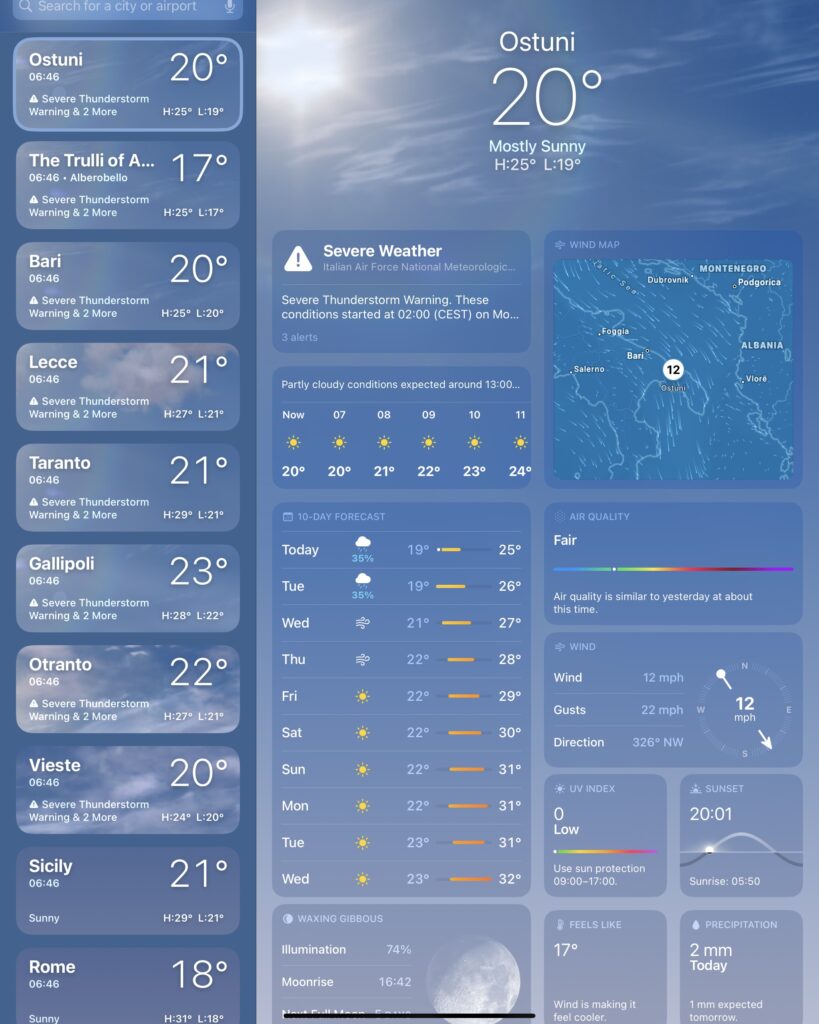
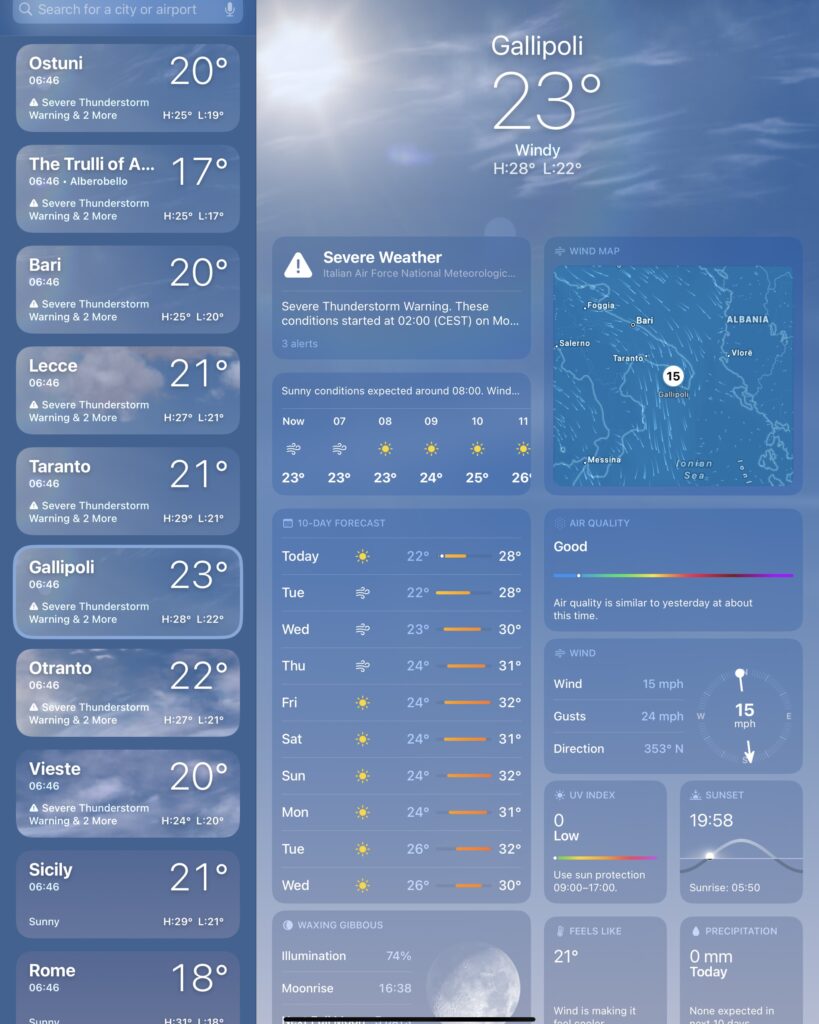
17 August 2025
Between these snapshots, we celebrated the ferragosto summer holiday on 15 August. The weather pattern over this holiday is usually always the same. Hot and humid conditions cause storms and heavy rain showers for around a week, usually starting around 12 August.
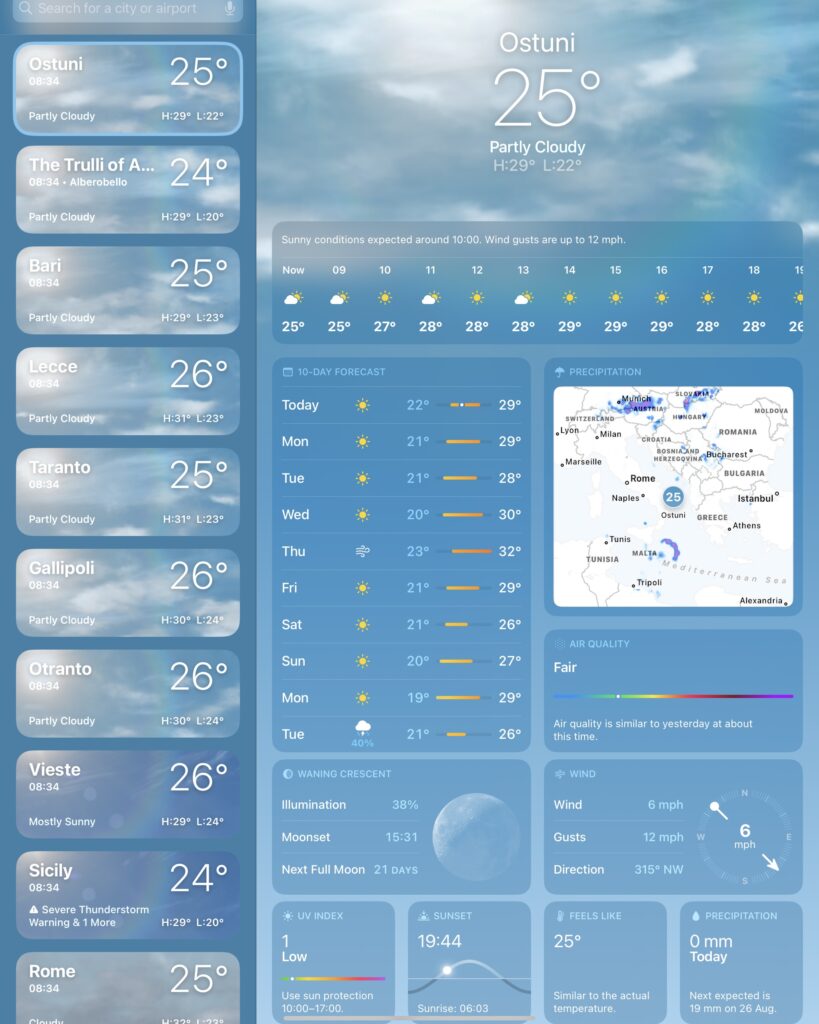
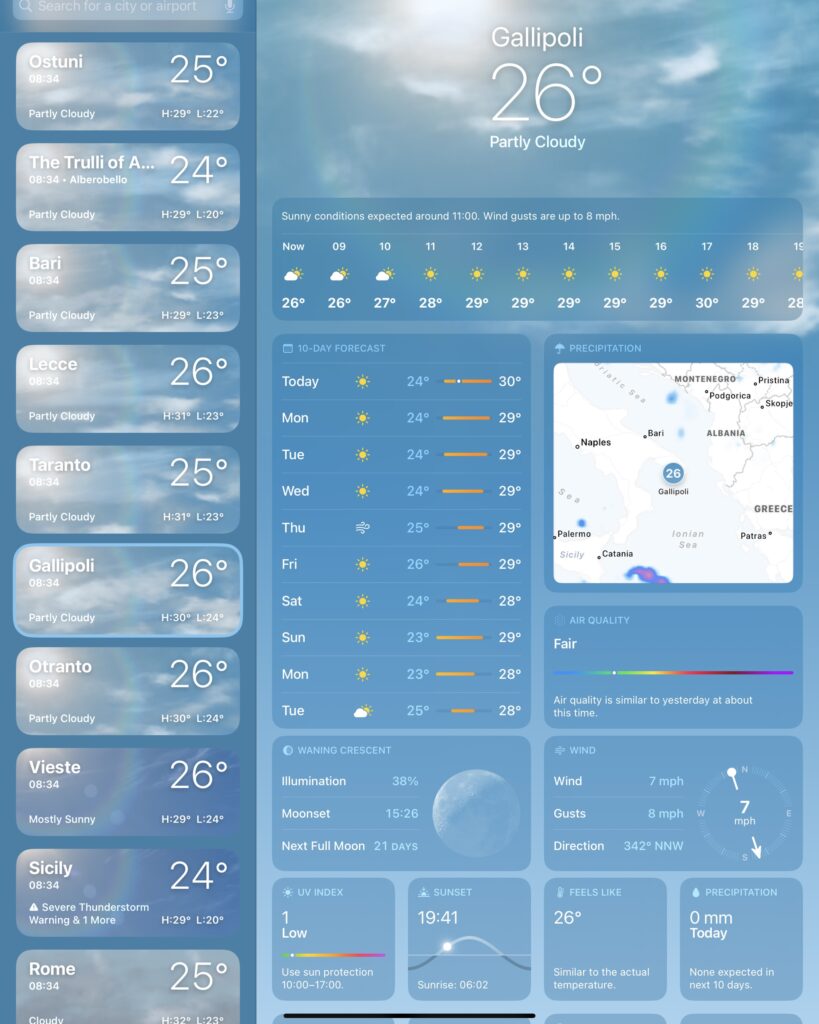
On 30 August we received a severe weather alert: Strong thunderstorm with cloudbursts, hail and gusts of gale (08/30 19:31 – 08/30 21:01).
Autumn in Puglia (September–October): warm seas and golden light
As the summer crowds fade, September and October usher in a calmer rhythm. The sea stays invitingly warm – still holding the heat of August – and early September often brings days of 25–28°C. But in 2025 we noticed autumn arriving earlier than expected. The first severe storm warning of the season came on 11 September. Though many days were still bright and warm, cooler air began to make itself felt. By 1 October, a sudden two-hour downpour was followed by forecasts of more than 17 hours of continuous rain in the next 24 hours. That marked the start of three unsettled days in a row, with further storms returning in the second week of October. Daytime highs dropped to 15–16°C before rising again to 20–22°C in central Puglia by the end of that week, while Salento stayed a few degrees warmer.
Even so, during these months some relaxed travel remains possible. Restaurants and bars are still open, beach days are possible when the skies clear, and prices start to dip. The light softens into a mellow, golden glow across the olive groves, grape and olive harvests begin, and food festivals return in earnest.
The Puglia Podcast: Autumn in Puglia
The Puglia Podcast is also available from Apple Podcasts, Spotify and wherever else you get your podcasts from.
Follow us on Instagram for reels, stories, and daily inspiration.
Beach clubs and lidos
The Puglia Region prescribes a period during which private beach clubs and lidos must operate if they wish to open for the season. In 2026, that period ended on 13 September. After this date, beach clubs are free to remain open or close for the season, and many begin to wind down as visitor numbers fall and the weather becomes less reliable. Some, however, continue into October.
From mid-September onwards, always check individual beach club opening times before visiting. Public beaches remain open year-round.
The best time to visit Puglia for: Swimming without crowds, food lovers, couples, and relaxed road trips.
Weather snapshots
The main temperature shown is that at the time the screenshot was taken – check the high and low for the maximum and minimum daily temperature, and the 10-day forecast.
30 September 2025
The first three weeks of September continued as the end of August. Settled, sunny and a little cooler. Extremely pleasant – apart from a storm towards the middle of the month.
Weather Alert: Strong thunderstorm with cloudbursts and hail, risk of flooding (11/09 03:50 – 11/09 05:20).
It cleared and we returned to settled weather.
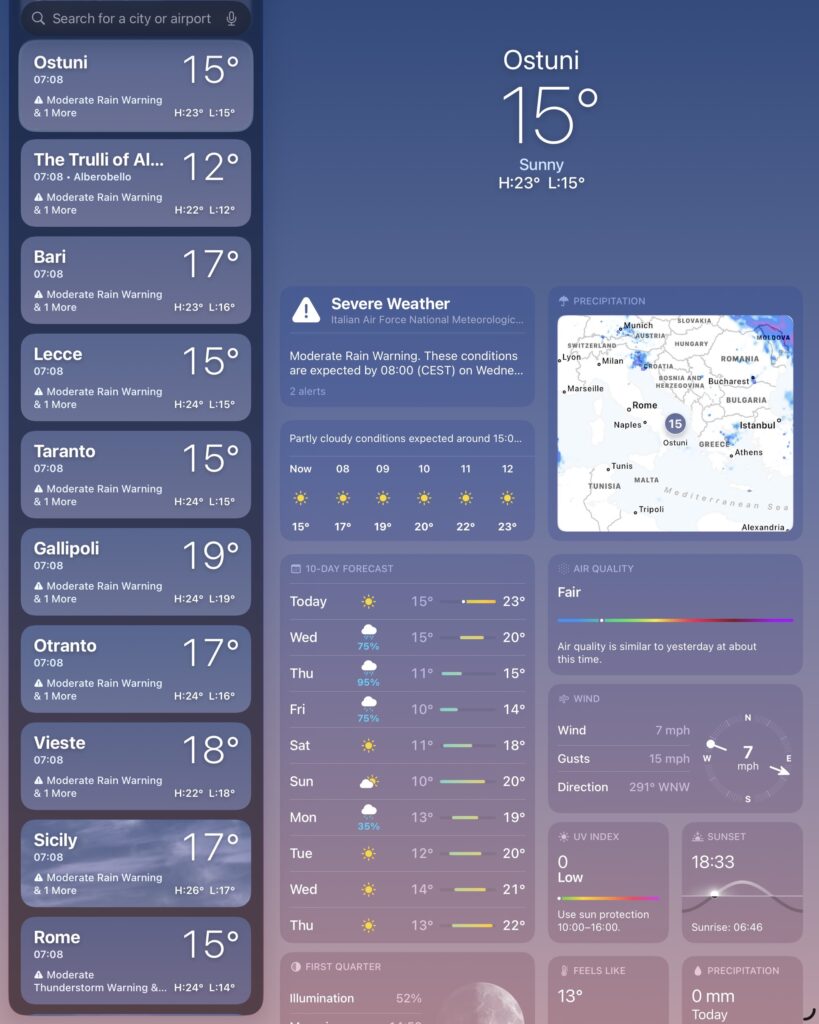
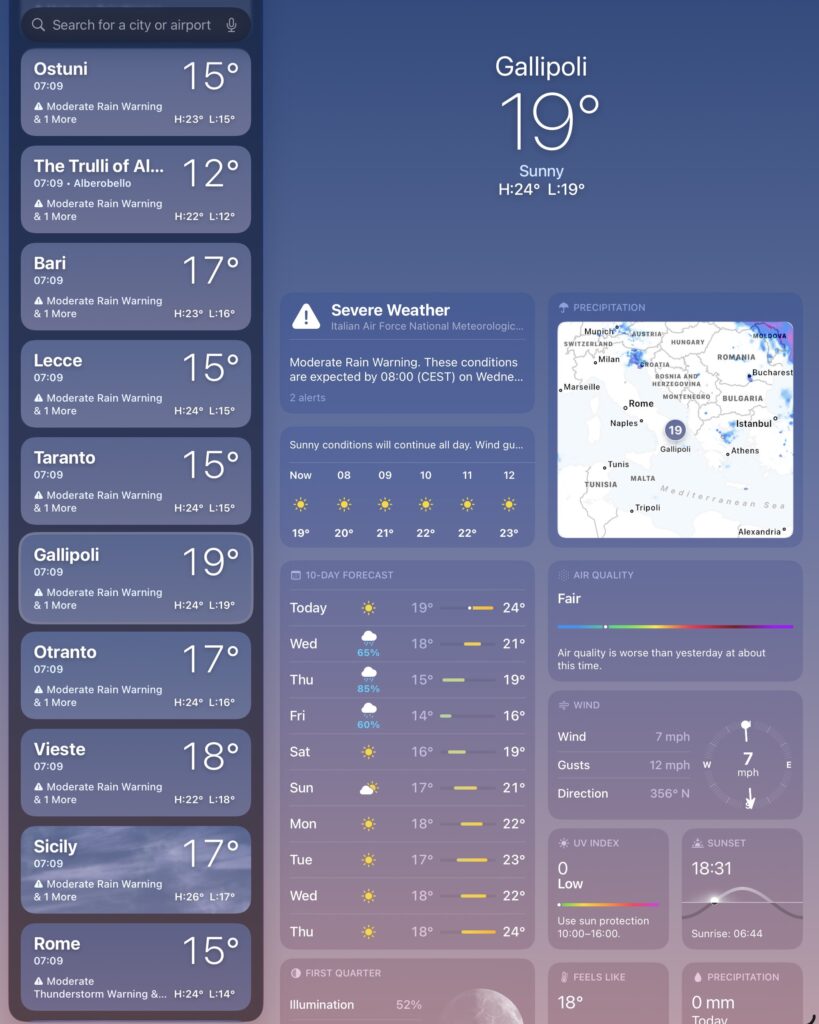
September 2026 ended gloriously, with the outlook good through the first week of October. The month tended to follow the same pattern as 2025. The middle of the month was changeable. The third week was much cooler. Out came warm clothes, and a blanket for the night. But it ended sunny and bright, with a late morning temperature of 26°C. The evenings get darker much sooner, and the warmth disappears immediately.
Puglia in October: The Season Turns
October marks the start of Puglia’s not-summer — the moment when the rhythm changes, beaches empty, and the region exhales after months of heat and crowds.
The light softens, the evenings draw in, and the air takes on a damp edge. The first week of October can already feel like autumn proper: grey skies, heavier showers, and a chill that surprises visitors expecting an endless Mediterranean summer. Mid-month often brings another unsettled spell before clearer days return towards the end.
This isn’t the time to come chasing sunshine. It’s the time to slow down, eat well, and experience Puglia when it belongs almost entirely to itself again. There’s beauty in that — quieter, moodier, and often more honest than summer. But it’s a different kind of beauty, and it helps to arrive with the right expectations.
Weather: Unpredictable and Unapologetic
On paper, October should still be mild — daytime highs around 20–23°C, cooler evenings around 14–15°C. In reality, the weather can swing sharply from warm sunshine to long, damp spells. The first ten days of October 2025, for example, brought grey skies and persistent rain across much of Puglia, followed by a shorter but equally fierce period of storms mid-month.
When the sun does return, it can still feel like summer for a few hours each afternoon — perfect for a walk or an al fresco lunch. But nights are cool, and damp air settles quickly inland. The sea remains swimmable (around 21–22°C) for the hardy, though you’ll often have the beach entirely to yourself.
As the month ends and November nears, daylight shortens and shutters start to close: beach clubs, seafront bars, and seasonal masserie wind down, leaving a smaller circle of places open year-round.
A Quieter Kind of Puglia
October is when the region finally belongs to its residents again. The roads are calm, the air smells of woodsmoke and soil, and the sound of the sea carries further. Life moves indoors: meals linger longer, conversations stretch out, and small towns feel more intimate — but also, sometimes, more closed.
In coastal towns like Polignano a Mare, Monopoli, or Gallipoli, you’ll notice the shift immediately: shopfronts shuttered, fewer evening lights, and locals catching up after the season. Inland, the rhythm is steadier — life continues much as usual in Cisternino, Locorotondo, or Martina Franca, though even here some restaurants and bars start closing midweek.
It’s a time for long lunches rather than long days.
If the weather turns, follow the local instinct: go inside, eat, talk, wait for the next clear spell.
Weather snapshots | October
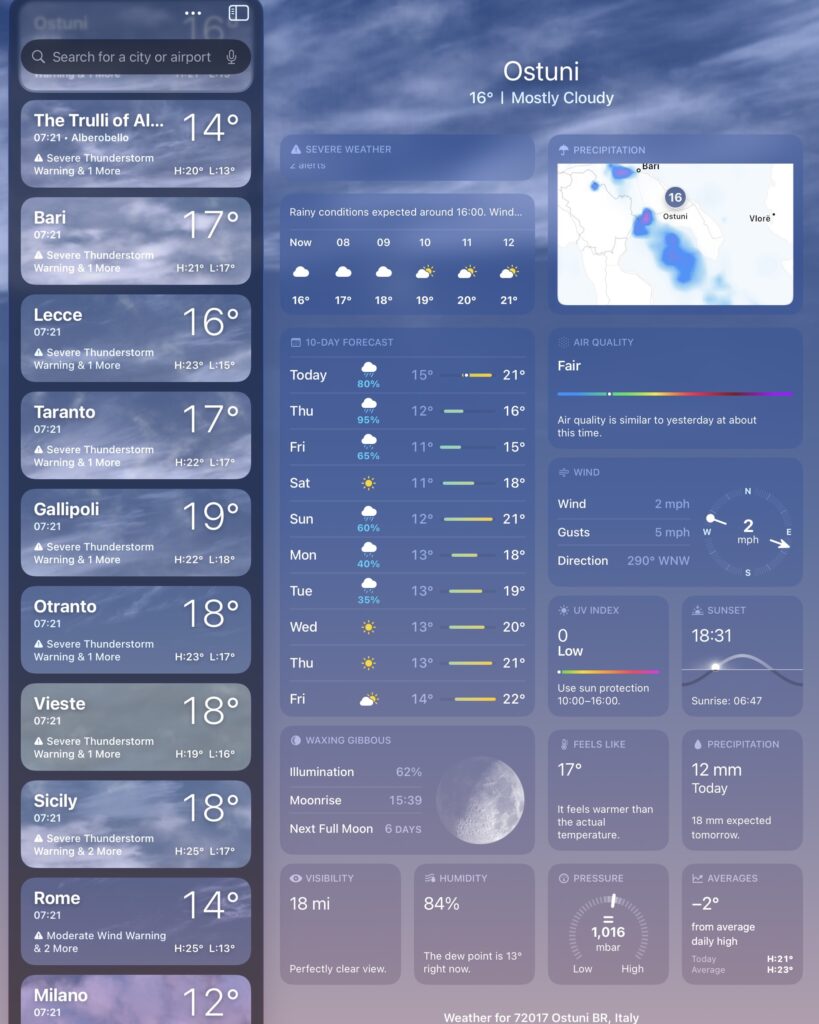
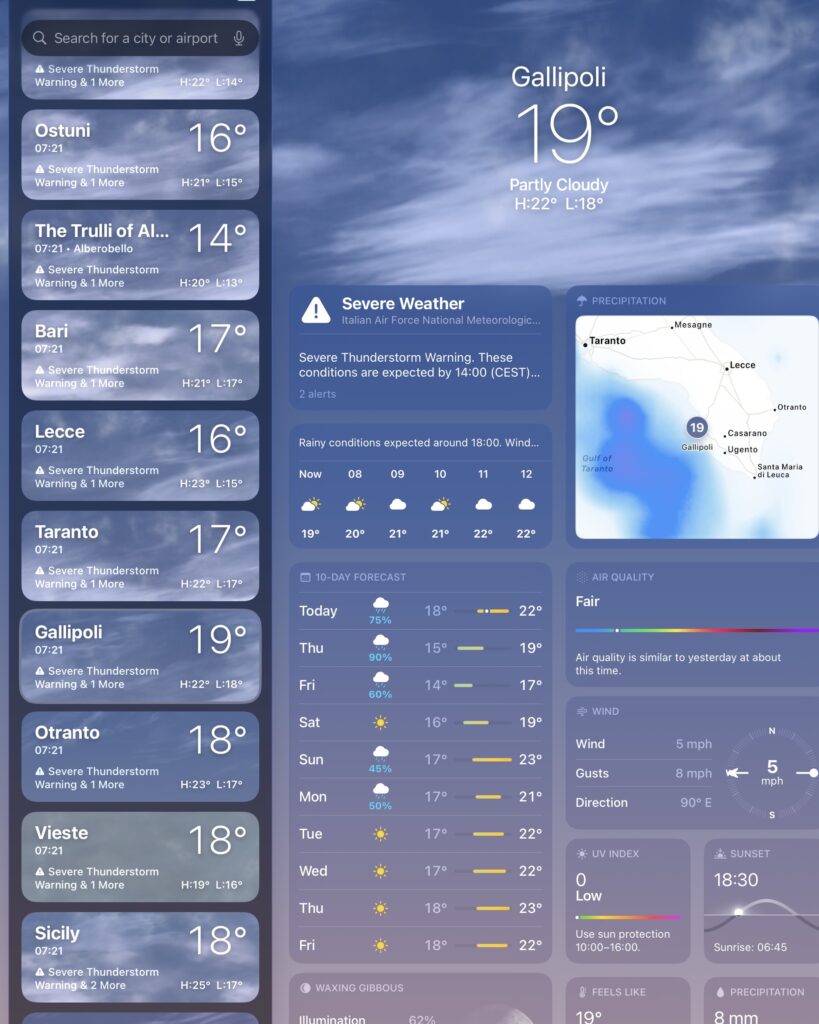
The main temperature shown is that at the time the screenshot was taken – check the high and low for the maximum and minimum daily temperature, and the 10-day forecast.
1 October 2025
As we moved from 30 September into 1 October, we moved from summer to not-summer.
Weather Alert: Strong thunderstorm with cloudbursts and hail, risk of flooding (10/01 2:40 PM – 10/01 4:10 PM).
Weather Alert: Windstorm from N-NE with peaks at 70-100 km/h (10/02 11:00 PM – 10/03:00 6:00 PM).
Suddenly, three to four weeks earlier than usual, the weather changed dramatically. It became colder (dropping to 12°C during the day). Much colder. And the rain started. Heavy downpours, which continued through to 7 October, pretty much non-stop for five days. Some of these developed into heavy hailstorms. We had thunder storms continuously for more than 24 hours.
When the rain stopped the winds continued. Finally on 9 October, the sun shone once more and the wind disappeared.
11 October 2025
Mid-October we are still enjoying settled weather. We were on the main piazza in Ostuni yesterday. There was plenty of al fresco dining going on at lunchtime. The locals in warm sweaters and winter jackets, tourists in shorts and t-shirts, and summer dresses.
But later in the week, more rain is to come. October will end as it started – and that is likely to move us very definitely from the tail end of summer into four or five months of not-summer!
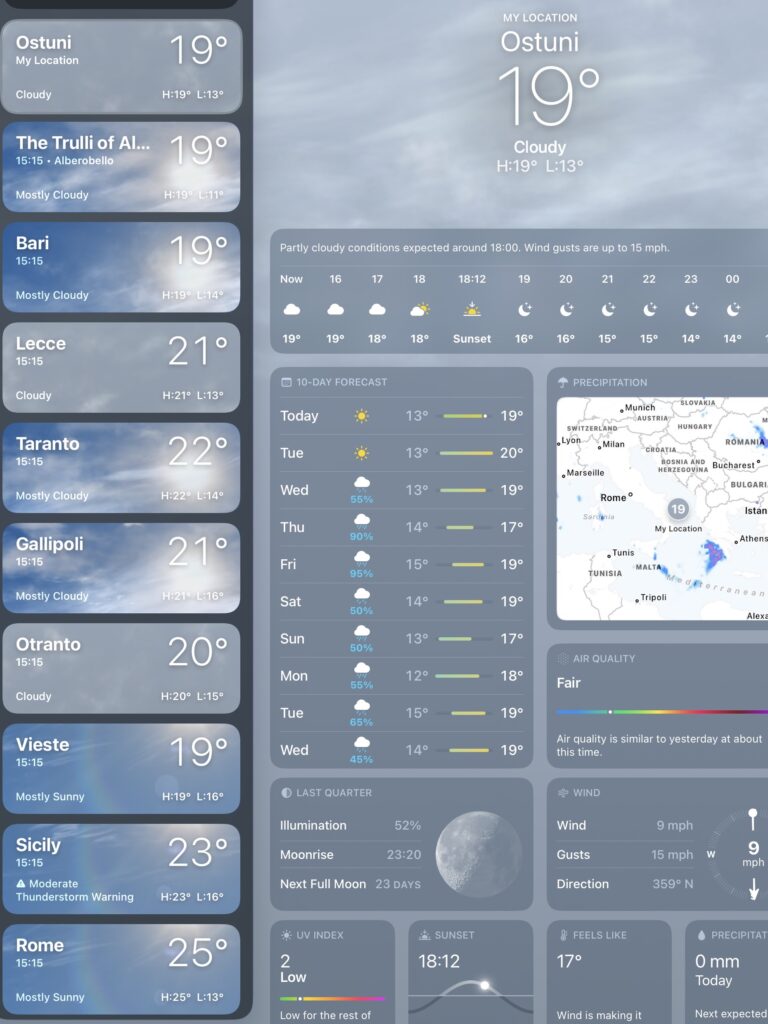
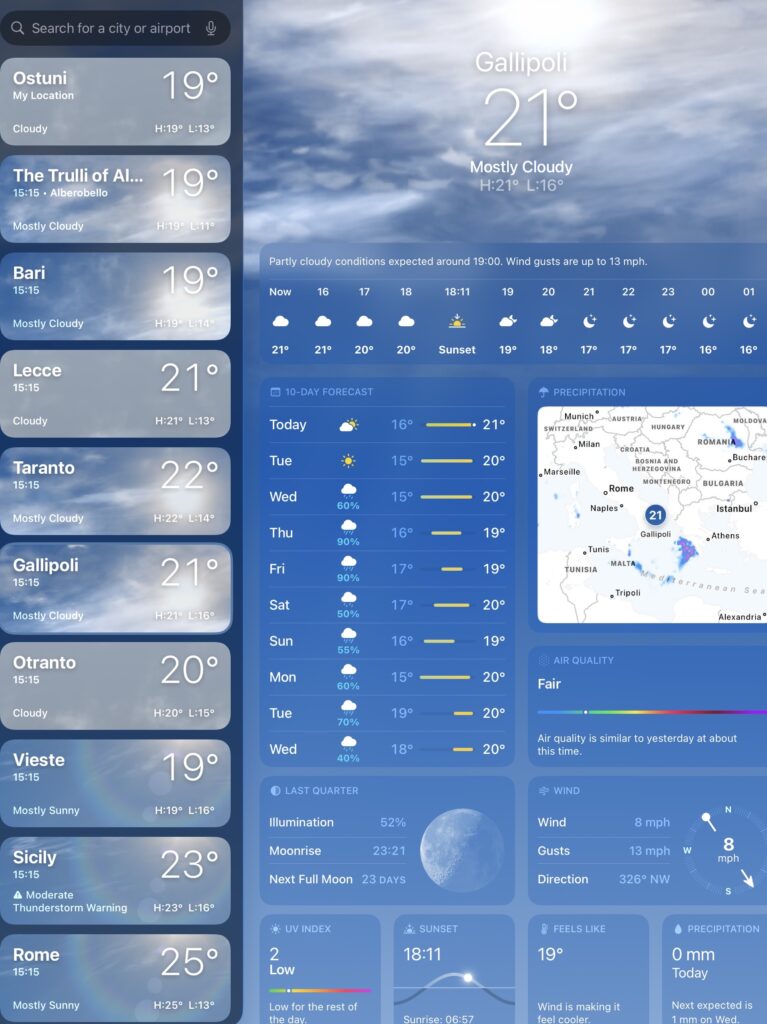
More severe weather warnings for October:
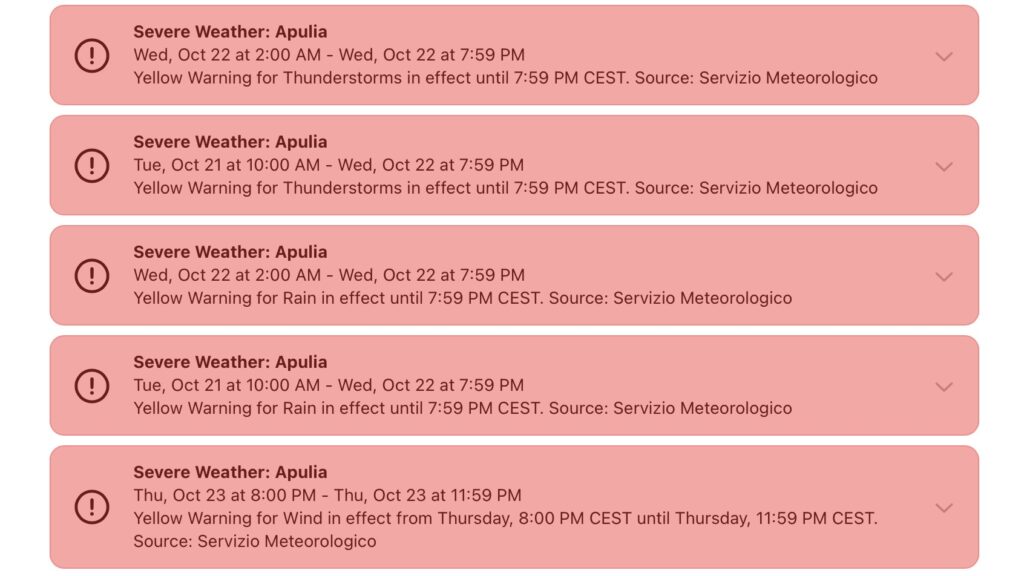
27 October 2025
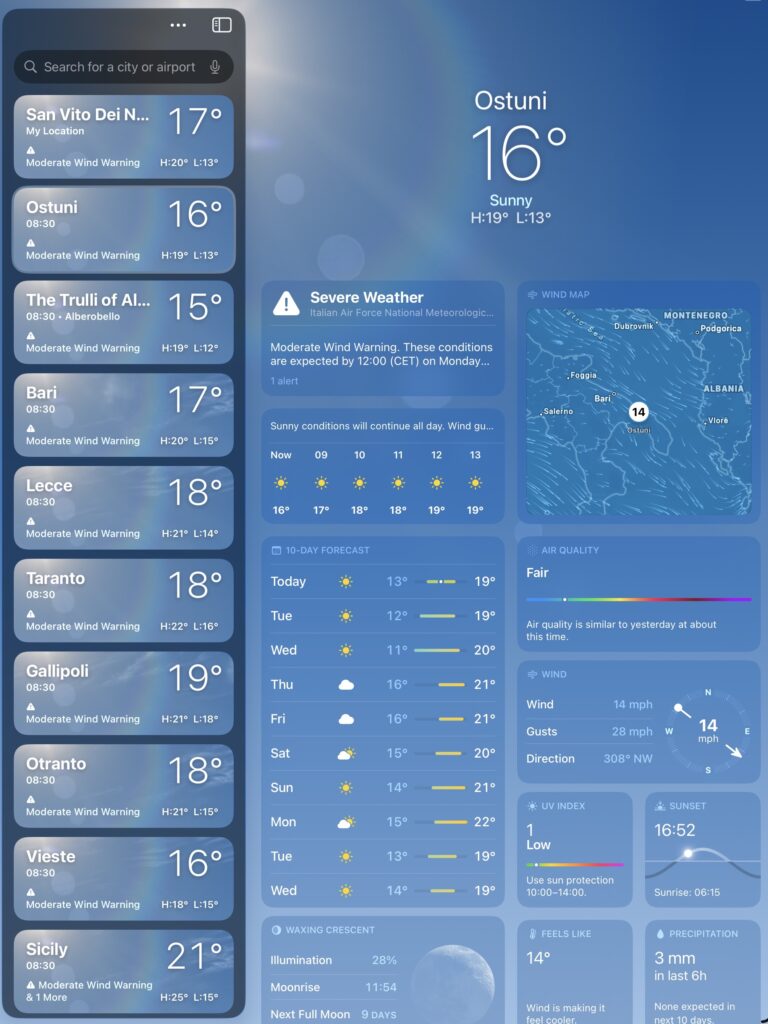
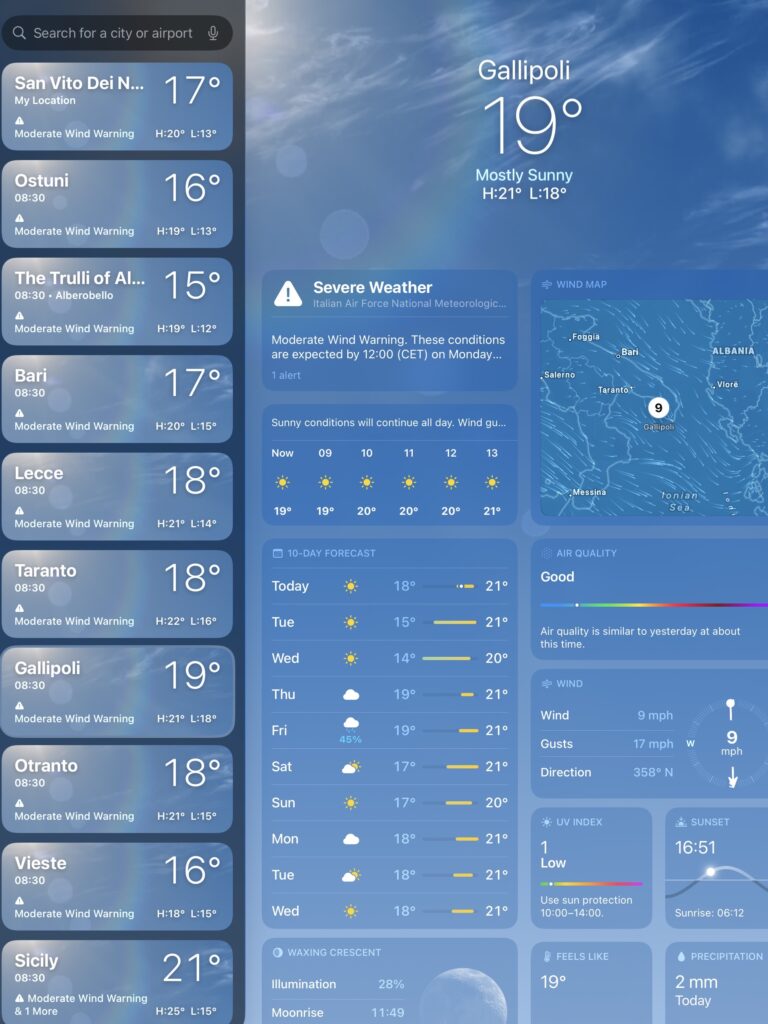
vs October 2026
On 1st October we read an article on the UK Times suggesting Alberobello as a destination for November sun. So, we thought we’d record the weather across the Autumn months this year.
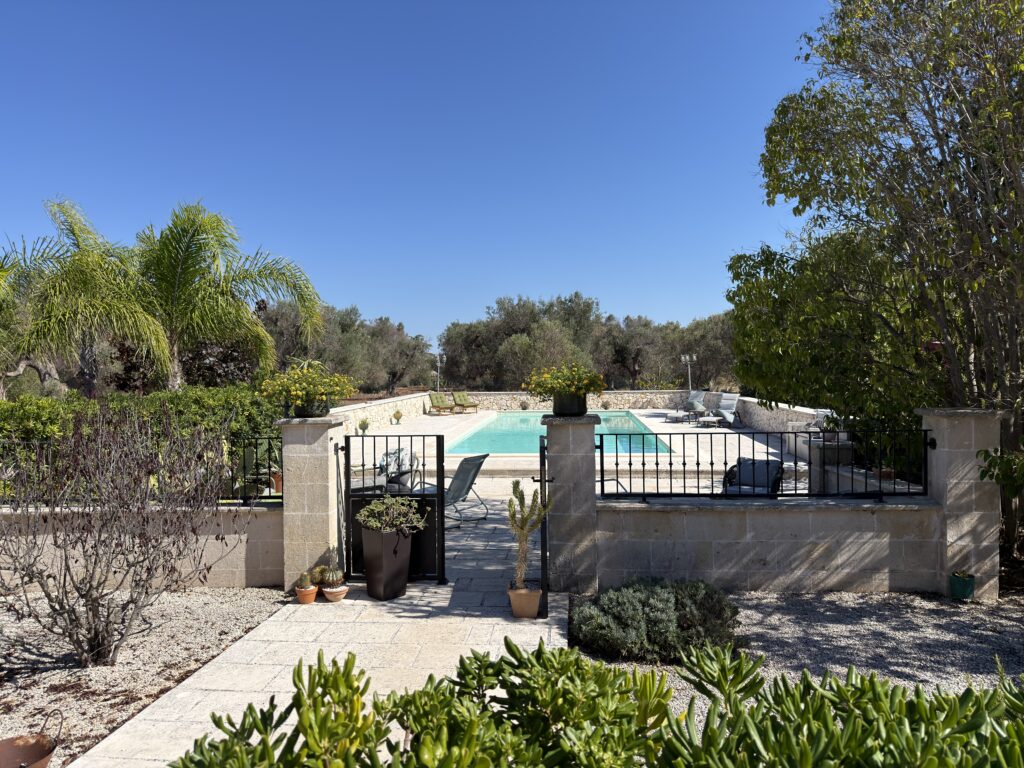
October 1st and 2nd were glorious – the temperature at lunch time was 26°C, perfect to sit out during the day. In the shade the temperature dropped, and around 5pm it was time to put on a sweatshirt. Shorts were worn for dinner out – but it won’t be long until long trousers are needed in the evenings! The weather continued likewise on the 3rd (27°C) and 4th (24°C), with local news reporting that more than ever, foreign tourist were here visiting the beach, and the disappointment of Puglia’s “destagionalizzazione” (extending the tourist season beyond the summer) not being matched, with tourists finding closed beach lidos, restaurants and bars!

Just slightly cooler today, October 5th, with a few light clouds in the sky, and a lunchtime temperature of 24°C. Lunch was eaten outside, and afternoon coffee too. But inside the sweatshirt went on at 4pm. The sun is lower in the sky, its arc more pronounced towards the south. Tuesday 6th was similar, though the morning felt much cooler (at 14°C), with heavy condensation on the pool furniture. Reports in the press indicate that Puglia’s Indian summer is about to come to an end, after such a long extended dry spell. With temperatures set to drop closer to seasonal normal.
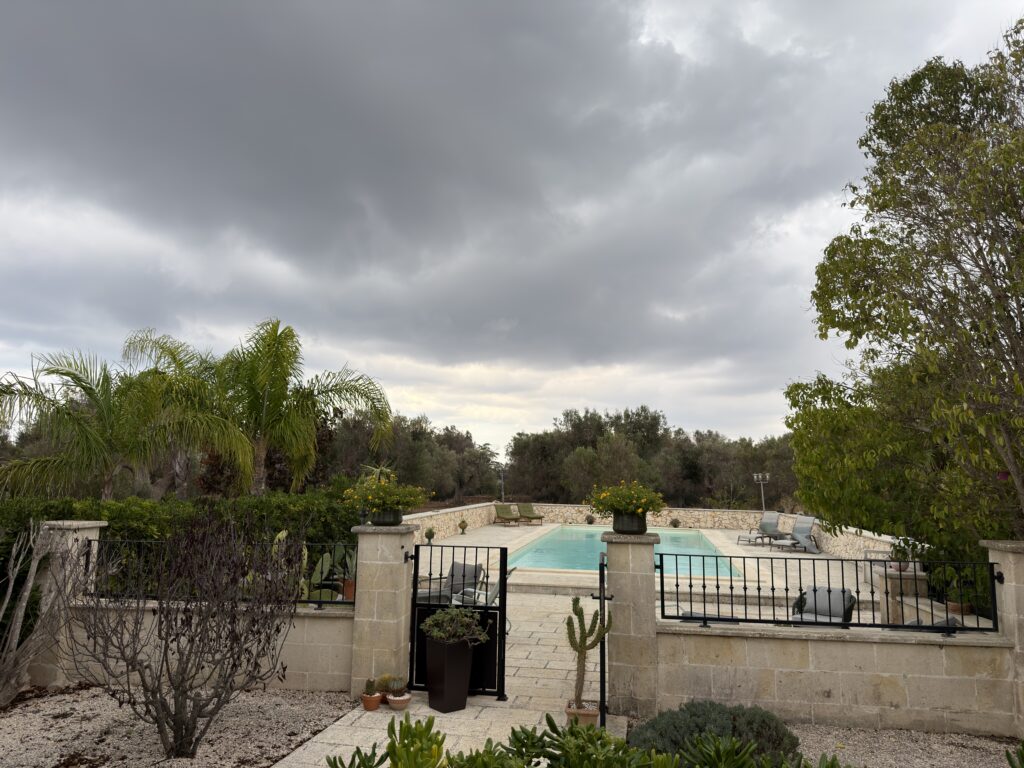
The cloud cover continued late through a cooler morning, with the sun peeping out around 10.30am, before the sky became heavier, with what looks like dark grey clouds about to pass over. It started raining a little after midday, pulling the temperature down by lunchtime to 22.3°C. We’ll take a rain check on lunch outside (for the first time this season). Rain is forecast for at least the next week.
The rain lasted for around 50 minutes, the sun came out again, followed by a mid-afternoon downpour. In the meantime, in Salento, there were severe thunderstorms with heavy rain, while in Savelletri on a visit to Masseria Calderisi, the sun was shining. Demonstrating the microclimate weather conditions we have across Puglia.
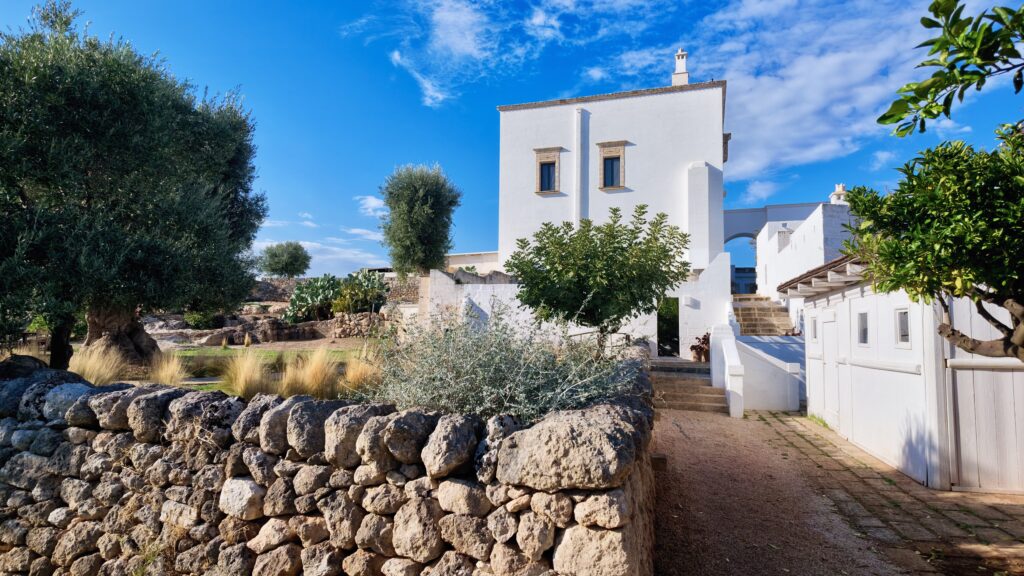
On 8th October we received a severe weather alert for early evening: strong thunderstorm with hail and rain, risk of flooding. The weather followed the same pattern through until 12 October. Overcast to clouds, with heavy downpours and thunderstorms, lasting up to 2 hours, with the sun peaking out occasionally. The lunchtime temperature dropped to around 19°C, except on the 10th the sun came out for a longer period, and it was a warmer day, with lunchtime temperature peaking at just under 26°C.

Understanding Puglia’s weather: it’s all about the wind
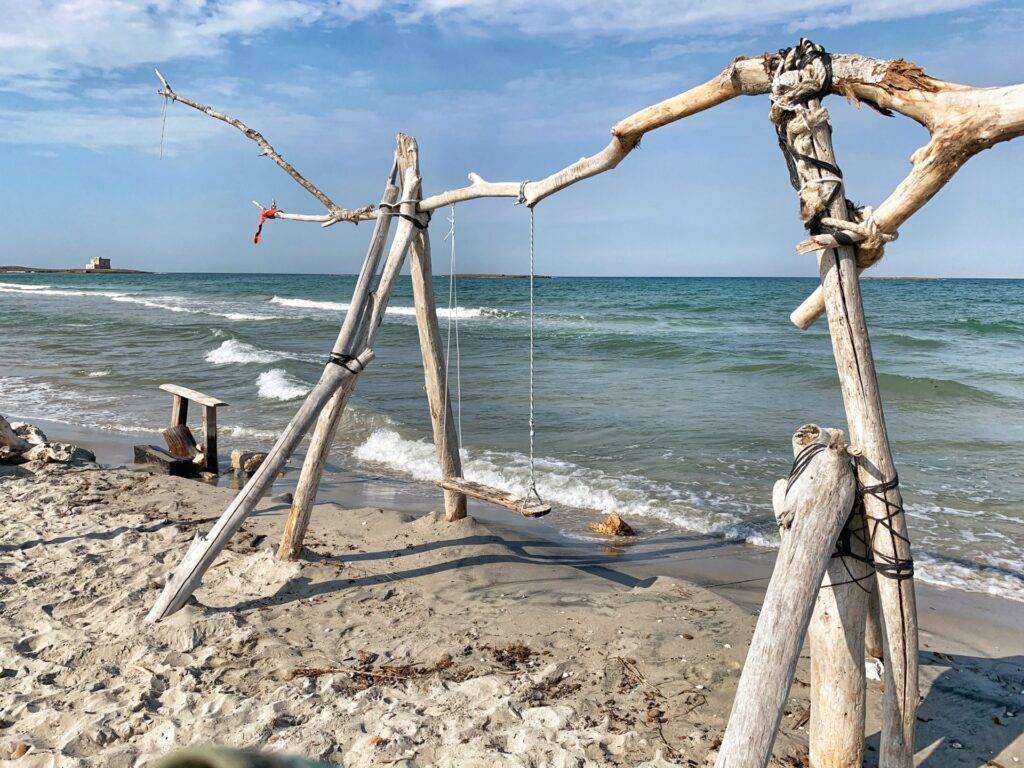
Spend a little time in Puglia and you’ll soon realise the weather here isn’t just about sunshine — it’s about the wind. Locals talk about lu sule, lu mare, lu ientu — the sun, the sea, the wind — with real affection. It’s more than a saying; it’s a way of reading the day. The same sun that warms our olive groves and fills our beaches also powers the breezes that shape our weather. Those breezes can turn the sea from calm turquoise to crashing surf in a few hours, and dictate whether your washing dries in ten minutes or not at all. Understanding them helps you understand Puglia itself.
Lu sule, lu mare, lu ientu (the sun, the sea, the wind)
The sun is obvious. Puglia is Italy’s southernmost region on the Adriatic coast — the heel of Italy’s boot — and one of Europe’s sunniest corners, with more than 300 days of sunshine a year.
The sea needs little introduction either. With around 865 kilometres of coastline — the longest of any Italian mainland region — Puglia offers endless beaches, spectacular cliffs, and rocky coves washed by both the Adriatic and the Ionian seas.
And then there’s the wind. Or rather, the winds, plural. Each has its own name, mood, and direction — and understanding them helps explain Puglia’s unique climate and shifting weather patterns.
Here comes the science
Understanding why the wind blows inland from the sea towards the land is, quite literally, a breeze.
The temperature difference between the sea and the land — and the resulting contrast between high air pressure over the water and low pressure over the land — causes the sea breeze to form. That’s why the wind tends to pick up in the afternoon, when the land is at its hottest, and is most noticeable in spring and summer when the temperature contrast is greatest.
During the day, both the land and sea absorb heat from the sun. But water warms up more slowly than land, so the air above the land becomes much warmer. This warm air rises, creating low pressure at the surface. Over the sea, the cooler air sinks, creating high pressure. Air moves from high to low pressure — and that movement is what we feel as the wind.
At night, the system flips. The land cools quickly, while the sea retains its warmth. Low pressure now forms over the water, and high pressure over the land, sending breezes seaward. These gentle offshore winds — known as land breezes— are common along Puglia’s coast on calm summer nights.
OK, so what about Puglia?
On the Salento peninsula, winds blow from almost every direction. From the north, east and south off the Adriatic Sea, and from the west and southwest off the Ionian. These opposing airflows converge over the central part of Salento, where the air rises and often forms clouds, rain, or even summer thunderstorms. It’s why you’ll often see dramatic clouds hanging over Oria in mid-afternoon.
During the hottest months, winds from the south bring warm, humid air and choppy seas along the Ionian coast. The Sirocco (Scirocco) — a wind that travels north from Africa — carries heat and moisture, and sometimes even deposits fine red Saharan dust across cars, balconies, and olive trees.
The Tramontana, by contrast, is a cool, dry wind blowing down from the Alps through the Balkans. It clears the skies, drops temperatures, and brings that crystalline light photographers love. From the northeast comes the Grecale, another Balkan visitor, brisk and refreshing, often following a storm.
Because the Salento peninsula is mostly flat, with no mountains to act as a barrier, these visiting winds sweep freely across the landscape — shaping the weather, the waves, and even daily life. Locals know which direction to face their washing lines, and which beaches to head to depending on the wind that day.
And what about humidity?
Inland areas heat up rapidly under the summer sun, but they also cool quickly once it sets. Coastal towns, meanwhile, benefit from the moderating influence of the sea. The air near the coast holds more moisture, keeping daytime temperatures slightly lower and nights milder.
In winter, the reverse is true: coastal areas stay noticeably warmer than inland Puglia. In summer, the sea breezes help keep the coasts more comfortable than the sweltering plains inland. It’s why a 30°C day in Ostuni can feel manageable, while the same temperature in the Valle d’Itria can feel like an oven.
A note on today’s climate
In recent years, Puglia’s winds have played an even more visible role in the region’s changing weather patterns. Stronger Sirocco events have carried heavier dust and higher humidity, while prolonged Tramontana spells have brought cooler, drier air earlier in the season. These shifts, combined with longer summer heatwaves and sudden autumn storms, remind us that lu sule, lu mare, lu ientu aren’t just poetic — they’re the forces that continue to shape daily life here in southern Italy.
So, when should you visit?
- For beach holidays: June or September — warm sea, fewer crowds.
- For local life and food: May, September, or around Christmas in Bari or Lecce.
- To avoid tourists entirely: November to March — just bring a coat and manage expectations.
- For vibrant Puglian summer magic: July and August, if you can handle the heat and crowds.
There’s no bad time to visit Puglia — but knowing what to expect can help make your trip exactly what you want it to be. Whether you come for the still-warm waters of October, the blooming countryside of May, or the cosy trattorias of a December evening, Puglia always offers something… just not always to everyone, at the same time.
Hi thank you for this super helpful article. Wondering what would you say is the best month or period to have a wedding in Puglia? Thinking between May 19-30 or September, would be great to know your thoughts!
The thinking on timing would be the same as in our Honeymoon in Puglia Guide.
LuigiM.
I just wanted to say thank you for your super helpful podcast — I’m planning a two-week trip to Puglia this December with my mother, and your tips have been a great resource. I was wondering if you have a Masseria you’d recommend for a cozy and festive New Year’s celebration in Valle d’Itria. Would love your insight!
Ciao Jacqueline
Have you seen our Masseria guide? You also have to factor in getting to and from if you are planning to see some of the region – fine if you have your own transport. At this time of year where most Puglia is in relative hibernation away from the main cities, and to a lesser extent Monopoli, a city break in Bari or Lecce might be more interesting. Your choice of masserie open during this period might be a little more limited. Wrap up warm.
Buon viaggio, Gianmarco.
Hello
Are there any local guides you would recommend for people staying near Ostuni who could take us around the region
Ciao – details here in the section Puglia by tour guide. However Pietro does small group tours and is usually booked well ahead, in which case ask your host or at the hotel you are staying. They should have recommendations. All our recommendations come from personal experience, and we don’t often have need for a tour guide ourselves!
Buone vacanze
LuigiM.