
The Core Problem
Puglia is long, varied, and deceptive. At roughly 400km from tip to toe, it contains at least five distinct cultural zones, two coastlines with entirely different characters, and a density of good stops that would embarrass most countries. The instinct, especially for first-timers, is to try to catch everything.
That instinct might ruin your trip. The foundational principle of a good Puglia itinerary isn’t selection. It’s deliberate omission.
Principle 1: Anchor First, Fill Second
Before you pick a single destination, establish your bases. Puglia rewards the hub-and-spoke model more than almost any other Italian region, because:
• Distances between highlights are short
• The best masserie, trulli stays, and boutique hotels are outside towns
• Returning to a base you know feels like coming home, which is the whole point
Our rule of thumb: Never move bases more than once per three to four days. On a 7-day trip, that means two bases maximum. On a fortnight, three. On three weeks, you can afford four. Use our Puglia Guys guide to finding the best base in Puglia to help you choose.
Principle 2: The North-South Decision Comes First
Puglia splits broadly into three latitudinal bands, and your interests should determine which you inhabit:
The north (Foggia province / Gargano / Tavoliere) suits people drawn to wild, undervisited landscapes, pilgrimage history, and the Adriatic’s most dramatic cliff coastline. It is harder, slower, and more rewarding for independent travellers who don’t need polish.
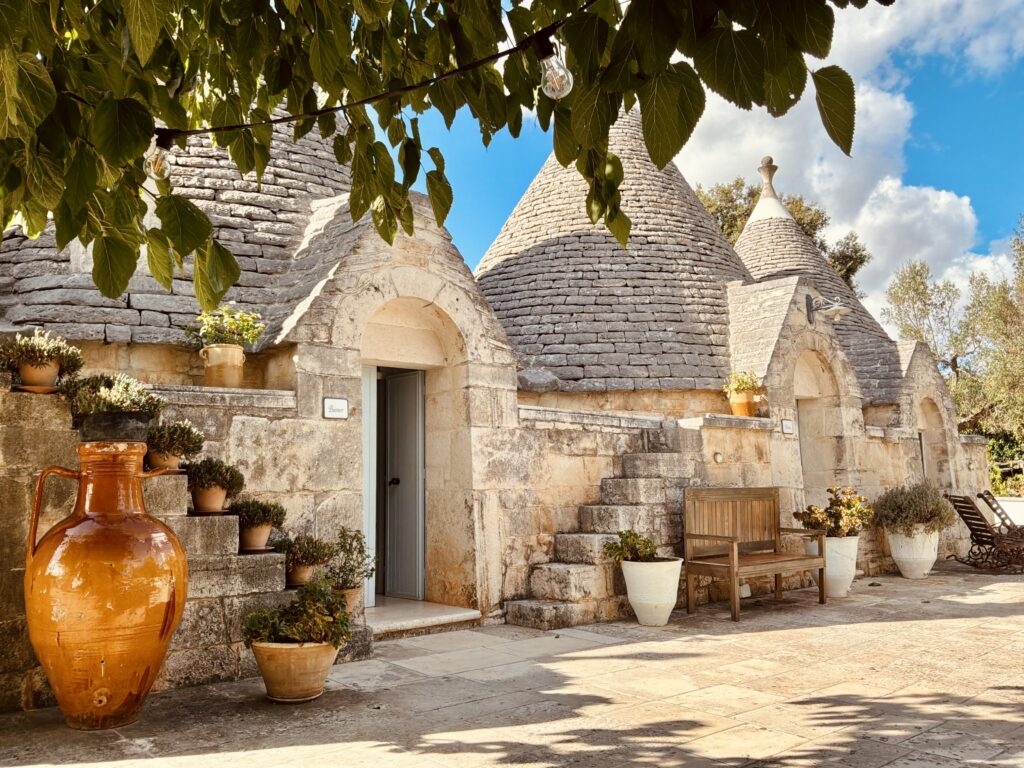
The centre (Bari / Valle d’Itria / Taranto / Brindisi) is the cultural and gastronomic spine of the region: trulli, baroque towns, masserie, cave churches, Itria valley olive groves. It’s also the most touristic part.
The south (Lecce / Salento) is baroque, beachy, and increasingly well-touristed. It is the obvious choice for anyone who wants a softer landing, a stronger food and wine scene, and more anglophone infrastructure.
The decision: Unless you have three weeks or genuine prior knowledge, do not try to traverse all three bands. Pick two. Accept the sacrifice. Use our Puglia Guys destination guides to choose destinations that interest you, and use our Puglia Guys Puglia itinerary planning guide to bring these together.
Principle 3: Trip Length Determines Depth, Not Distance
This is the most commonly overlooked principle in Puglia planning.
| Trip length | Right approach | Wrong approach |
|---|---|---|
| 7 days | One zone, two bases, deep | Two zones, five bases, surface |
| 14 days | Two zones, three bases, thorough | Three zones, seven towns, exhausted |
| 21 days | Full north-south traverse OR one zone at genuine pace | Same as 14 days but more driving |
A week done well in the Valle d’Itria – including Alberobello, Locorotondo, Cisternino, Martina Franca, Ostuni, a masseria dinner, a morning in Fasano, a day on the Adriatic coast near Monopoli – is a complete, satisfying trip. The person who also squeezes in Lecce, Otranto, Taranto, and Matera will remember being tired.
The diagnostic question: Ask yourself this. Would you rather see ten places adequately, or five places properly?
Principle 4: Apply the Circumstance Filter Before Anything Else
Trip design should begin not with a map, but with a set of honest questions about who is travelling and why.
Mobility and base age
Older travellers, or those with any mobility consideration, should prioritise towns with flat historic centres (Lecce, Gallipoli’s island centro) over hill towns with cobbled gradients (Ostuni, Locorotondo). This is not a concession — it’s intelligent planning.
Party composition
Couples move faster and eat more adventurously. Families with young children need beach access within 30 minutes of base — which means the Adriatic coast north of Monopoli or the Ionian between Gallipoli and Santa Maria di Leuca. Groups of mixed ages need a base with enough scale to absorb different appetites on the same evening.
Season
This is non-negotiable. Puglia in July and August is a different destination. Prices treble, roads congest, masserie are booked months out, and the trulli towns become theme parks. If you’re planning July–August, your itinerary must pre-solve for heat management (beach by 9am, shade by noon, siesta mandatory, evenings out late) and crowd avoidance (reach baroque town centres before 9am or after 6pm). May, June, September, and October are the craft windows. Winter rewards people who want the place to themselves.
Self-drive vs. public transport
Puglia without a car is possible but severely limiting outside Lecce and Bari. If your traveller cannot or will not drive, your itinerary must be built entirely on rail-accessible towns (Bari, Lecce, Brindisi, Taranto, Ostuni, Fasano) and the FSE branch lines. That’s a different itinerary entirely — and actually a rather good one.
Use our Puglia Guys guide to travelling around Puglia using public transport and our Puglia Guys guide to driving in Puglia to help plan.
Gastronomy as anchor vs. backdrop
For serious food travellers, the itinerary should be built around lunch – specifically, which restaurants require advance planning, which towns have a market worth catching, which masseria dinners are worth the taxi fare. The geography then fills around the eating. This sounds indulgent. It produces the best trips.
Use our Puglia by Food guides to help you plan your trip. We have a dedicated guide to eating out in Bari, a guide to Puglia’s top dishes, our destination guides include recommendations on our favourite restaurants. We even have a guide to spaghetti all’assassina, one of the unmissable dishes made in Bari.
Principle 5: Assign Each Day a Single Dominant Purpose
The itinerary that tries to do a morning town, an afternoon beach, and an evening food market every single day becomes a logistics exercise rather than a trip. Instead:
• Town days: Go deep into one centro storico. One cathedral, one specific church you sought out, one lunch that isn’t the obvious tourist choice, a passeggiata, dinner nearby.
• Landscape days: Drive a slow road, stop at a masseria or frantoi oleario, eat simply, don’t plan the afternoon.
• Beach days: Pick a single stretch of coast. Arrive early. Stay late. Eat wherever the locals eat at that beach. Do nothing else.
• Transit days: Accept that moving bases costs half a day. Don’t try to sightsee en route as well as settle in. You’ll arrive frantic.
Principle 6: Build in One Full Day With No Plan
On any trip of 7 days or more, reserve one day that is structurally empty. No booking, no destination, no must-see. In Puglia, these days reliably produce the best memories: the market you found by accident, the lunch that became a three-hour affair, the road that turned out to lead somewhere extraordinary.
This is not laziness. It is itinerary design.
The Summary Framework
Start with: How long do I have? What time of year? Who is travelling, and how do they move through a place?
Then decide: North, centre, or south — or which two of the three?
Then set bases: One per four days, maximum. Choose accommodation outside town centres.
Then assign days: Town, landscape, beach, or transit. Not all four in one day.
Then subtract: Whatever remains on the list after the above constraints have been applied is what you don’t do this time. Write it down. It’s your reason to return.
The perfect Puglia itinerary isn’t the one that covers the most ground. It’s the one where, on the last evening, you feel you’ve actually been somewhere, rather than passed through it.
Salve,
What a wonderful resource I have stumbled upon. I was wondering if you have insight into Christmas travel. I was hoping to find information on the best local Christmas markets. Most of the information out there is about the lights and decorations around Locorotondo and Alberobello, however not much in the way of markets.
We are a group of 5, ranging from 30-50 years old. We are all fit and very active. We have planned to stay in Monopoli for 4 nights, Lecce for 4 nights and Matera for 2 before heading back to Rome for a few nights.
In addition, what is the probability of having a private guide run tours during the Christmas season? (Not Christmas Eve or Christmas Day of course.)
Grazie infinite
Ciao,
Thank you for your message—we’re pleased you’ve found our guides helpful.
Christmas markets aren’t really a long-standing tradition in Puglia in the way they are in northern Italy or many parts of central Europe. In recent years, more towns have introduced festive markets, but we wouldn’t recommend visiting Puglia with the expectation of finding large Christmas markets as the main attraction.
What Puglia does exceptionally well is create a wonderful Christmas atmosphere. The spectacular light displays in Locorotondo and Polignano a Mare (and, to a lesser extent, Alberobello) are quite unique and are well worth experiencing. Another beautiful southern Italian Christmas tradition is the *presepe* (nativity scene), particularly the presepi viventi (living nativities), where entire historic centres are transformed into scenes from the Nativity. If your dates coincide with one, they’re a wonderful experience.
We’d recommend taking a look at our Puglia by Season guide, which covers what to expect from a winter visit, including typical weather conditions, festive events and seasonal highlights.
As for private guides, you shouldn’t have any difficulty arranging tours during the Christmas season. Most guides continue working throughout December, festive holidays excepted, Boxing Day. January and February tend to be the quieter months when many guides take their holidays.
Buone vacanze
LuigiM.
We’re visiting Puglia for 8 days in early October. We have a night in Bari and will finish in Matera but are stuck choosing between the fabulous sounding villages in the Valle d’Itria. We keep reading your great resources and guides and going around in circles!
We’d love a steer for two bases to stay that you think would suit a mid-50’s fit adventurous New Zealand couple who want to experience the local vibe, food, wine, wandering streets and soaking up the landscapes. We have a rental car for the duration.
Your destination guides have so much information that it’s easy to fill in the finer details – it’s harder to settle on where to base yourself!
Graize mille
Ciao,
For an 8-day trip, we’d keep things simple and choose one base in Central Puglia/Valle d’Itria and one base in Salento.
As for Matera, it’s really a question of whether you want to spend a night there. That’s entirely a personal decision, but we do think an overnight stay is worthwhile if your schedule allows. Matera has a very different atmosphere after the day-trippers leave, and the transition from day to evening is part of what makes it special.
When it comes to choosing your bases, we’d worry less about food and wine. You’ll find excellent food and wine almost everywhere in Puglia, so that isn’t really something that should determine where you stay.
We’d suggest creating a contrast between your two bases by choosing countryside for one and seaside for the other.
For example:
* Martina Franca, Ostuni or Locorotondo for Central Puglia, paired with Gallipoli or Otranto in Salento.
* Alternatively, Monopoli for Central Puglia, paired with an inland Salento base such as Lecce or Galatina.
From there, think about what best matches your travel style.
Do you prefer larger towns with more activity and a wider choice of restaurants and evening atmosphere? If so, Martina Franca, Ostuni, Monopoli and Lecce are all strong candidates.
Or do you enjoy somewhere smaller, quieter and a little less visited? In that case, places such as Locorotondo, Gallipoli and Galatina might appeal more.
The coastline is another factor worth considering.
Monopoli offers lovely rocky coves and the character of the Adriatic coast, but it doesn’t have the sandy city beach that Gallipoli enjoys. Gallipoli combines a beautiful historic centre with a wonderful beach within walking distance of town, and the Ionian Sea is generally calmer than the Adriatic.
Personally, we tend to prefer the Ionian coast. However, parts of the Adriatic are arguably more dramatic and rugged. Whether that matters depends entirely on what you’re looking for.
Reading your message, we wonder whether the slightly smaller and less obvious choices might suit your style best, which could point you towards somewhere like Locorotondo for Central Puglia and either Gallipoli or Galatina for Salento.
As for the itinerary itself rather than the bases, there is one place we always encourage visitors not to overlook: Taranto, particularly the Borgo Antico. It remains one of the most fascinating and underrated places in the entire region.
One final suggestion. We often share video clips in our Instagram Stories and Reels that don’t necessarily appear in our written guides. Sometimes seeing places in motion can be surprisingly helpful when you’re trying to decide where you’ll feel most at home.
Ultimately, there are very few “wrong” choices here. The challenge isn’t finding the best base — it’s finding the base that best aligns with your own travel style and what you most enjoy when you travel.
Buona vacanza
LuigiM.