

Snapshot
Alberobello is Puglia’s trulli capital and a UNESCO World Heritage town with more than 1,500 of these conical dry-stone houses clustered across its centre. They are as instantly recognisable as Polignano’s Lama Monachile, and just as likely to grace the cover of a guidebook.
Expect the famous Monti district to feel crowded and commercialised. Balance that with time in the quieter Aia Piccola, a wander off the main lanes, and, if you can, at least one night spent inside the walls. That’s where you still find the Alberobello that so moved Pasolini.
“Maybe the masterpiece of Puglia” — Pier Paolo Pasolini, 1951

Managing Your Expectations
Visitors often arrive with a picture-perfect image in mind. The reality? The Monti district can feel like a film set: souvenir shops in almost every doorway, tour buses disgorging passengers by the hundred, menus that somehow find room for hamburgers and hotdogs alongside orecchiette. It is easy to feel underwhelmed if you are not prepared.
But step sideways, and Alberobello remains extraordinary. The trulli here are not unique to this town: Cisternino, Locorotondo and the countryside of the Valle d’Itria are full of beautiful examples. What is unique is the density and scale. This is an essential stop in Puglia, but the trick is to see it as a chapter in your journey rather than the whole story.


The Italian View
Ask an Italian what they think of Alberobello and you will get something more complicated than the simple postcard superlatives the town tends to attract from international visitors. There is pride, certainly – these whitewashed conical-roofed trulli are a UNESCO World Heritage Site, and Italians feel a genuine proprietary affection for them. But there is also candour, and a quiet frustration that one of the country’s most singular places has become, in parts, a victim of its own fame.
What they love
The trulli themselves remain transcendent. Italian visitors describe the townscape as surreale, surreal in the best sense, and the experience of wandering its lanes as unlike anywhere else in the world. The word that recurs in Italian reviews is unico: unique, irreplaceable, non-negotiable. Even the most jaded Italian traveller tends to find something disarming in the geometry of it all.
They love, too, what happens when the day-trippers leave. Italians who stay overnight in Alberobello (usually in a trullo rental) describe the early mornings and late evenings as close to magical: the stones still warm, the lanes quiet, the place finally breathing. This is the version of Alberobello they recommend to one another, and it is a genuinely different town from the midday scrum.
What gives them pause
The criticism centres on Rione Monti, the main tourist zone and the one that most visitors never leave. Its streets are undeniably spectacular, but they have also become a procession of souvenir shops, tourist-trap restaurants, and olive oil boutiques that feel, to Italian eyes, disconnected from actual Pugliese life. The risk of eating badly – overpriced, underwhelming food dressed in regional costume – is real, and Italians warn each other about it with some heat.
The consistent Italian recommendation is to cross to Rione Aia Piccola, the quieter residential trulli zone on the other side of town. Most international visitors never find it. Italians consider it the soul of Alberobello: fewer crowds, fewer signs, more cats and locals, more of the texture of a place where people actually live.

How to use Alberobello well
The Italian consensus is clear: Alberobello is best experienced as part of the wider Valle d’Itria circuit, alongside Locorotondo, Cisternino, Martina Franca, and Ostuni, rather than treated as a standalone destination. It rewards at least one overnight stay, approached early in the morning or in the soft light of evening. As a full base for several nights, Italians tend to prefer the greater liveliness of Locorotondo or Cisternino, both just twenty minutes away.
Come with the right expectations, stay long enough to see past the crowds, and Alberobello will deliver, as Italians will readily tell you, something genuinely, stubbornly extraordinary.


Orientation
Alberobello sits on a ridge at 428 metres, with steep slopes to the north-east and south-west. While many nearby towns – Locorotondo, Martina Franca, Ostuni, Carovigno, Ceglie Messapica – occupy single hilltops, Alberobello developed differently: nestled along the slopes of a shallow valley carved by an ancient watercourse. The result is a town of unexpected depth, where lanes dip and rise in ways that keep revealing new angles.
- Rione Monti — west of Largo Martellotta; a jumble of lanes (Via Monte San Michele, San Gabriele, San Marco) climbing the slope, packed with trulli and visitors. The main show.
- Rione Aia Piccola — across Via Brigata Regina, east of Largo Martellotta; a quieter, more residential quarter with around 590 trulli, many still inhabited. The soul.
- Corso Vittorio Emanuele — the historic spine of the town, linking the old Acquaviva palace site with Piazza del Popolo, Casa d’Amore, and the basilica of Santi Medici.
A note on the trulli districts: today’s layout might suggest the original trulli were always confined to Aia Piccola and Monti, a view reinforced by a 1930 landscape protection decree. In fact, until 19th-century transformations, the town was organised along Corso Vittorio Emanuele, with trulli distributed more widely. The two rioni we visit today are in some sense a curated remnant of a much larger, more dispersed settlement.

How Long & When to Go
- Time needed: Two hours covers both trulli districts at a steady pace, not counting a sit-down meal. Add an hour if you linger in Aia Piccola.
- Best time of day: Most guides say early morning or late evening. In practice, everyone tries the same thing. We say: embrace it. Mid-morning or after 5pm both work well, and in summer the streets stay lively well into the evening.
- Seasonal tip: Autumn and late winter are exceptional – atmospheric, golden-lit, and blissfully uncrowded. You may find yourself almost alone in the lanes.


What to See
- Trullo Sovrano — The only two-storey trullo in town, built in the early 18th century as a family home and private chapel. The upper floor is reachable by an internal stone stair, a remarkable feat of dry-stone engineering.
- Casa d’Amore (Piazza del Popolo) — The first house built with mortar after Alberobello won its freedom in 1797. Constructed deliberately in the central piazza, it was a pointed act of defiance, stone proof of liberation from feudal rule.
- Pezzolla House Complex — A cluster of 15 interlinked trulli showing how these structures formed entire lived-in neighbourhoods, not just isolated curiosities.
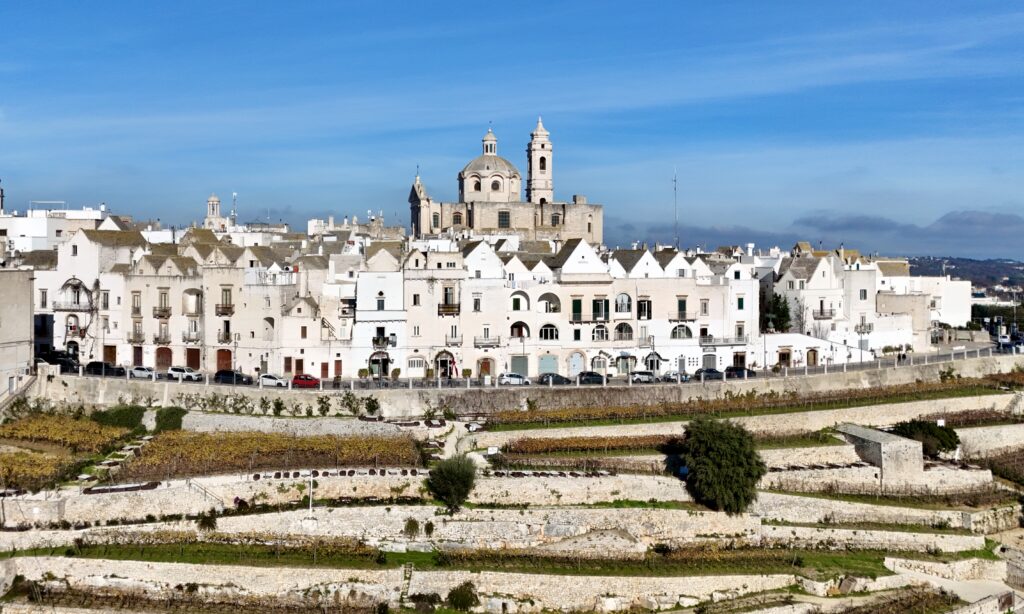
- Basilica of Santi Medici Cosma e Damiano — The late-19th-century basilica that dominates Alberobello’s skyline – an incongruous Romanesque bulk among the cones, but central to local identity.
- Chiesa di Sant’Antonio (1927) — A trullo-shaped church on the edge of Rione Monti, built as the town’s fame began to grow. Part homage, part architectural experiment.
- The Acquaviva house — Now partly obscured by later additions near Piazza XXVII Maggio, this was the seat of the feudal lords who shaped Alberobello’s early history. A small belvedere stands adjacent.


A Simple Walking Route
Alberobello is best explored entirely on foot. The route below covers both districts, the key landmarks, and some of the less-visited corners.
Begin in Largo Martellotta – formerly known as largo delle fogge for the underground public cisterns once located here, now the town’s busiest square. From there, climb into Rione Monti via Via Monte Nero and Via Duca d’Aosta, winding up to Piazza D’Annunzio. Descend back through Via San Michele or the streets of Cadore, Monte Cucco, and Monte Santo. Though tourism has altered many trulli façades here, the area still holds untouched corners (look into the lanes that run parallel to the main routes).
Cross Via Brigata Regina to enter Rione Aia Piccola, whose name recalls the threshing floors once used for processing grain. Along Via Duca degli Abruzzi and Via Verdi you will find rows of well-preserved trulli, many still used as homes. The atmosphere is noticeably different: quieter, less performed, more genuine.
Continue towards Piazza XXVII Maggio, passing the 18th-century Casa Pezzolla complex and the ruins of an old granary. Just before the square, note the Acquaviva house and the small belvedere. In adjacent Piazza del Popolo, stop at Casa d’Amore. Then follow Corso Vittorio Emanuele, the old spine of the town, to the Basilica of Santi Medici, and finish at Piazzetta del Trullo Sovrano.

Eat & Drink
The rule in Alberobello is simple: avoid the vast canteen restaurants operating for coach parties. For food that actually tastes of Puglia, seek out these options.
The fine-dining tier
Alberobello punches above its weight at the top end, with three restaurants holding or listed in the Michelin guide.
Il Poeta Contadino
A historic institution and highly regarded. Recognised for its fine dining, high-quality food, and award-winning wine list, it was a Michelin-starred restaurant for 25 years, but recently lost its star rating. Operates both a formal dining room and a more relaxed Osteria side by side, the latter offering genuine Puglia classics at around €25–30pp without the ceremony.
Try: Orecchiette with cime di rapa, braised lamb, seasonal antipasti
Ristorante Fidelio ✦ Michelin Guide
Consistently top-ranked restaurant praised by Italian visitors for its garden setting, warm family service, and straightforward regional cooking done with real flair. Slightly outside the centre but worth the short walk.
Try: Cardoncelli mushrooms, braised pork, house antipasto
Evo Ristorante ✦ Michelin Guide
A sleek, modern room in the heart of Alberobello with strictly local ingredients. The seasonal tasting menu (around €70pp) is praised as one of the most sophisticated meals in southern Italy. Book well ahead.
Try: Lamb with myrtle, spaghettone with black garlic and cheese, seasonal tasting menu
Our tried-and-tested favourites


Long-standing favourite for traditional cuisine inside a formal historic trullo.
Try: Orecchiette, stewed lamb, tagliolini with mushrooms.
Macelleria La Fontana 1914 da Mimmo
Butcher-grill, no frills, absolutely Puglia. A working macelleria that cooks what it sells – the antidote to any tourist-trap meal. Queue, order at the counter, find a table.
Try: Bombette, salsiccia, steak alla brace
Trattoria Terra Madre
Garden setting, seasonal zero-kilometre cooking, ideal for vegetarians and anyone wanting the slow-food ethos made real. Praised by Italian visitors for its genuine commitment to local produce.
Try: Oven-baked vegetables, fresh pasta with seasonal greens

Coppino
Counter-order homestyle cooking – orecchiette and polpette served in eco tubs. Exceptional value and refreshingly unpretentious.
Try: Polpette di pane, orecchiette al pomodoro e basilico
Trattoria Amatulli
Handmade orecchiette by the owner’s mother, generous portions of bombette, all at prices that feel like a different era. Flagged specifically by Italian food bloggers for its km-0 recipes.
Try: Orecchiette al ragù, bombette, fave e cicorie
Ristorante L’Aratro
Established 1987, run by owner Domenico Laera with his son, set inside a genuine 1400s trullo. It’s Slow Food-affiliated, uses Senatore Cappelli wheat for the orecchiette and other pasta, and sources ingredients locally. Genuinely good, yet undeniably on the tourist circuit. As locals, we notice that pricing can seem high for portions of size.
Try: The antipasto – a huge, high-value spread
Apperó Alberobello
A small intimate spot with open kitchen, serving traditional Pugliese products in street-food style. Doubles as an enoteca for Pugliese wines. Well-loved by Italian visitors for its lack of tourist pretension.
Try: Fried lampascioni, legume croquettes, brasciole sandwich


Il Guercio di Puglia
Wine-bar and gourmet pizzeria bistro hybrid – ideal for a light dinner or upscale aperitivo. Named for Giangirolamo II Acquaviva, the one-eyed count who shaped Alberobello’s early history.
Try: Burrata with anchovies, bread polpette, seasonal vegetable plates
Martinucci Laboratory
Pastry, coffee, cocktails. The best pasticciotto in town, and a caffè leccese worth seeking out on a hot afternoon.
Try: Pasticciotto, torta della nonna, caffè leccese
Puglia Guys insider tip: If the crowds get too much, drive 35 minutes to Monopoli and eat by the old port – a completely different atmosphere. Or head to Locorotondo if you are continuing on a Valle d’Itira loop.
Getting There
Half the pleasure is the approach: the road up through the Valle d’Itria, past trulli-dotted fields and dry-stone walls, is one of the great short drives in southern Italy.
- From Monopoli — 20 km / 25 minutes, climbing into the Valle d’Itria
- From Ostuni via Cisternino & Locorotondo — 35 km / 40 minutes; add 10 minutes for a detour through Martina Franca
- Public transport — Trains and buses from Bari and Brindisi/Lecce via Ferrovie Sud Est (FSE). The station is conveniently central. Journeys can be slow with connections. Check timetables in advance.

Parking
- Via Indipendenza corridor — main parking area with several large car parks. Follow the signs to the trulli district where you will find at least three main car parks
- Parcheggio Anfiteatro Comunale (Piazzale Biagio Miraglia) — historically around €2/hour or €6/day, open 24/7, usually full by 11am in summer
- Other options — L’Olmo Bello, Parking Service, Trulli Parking Area, Via Colombo, Puglia Parking
- From Monopoli — park on Corso Trieste e Trento near the basilica; pay-and-display, free during siesta hours, and a 10-minute walk from the trulli
- From Cisternino/Locorotondo/Martina Franca — Area Camper “Nel Verde” (Via Cadore), around €5/day for cars
Good to Know
- Footwear: Streets are cobbled and often steep – wear proper shoes, especially after rain.
- Accessibility: Many lanes are narrow, uneven, and stepped. Rione Aia Piccola has fewer shops and slightly easier terrain for a quieter stroll.
- Public transport: FSE trains from Bari take around 1h45. Services are not frequent – check timetables before you go.
- Parking hack: Coming from Monopoli, the Corso Trieste e Trento car parks near the basilica are cheaper than the main trulli car parks and only a short walk away.
The History of Alberobello

A landscape of stone and labour
The surrounding landscape is shaped by surface karst features – sinkholes and terraces formed primarily by tectonic activity and the slow erosion of limestone. These layered rocks have long provided Alberobello with its distinct building materials. From the stratified limestone, rectangular blocks are extracted to build perimeter walls and dry-stone boundary fences. Irregularly shaped fragments are fashioned into the chianche and chiancarelle used for the conical roofs and stone floors of the trulli. The result is a landscape unmistakably shaped by human hands yet deeply tied to the geology beneath it.
The original forest, once dense and vast, has now largely vanished, cleared over centuries to create the olive groves, almond orchards, and vineyards that define the region today. Ancient signs of that labour are everywhere: specchie (piles of stones removed from fields during cultivation), dry-stone boundary walls, vineyard huts, terraces. Of particular interest is the Quercus trojana, a rare oak native to the Balkan Peninsula, found in this area and nowhere else in Italy.
Woodland origins
Alberobello began as forest. Its name first appears in a 1359 decree by Robert of Anjou, Prince of Taranto, who listed the silvam arboris belli (the forest of the war tree) as a possession of Martina Franca. Its position between Monopoli and Martina Franca led to centuries of disputed ownership. In 1485, Frederick of Aragon attempted a resolution: lands from the Murgia to the sea were granted to Monopoli, while the forested inland uplands – including Alberobello – were declared common lands, though still subject to dispute. Over time, the Acquaviva d’Aragona family, Counts of Conversano, took control.
While some believe Alberobello remained forested until its settlement, others suggest long-term habitation, supported by Neolithic finds and the ancient origins of the tholos-style construction on which trulli are based. Nineteenth-century scholars credited the Acquaviva family with colonising the forest and mandating dry-stone construction. Houses built without mortar could be demolished easily if the landowner wished to evict a tenant, reinforcing the lords’ control.

Settlers and trulli
From the late 1500s, debtors, fugitives, and peasants from neighbouring towns began clearing the land. 17th-century documents describe these settlers frankly as fugitives, marginal figures who, over time, quietly began to assert their rights, cultivate the land, and develop a material culture rooted in agricultural ingenuity. By the early 1600s, around 40 round dry-stone huts with conical roofs stood here. Until 1609, the area’s church registers were maintained by Noci, meaning Alberobello’s settlers were still legally considered residents of that town.
Only in 1630, under Giangirolamo II Acquaviva d’Aragona – known as Il Guercio, the one-eyed – did Alberobello begin to take shape as a real settlement, with a tavern, butchery, mill, oven, and trading post established. This marked the start of proper urbanisation.
Conflict and resilience
In 1654, pressured by neighbouring towns, the Royal Chamber ordered the Count to formally declare the population centres of Alberobello and Montalbano. As the Count had defied laws prohibiting the founding of new towns without royal consent, he allegedly had many dwellings destroyed ahead of a royal inspection – evicting families who then returned and rebuilt once the danger had passed. Despite such feudal manoeuvres, the community persisted, sustained by olives, almonds, and vines. The stone landscape – terraces, dry-stone walls, specchie, trulli – spoke of relentless labour reclaimed from forest.
Liberation
The breakthrough came in 1797, when seven community leaders (four priests, two doctors, and one artisan) travelled to Taranto and successfully petitioned King Ferdinand IV. On 24 May, from Foggia, the King issued a royal decree declaring Alberobello a royal town, finally removing it from feudal control. Shortly after, Casa d’Amore was built with mortar in Piazza del Popolo: a deliberate, visible act of defiance, stone proof of liberation. From there, the town expanded along what is now Corso Vittorio Emanuele, with Monti and Aia Piccola taking their current form.
Understanding the Trulli
Each trullo looks deceptively simple but conceals real ingenuity. The typical layout is a square central room topped by a false dome – the conical roof visible from outside – with smaller lateral alcoves branching off for sleeping, cooking, or storage, revealed externally by tiers or ledges. Walls are rough-hewn limestone stacked without mortar, thick enough to insulate against both summer heat and winter cold. Roofs use thin overlapping slabs known as chiancarelle, laid in irregular patterns and often leaving visible gaps.
The cone’s silhouette curves gently. In older trulli, thick stone walls support a complex geometry where alcoves connect to the main cone through varied levels and irregular junctions, giving each structure its unique character. No two trulli are exactly alike. Roof lines curve slightly differently, chimneys sprout in unexpected shapes. The effect is of a settlement that grew organically rather than by plan.
The cone is often painted with mysterious symbols: crosses, zodiac signs, hearts pierced by arrows, primitive emblems whose meaning remains genuinely disputed – religious, magical, decorative, or all three. Visitors should focus not only on the districts as a whole but on individual trulli. Each is a small masterclass in Mediterranean dry-stone architecture.

The geology behind the buildings
The town sits on stratified limestone shaped by tectonics and water erosion. From this same rock came both the building blocks for walls and the thin slabs for roofs – the landscape and the architecture are made of the same material, which is part of why Alberobello looks so utterly of its place. The surrounding countryside shows centuries of cultivation: olives, almonds, vineyards, dry-stone walls, patches of remnant woodland. Ancient stone piles (specchie) and vineyard huts dot the fields.
Nearby masserie and heritage
- Masseria Barsento (5 km NW) — with a 6th-century rural church linked to a Benedictine abbey founded in 591
- Other historic farms of note — Chietri, San Leonardo, Muscio, Marraffa

Did You Know?
- UNESCO status — Alberobello’s trulli were inscribed in 1996 as “remarkable examples of corbelled dry-stone construction, a prehistoric building technique still in use.”
- Singular and plural — The singular is trullo, the plural trulli. Easy to confuse after a glass of local Primitivo.
- The tax avoidance story — A favourite legend: trulli were built without mortar so they could be demolished when royal inspectors arrived to count taxable structures. Historians are sceptical. The story persists.
- The cone symbols — Crosses, zodiac signs, hearts, primitive emblems. Their meaning is genuinely debated: religious, magical, or a practical signal to identify a household. Nobody knows for certain.
- Trullo Sovrano — The only two-storey trullo and the largest in town. Legend holds that it once housed a priest who used the upper floor as a secret chapel.
- Name origins — Arboris belli: the tree of war. A reference to the dense oak forest that once covered these slopes.
- Pasolini’s favourite — Pier Paolo Pasolini called Alberobello “maybe the masterpiece of Puglia” in 1951 and described its trulli as “serene and pure, veiled by narrow, winding streets.”
- Il Guercio — The restaurant Il Guercio di Puglia takes its name from Giangirolamo II Acquaviva, the one-eyed count under whom Alberobello first took shape as a settlement in the 1630s. History at the dinner table.
Visit Responsibly
- Season — Autumn and winter are quiet and atmospheric; spring and early summer are increasingly busy.
- Transport — Trains and buses from Bari and Brindisi run via FSE; parking in high season requires patience.
- Stay — Countryside trullo rentals offer far better value than touristy conversions in Rione Monti, and a completely different experience of the landscape.
- Spend wisely — Look for the smaller, family-run restaurants and shops rather than the large tourist-facing operations on the main routes.
- Approach — Treat Alberobello as a chapter in your Puglia journey, not the whole story.


Alberobello – the Puglia Guys verdict
What we love
- Overnight stays offer a different side of Alberobello. To fall in love with Alberobello, we recommend spending at least one night in a traditional trullo to see the town after the day-trippers leave. The early morning hours are magical.
- We are enthusiastic about Alberobello’s food scene if you look beyond the tourist-trap restaurants. Dishes to try include orecchiette with cime di rapa, bombette (pork rolls), burrata, and focaccia. Italian food writers describe the cuisine of the Valle d’Itria as authentically cucina povera. Simple origins transformed into extraordinary flavours by centuries of peasant craftsmanship.
What we love less
- The overcrowding criticism. Alberobello has sacrificed authenticity for throughput. Rione Monti, while spectacular, has become a highly commercial zone where the density of tourists in peak periods makes the streets feel chaotic.
- Alberobello works best as part of a wider Valle d’Itria circuit rather than as a standalone destination. Loop it with Martina Franca, Locorotondo, Cisternino, Ostuni, or en route from the Valle d’Itria to Monopoli.
- We have mixed views on using Alberobello as a base. While it’s not a ghost town at night, it feels less lively and has fewer traces of local everyday life compared with Martina Franca or Locorotondo, which are considered better bases.
The overall Puglia Guys verdict: deeply worth seeing, but approach it with realistic expectations. Go early or late, sleep there at least one night in a trullo, and don’t let Rione Monti be your only experience.
If you rush, Alberobello can feel like a theme park. Slow down. Look at the joints in the stone, the curve of a roof, the little irregularities that no two trulli share. That’s where the real Alberobello still lives.

Eat Puglia | The Puglia Guys guide to Puglia’s must eat dishes
Essential Puglia road trips | the Puglia Guys itinerary guide

So Happy to have come across your very helpful site.
We are coming to Puglia in September for 14 nights, please can you look at what we our thinking for an itinerary, (ideas taken from your site) We will have a hire car:
1st 7 nights based in Lecce, days planned are as follows but in no particular order
Full day in Lecce
Galatina /Gallipoli
Nardo / Porto Selvaggio/ Santa Maria Bagno
Grotte Zinzulusa/ Tricase/ Santiero delle Cipollane/ Santa Maria di Leuca
Cave of Poetry/ Torre Sant Andrea/Otranto/Bauxite Quarry/ Punta Palascia
Still another day to plan, any suggestion?
Transfer to Martina Franca for next 7 days with a stop off at Grottaglie on way
Full day in Martina Franca
Alberobella/ Monopoli/ Polignana a Mere
Matera (full day)
Cisternino/ Lacorotonde
Ostuni/ Ceglie Messapica
Possibly Taranto
Your view on the above would be very much appreciated
Thanks Steve
Ciao Steve,
Glad to hear our Puglia Guys website has been helpful.
Your itinerary is certainly possible, but you are covering a lot of ground. Puglia is somewhere we think rewards slowing down rather than trying to tick off as many places as possible. We often hear from visitors (particularly those coming from the US) that they wish they had planned less and taken things at a more relaxed pace. We NEVER hear someone tell us their vacation was too slow. Keep that in mind, but we appreciate that the very point we make is that it’s your travel style.
A few thoughts on your plans:
1. Don’t miss Taranto
Of everything you have listed, missing Taranto’s old town could be the biggest disappointment. It is unlike anywhere else you are likely to visit in Puglia. This is the southern Italy many people imagine: stepping into the old town can feel like going back 60 years.
We particularly enjoy eating there. The restaurants can be rough and ready, but this is food that is accessible to locals, with waiters who range from those who look like they should have retired ten years ago to enthusiastic, loud youngsters speaking in dialect. It can be a wonderfully chaotic experience, with the plates just keeping coming. If you understand that lunch takes us at least two hours, you’ll understand why we favour a slower pace!
2. Gallipoli and Galatina
It certainly is possible to do Gallipoli and Galatina from Lecce in one day, but we wouldn’t. We’d want to visit them both for sure, but Gallipoli especially is a full day. Really, we’d consider them both full-day trips. But that’s our travel style, not yours.
3. Ask yourself what you want from Nardò
From a Lecce base, if you are already planning Porto Selvaggio and beautiful Santa Maria al Bagno, and are visiting Galatina and Gallipoli separately, we’d question whether you need Nardò as well.
Nardò is a useful place to stay if you want an alternative base to Gallipoli, particularly if you prefer somewhere smaller and more compact. But as a day trip from Lecce, it wouldn’t be a priority for us.
4. Rethink the Otranto to Leuca trip
We’ve been doing the Otranto to Leuca road trip three or four times a year for the last eight years. It’s the one day trip we regularly do with friends.
We consider Marina Serra an essential stop. We’d only add Tricase if we were turning this into a two-day trip with an overnight stay. It isn’t far from the route, but it adds enough time that, for us, the benefit doesn’t really justify it as part of the same day.
We’ve written the full road-trip itinerary on the site, so you can get all the details there.
5. Split the Adriatic coast into two days
As you are seeing so much of the Adriatic coast, focusing on the spectacular geology, we’d divide it into two distinct trips.
One day, drive from Lecce to San Cataldo and then follow the coast via Grotta della Poesia, Torre dell’Orso and the Due Sorelle beach, the Faraglioni di Sant’Andrea and Spiaggia Alimini to Baia dei Turchi. You could finish in Otranto and return to Lecce, although we’d really recommend giving Otranto a full day of its own.
You could do Otranto as a full day, with a trip to the Bauxite Quarry and Punta Palascia lighthouse included in that day.
Or on another day, drive from Lecce to Otranto, visit the Bauxite Quarry and the lighthouse, then continue to Santa Cesarea Terme (or drive there direct if you have included the quarry and lighthouse in your Otranto itinerary), Castro, Marina Serra and Santa Maria di Leuca.
And don’t forget that there are also boat trips from Polignano a Mare to the caves — a tough call, as both that and Grotta Zinzulusa are worthwhile!
6. For your second week, we’d probably do something like this
* Full day in Martina Franca
* Full day in Taranto, via Grottaglie. Time your visit to the ceramic shops for when they are open — the afternoon pausa means many will be closed from around 1.30pm to 5pm. We’d probably drive directly from Martina to Taranto’s Borgo Antico, then return via Grottaglie.
* Alberobello, Monopoli and Polignano a Mare
* Bari Vecchia, returning via Locorotondo (a must is enjoying the sunset and having an aperitivo on the panoramic terrace overlooking the valley). Of the towns you have listed, Locorotondo is the one we’d prioritise over Cisternino and Ostuni.
* Ceglie Messapica and Ostuni
Then leave the remaining time unplanned and take it as it comes. Free days reward those who don’t plan too much in Puglia.
Buon viaggio,
LuigiM.
Thank you for the input it was very helpful, we have taken Nardo out and adjusted the days very much as you have suggested.
Grazie! Your podcasts and guides are thoughtful, authentic, and full of useful information. I am traveling to Puglia and Basilicata with my husband, his parents (85 & 83 y/o), his aunt & uncle (72 & 71 y/o), and his sister, the first week of September. We have 2 rental cars and all of our accommodations booked. I really appreciate your advice on parking, as well as your wonderful suggestions for authentic, non-touristy restaurants. We have a day trip planned to Ostuni, and I am concerned about the parking and walking to the historic center for the older folks. I reached out to Piero Ladolcevita via Instagram to inquire about a Tuk-Tuk tour, but have not heard back from him. Will we be able to park our cars somewhere and get a tuk-tuk to the city center, or can we have a tuk-tuk meet us for a tour near where we park our cars? Thank you for any advice! Ciao!
Ciao – glad to hear the podcasts and guides were helpful to your planning.
Piero has been on vacation, and we understand he has given up tuk tuk driving and is now planning a new Puglia adventure.
If you park at the Parcheggio Comunale on Via Giosuè Pinto mentioned in our Ostuni guide, the main (original) one rather than the overspill ones you come to on your way there, GoLapa (Ape Calessino) tuk tuk have their office there and it’s a main pick-up point. You could book in advance, but much of their business is from picking up there at the car park. They can whizz you around, drop you off, and collect you again as and when they are needed as you trip around. Let them know the Puglia Guys recommended them to you!
Ostuni is hilly, steep in places, and can make the fittest feel out of breath, so it really is a great place to plan a tuk tuk tour to get around.
Enjoy your visit.
LuigiM.